How a 1987 Mac Grayscale Hack Sparked the Creation of Adobe Photoshop
A grad student’s modest display tool evolved into Photoshop after his brother uncovered hidden capabilities, sparking a major software breakthrough.
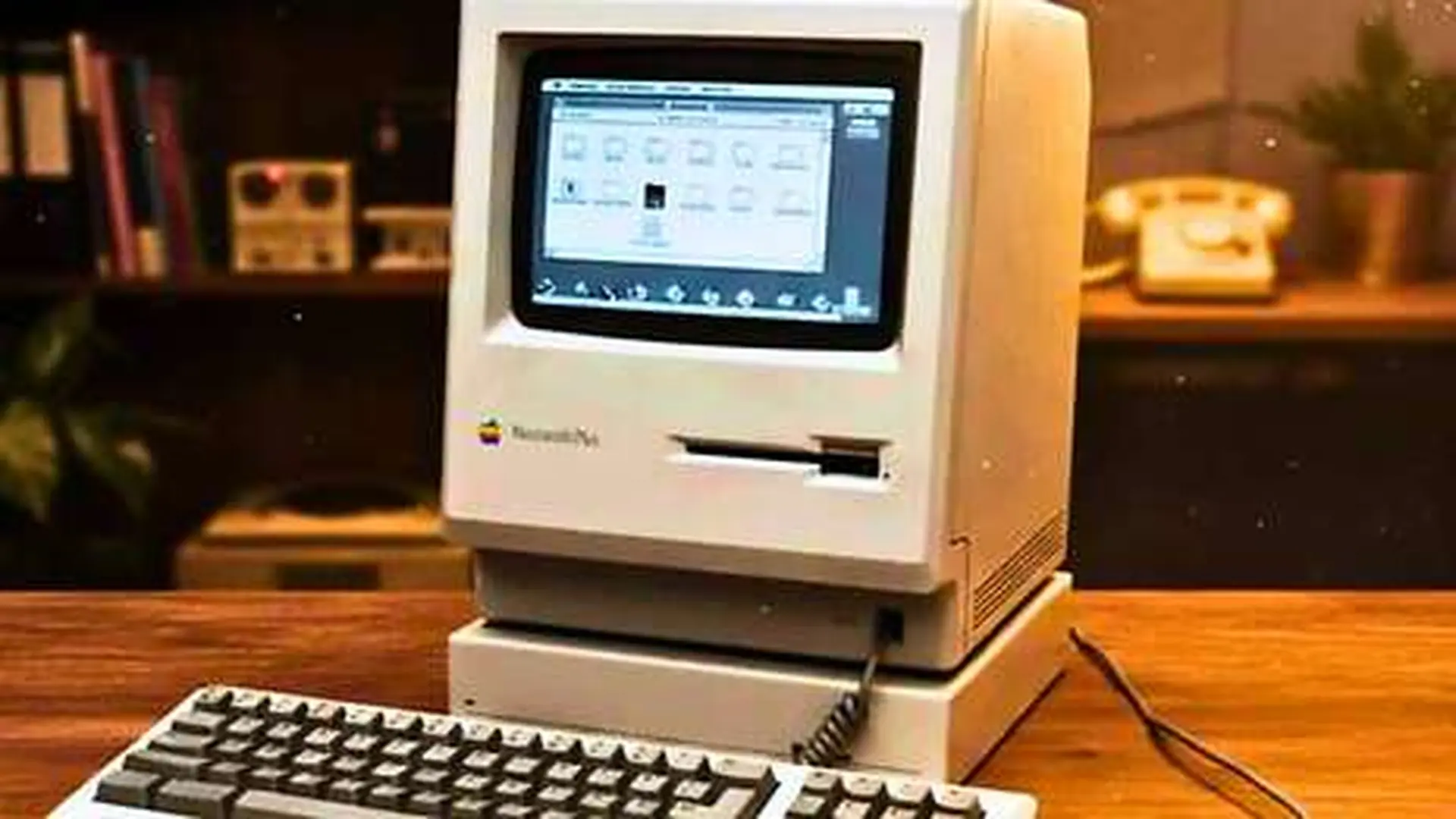
While still a graduate student, Thomas Knoll was wrestling with a modest technical hurdle: his Macintosh could only render pictures in monochrome. Determined to visualize grayscale tones, he began crafting a suite of image‑processing routines in 1987.
The collection of tools was initially dubbed Display. It was conceived as a research aid rather than a commercial graphics package, aimed at supporting his doctoral investigations into computer vision.
When his brother, John Knoll, started experimenting with the same code, the utilities gradually morphed into a product that would later debut as Adobe Photoshop on February 19, 1990.
John Knoll’s Drive for a Unified Editing Suite
Thomas’s fascination with imaging began long before he wrote code. At age 11, his father handed him an Argus Rangefinder and taught him darkroom techniques, while a few years later he taught himself BASIC on teletype terminals at his high school.
Those twin interests converged during his graduate studies, where image‑processing algorithms were employed to detect edges and other visual features for computer‑vision tasks.
Meanwhile, John was immersed in the world of visual effects at Industrial Light & Magic. The studio was experimenting with scanning individual film frames, applying digital alterations, and re‑exposing the results onto celluloid.
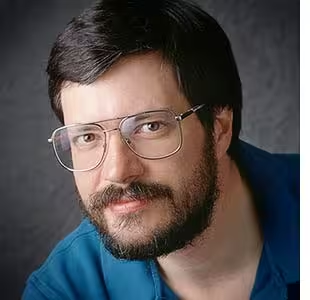
Seeing the promise of a fully digital workflow, John taught himself computer graphics during his off‑hours, hoping to manipulate individual pixels before they were baked back onto film.
Thomas already possessed many of the low‑level routines John needed, so he handed over his standalone utilities, allowing John to focus on rendering rather than rebuilding basic image‑display functions.
The scattered nature of the tools soon proved cumbersome. John asked, “Would you be able to merge these into a single program so I don’t have to hop between separate applications?”
Thomas responded by integrating the modules, steering the project away from a loose toolbox toward a cohesive image‑editing application.
Bringing Darkroom Adjustments to the Screen
Merging the utilities introduced a new challenge: differing gamma settings across the displays John used meant the same picture could look markedly different from one monitor to another.
For Thomas, this echoed the variability he had managed in his basement darkroom, where chemical processes, paper types, and equipment controls were used to tweak brightness and contrast.
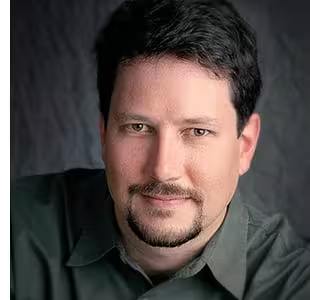
Drawing on that analog experience, Thomas devised the Levels dialog—a pioneering adjustment panel that let users fine‑tune tonal ranges digitally. This feature became a cornerstone of what would later be known as Photoshop.
Securing a Publisher After Multiple Rejections
Even after the software coalesced, the brothers needed a company willing to distribute it. Pitching to several firms in the late 1980s yielded mostly negative responses—some firms were already developing competing products, while others felt the software didn’t align with their existing lines.
A demonstration for Adobe, however, changed the narrative. Thomas recalled that the application “really clicked” with the company, which recognized its potential fit within its product ecosystem.
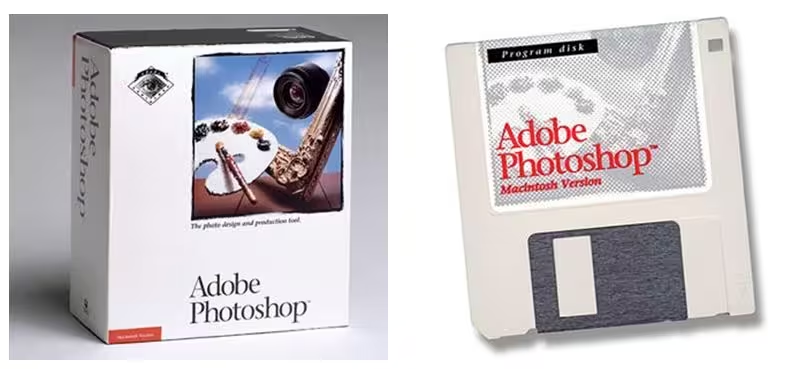
Adobe released Photoshop on February 19, 1990, but early versions were not yet tailored for photographers. The surrounding hardware—digital cameras and printers—had not caught up to the software’s capabilities.
At that stage, producing a single high‑quality print required creating four‑color separations on film and sending them to a commercial press, a process that could cost roughly $2,000 per photograph and up to $35,000‑$40,000 for a roll of 35 mm film. Consequently, Photoshop 1.0 was primarily marketed to publishing houses and graphic designers.
Hardware Evolution Finally Aligned with Photoshop
The early 1990s saw the web’s rise, prompting developers to resize, compress, and polish small images for online display—tasks Photoshop could already perform.
Inkjet printers later gave photographers a direct path from edited files to printed output, bypassing traditional press workflows.
The advent of digital cameras eliminated the need for film scanning altogether, allowing photographers to ingest large batches of images straight into Photoshop.
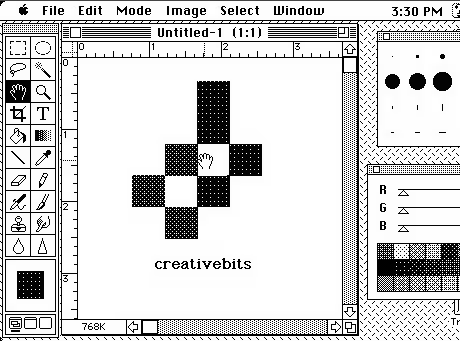
The program’s origin story is rooted in a simple need: a graduate student required software to compensate for a monochrome Macintosh, while his brother sought to consolidate disparate utilities into a single workflow.
By 2015, Thomas told Adobe that the proliferation of powerful mobile devices was reshaping where users performed creative work, prompting a renewed focus on bringing Photoshop to handheld platforms. He also expressed ongoing delight in seeing artists combine the low‑level tools he helped create in ways he never imagined.
Twenty‑five years after its debut, Photoshop’s humble beginnings—an academic project aimed at greyscale rendering—continue to echo in the program’s evolution and enduring influence on visual creativity.
This article has been fact checked for accuracy, with information verified against reputable sources. Learn more about us and our editorial process.
Last reviewed on .
Article history
- Latest version
Cite this page:
- Posted by Bilal Abbasi