Rare Alien-Like Bigfin Squid Filmed Two Miles Beneath The Pacific Ocean
Rare deep-sea footage captured thousands of meters below the surface is revealing mysterious, never-before-seen behaviors of elusive squid species.
Researchers from the Monterey Bay Aquarium Research Institute (MBARI) have documented a rare encounter with a bigfin squid, capturing high-definition footage of the elusive cephalopod nearly 3,300 meters beneath the surface of the Pacific Ocean. This latest observation provides a fleeting look at one of the deep sea’s most enigmatic inhabitants, a creature characterized by its massive fins and extraordinarily long, delicate appendages.
The bigfin squid, scientifically classified as Magnapinna, dwells within the perpetual darkness of the deep ocean. It remains among the least understood of all cephalopods, with fewer than 70 individuals having been recorded or collected globally. The discovery occurred near the Davidson Seamount, an underwater mountain range located off the coast of Central California, during an expedition that was not specifically targeting the species.
A Rare Sighting in the Northeastern Pacific
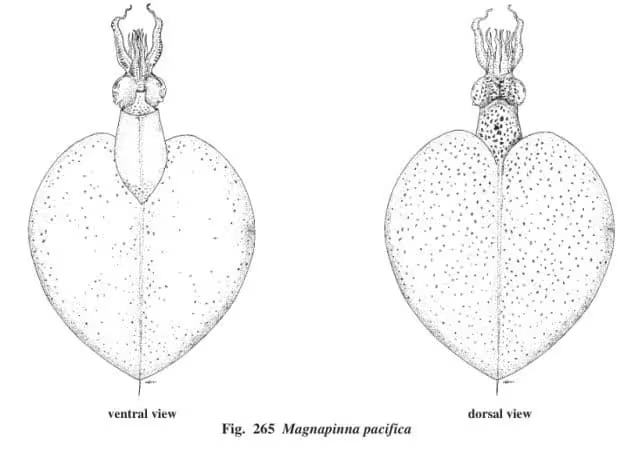
On 7 August, the MBARI research team utilized the remotely operated vehicle Doc Ricketts to survey the deep-sea floor at a depth of 3,277 meters (10,751 feet). As the vehicle navigated the seafloor, it encountered the squid hovering above the sediment. The specimen displayed the distinct morphology that defines Magnapinna, featuring two expansive fins extending from a compact mantle and ten elongated filaments—comprising eight arms and two tentacles—dangling toward the depths.
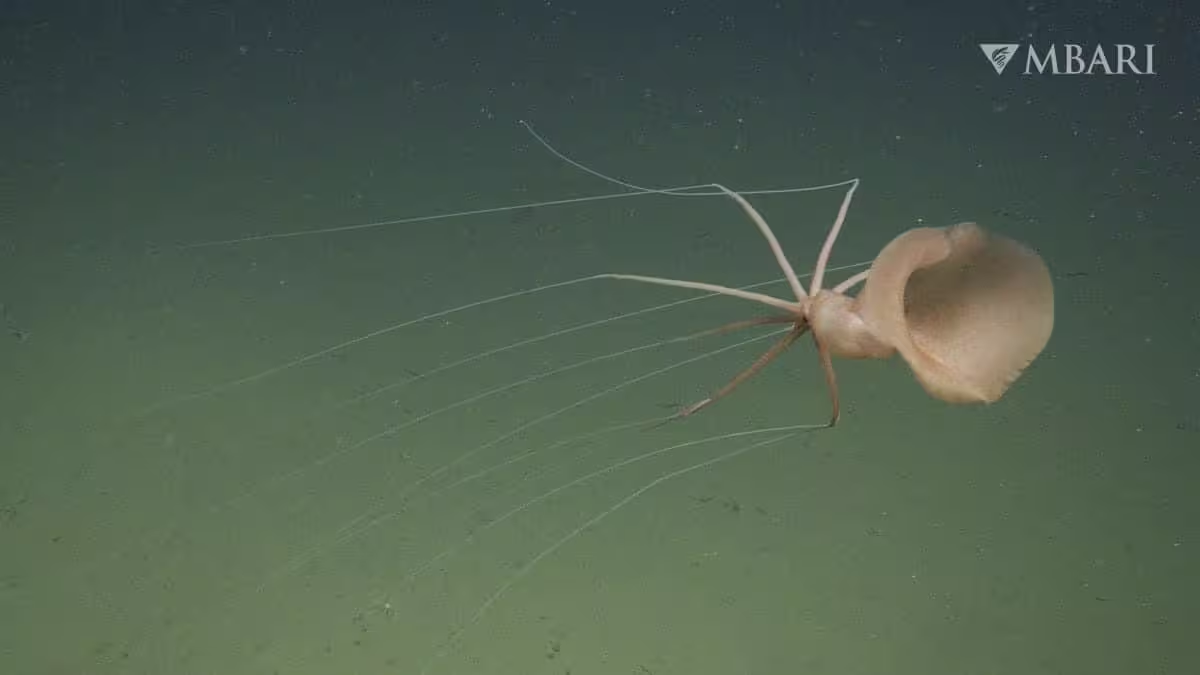
Using the ROV’s laser-based measurement tools, scientists estimated the animal’s total length to be approximately 1.25 meters. This event marks the first confirmed sighting of the species in the Northeastern Pacific. MBARI deep-sea ecologist Olívia Soares Pereira, who participated in the mission, noted that the initial appearance of the animal was deceptive.
“At first, I could only see the tips of what looked like fine tentacles, so I thought it was a jelly, but when the ‘elbows’ showed up on the screen, I knew this was something really special,” Pereira said. She added that Magnapinna stands apart from other deep-sea squid due to its uniquely flexible, elongated appendages.
Unraveling the Mysteries of the “Elbow” Pose
A primary point of curiosity for marine biologists is the distinctive behavior of the bigfin squid, specifically its ability to extend its tentacles outward at a near-perpendicular angle before creating a sharp bend, known as the “elbow” pose. While the functional purpose of this posture remains a subject of hypothesis, researchers suspect it serves as a passive hunting strategy, allowing the squid to trail its long appendages through the water column to snag passing prey.
Fundamental questions regarding the squid’s life cycle—including its diet, reproductive habits, and population density—remain largely unanswered. The scarcity of data is complicated by the extreme habitats they occupy; one individual has been recorded as deep as 6,212 meters, placing Magnapinna among the deepest-dwelling cephalopods ever documented.
Widespread Habitat, Elusive Presence
Although individual sightings are rare, they have been reported across the Atlantic, Pacific, and Indian oceans, including regions near the Philippines, Hawaii, Australia, and the Cook Islands. Recent analytical models suggest that the potential habitat for Magnapinna could encompass as much as 62% of the global ocean surface and 70% of its volume. This leaves researchers to debate whether the species is truly rare in terms of total population or simply difficult to detect within the vastness of the deep ocean.
“These scattered sightings make me believe they might be genuinely rare,” Pereira said. “But in a space so big as the global ocean, I think it’s hard for us to say for sure if they are genuinely rare or instead rarely encountered, or perhaps even a combination of both.”
The encounter highlights the biological significance of the Davidson Seamount, a region already noted by the scientific community for its ancient coral forests and deep-sea octopus nurseries. As technology improves our ability to probe these abyssal environments, such sightings provide vital clues into the hidden biodiversity of our planet’s least explored frontiers.
This article has been fact checked for accuracy, with information verified against reputable sources. Learn more about us and our editorial process.
Last reviewed on .
Article history
- Latest version
Reference(s)
- “Olívia Soares Pereira • MBARI.”, January 14, 2025 MBARI <https://www.mbari.org/person/olivia-soares-pereira/>.
- “Davidson Seamount | Monterey Bay National Marine Sanctuary.” <https://montereybay.noaa.gov/science/characterization/davidson-seamount.html>.
Cite this page:
- Posted by Hassan Raza