Scientist Lived 100 Days Underwater And His Body Changed In Unexpected Ways
A scientist spent months living deep underwater, leading to unexpected biological discoveries that are challenging our understanding of human health.

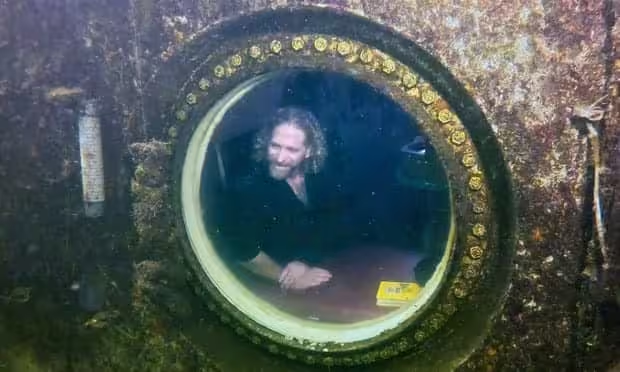
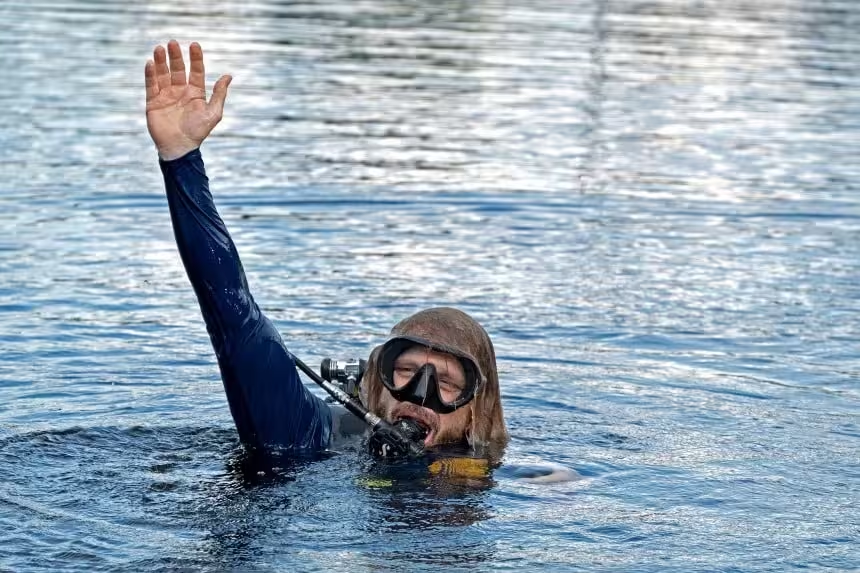
Biomedical engineer Joseph Dituri recently concluded a 100-day experiment that pushed the boundaries of human physiology. Living inside a pressurized habitat located 22 feet below the surface off the coast of Key Largo, Florida, the 60-year-old researcher aimed to observe how sustained exposure to high-pressure environments—similar to those utilized in hyperbaric oxygen therapy (HBOT)—impacts the human body over an extended duration. While the endeavor set a world record, Dituri maintains that the primary goal was to investigate the potential anti-aging and regenerative properties of pressurized living.
Physiological Shifts in a Pressurized Environment
During his time at approximately 1.6 atmospheres of pressure, or 25 pounds per square inch, Dituri observed several notable changes. His markers for health showed a marked improvement, including an eight-pound reduction in body weight without dietary modifications and a significant 72-point decrease in cholesterol levels. Furthermore, he noted a sharp increase in testosterone levels and a reduction in inflammatory markers, such as cortisol.
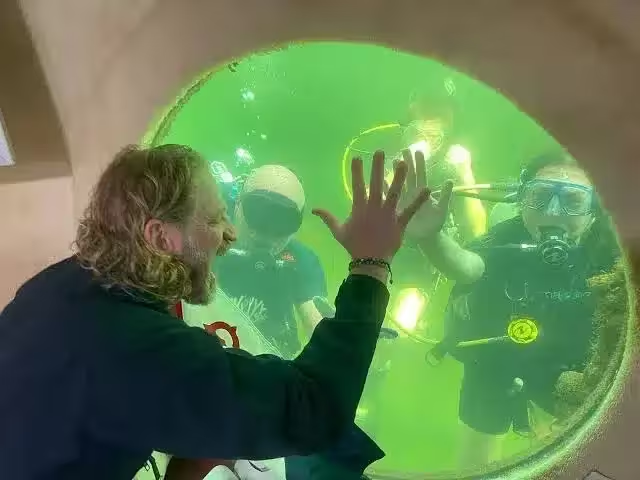
The physical constraints of the habitat also left their mark. The constant pressure compressed his spinal column, resulting in a height reduction of approximately three-quarters of an inch. Conversely, his neurological health appeared to benefit, as electroencephalogram tests conducted after his return to the surface indicated enhanced neural coherence. Additionally, he reported a significant increase in the quality and duration of his REM sleep compared to his baseline measurements taken on land.
Scientific Community Remains Skeptical
Despite the intriguing data, experts in the field of hyperbaric medicine urge caution regarding the interpretation of Dituri’s results. Neal Pollock, a specialist in diving physiology at Laval University, notes that while many patients undergo standard HBOT protocols for chronic conditions, there is currently no clinical evidence linking such pressure exposure to increased human longevity.
Other researchers warn that enthusiasm for HBOT as a general anti-aging tool often relies on misinterpretations of data regarding telomere length and stem cell activity. Kinjal Sethuraman, medical director of the Center for Hyperbaric and Dive Medicine at the University of Maryland Medical Center, suggests that focusing on established lifestyle factors remains the most reliable path to healthy aging. “That money is better spent on healthier food, regular exercise, reducing stress, restorative sleep, and being part of a community. Those are the pillars of aging well,” she stated.
Dituri acknowledges the limitations of his self-reported study, referring to his experience as an “n of one.” To move beyond individual anecdotes, he has joined a more robust research effort at Arizona State University. This project is currently competing for the $101 million XPRIZE Healthspan, which aims to study the effects of various interventions on 200 participants, providing a much larger dataset than the one afforded by his solo mission.
This article has been fact checked for accuracy, with information verified against reputable sources. Learn more about us and our editorial process.
Last reviewed on .
Article history
- Latest version
Reference(s)
- Stimpson, Ashley. “This Scientist Lived Under the Sea for 100 Days. What He Learned Could Add Years to Your Life, He Claims.”, May 8, 2026 Popular Mechanics <https://www.popularmechanics.com/science/a71222385/100-days-underwater-hyperbaric-therapy/>.
- “Dr. Deep Sea – Exploring for Life.” <https://drdeepsea.com/>.
- <https://www.sleepfoundation.org/stages-of-sleep/rem-sleep>.
- projects, Contributors. “Canadian researcher in diving and hyperbaric medicine.”, August 10, 2013 Wikimedia Foundation, Inc. <https://en.wikipedia.org/wiki/Neal_W._Pollock>.
- “Sethuraman, Kinjal | University of Maryland School of Medicine.” <https://www.medschool.umaryland.edu/profiles/Sethuraman-Kinjal/>.
- “XPRIZE Healthspan, Healthy aging made possible | XPRIZE Foundation.”, August 11, 2026 XPRIZE <https://www.xprize.org/competitions/healthspan>.
Cite this page:
- Posted by Hassan Raza