Scientists Trigger Regeneration Pathway in Mammals Turning Scars Into Bone and Tendon
Study finds mammals could reactivate dormant tissue regeneration when healing signals are precisely redirected, hinting at new regenerative therapies.
A recent report in Nature Communications shows that mammals can be coaxed into rebuilding complex structures such as bone, ligament, tendon and joint‑like tissue when wound‑healing signals are precisely timed. The work demonstrates that the default scar‑forming response can be overridden, hinting that regenerative pathways remain dormant rather than lost.
Why Mammals Scar Instead of Regrowing
For generations biologists have wondered why amphibians and fish can replace entire limbs while mammals, humans included, form scar tissue. Teams from Texas A &M University’s College of Veterinary Medicine and Biomedical Sciences approached the problem from a cellular‑flexibility perspective, suggesting that the key difference lies in the instructions given to repair cells rather than in an absent capability.
“Why some animals can regenerate and others, particularly humans, can’t is a big question that has been asked since Aristotle,” said Dr. Ken Muneoka, a professor in the VMBS’ Department of Veterinary Physiology & Pharmacology (VTPP). “I’ve spent my career trying to understand that.”
Muneoka and colleagues frame the issue as a biological switch that may still operate in mammals, albeit in a suppressed state. Unlocking that switch could transform strategies for wound repair and tissue engineering.
Fibroblasts: Cells with Two Possible Paths
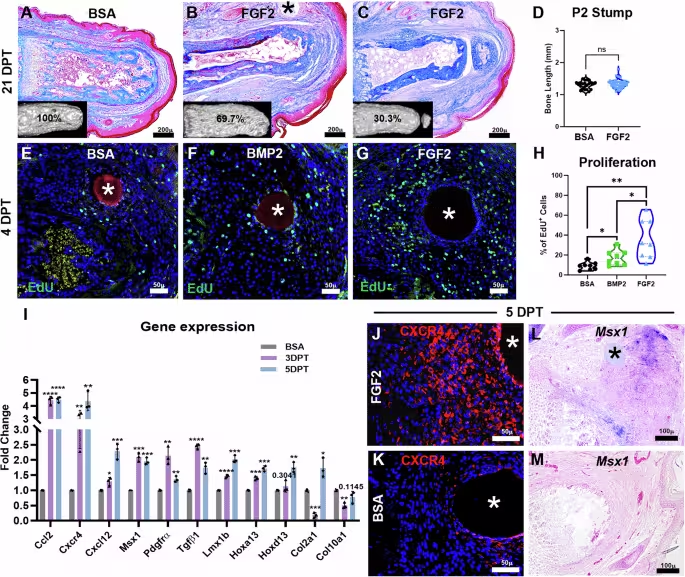
Fibroblasts normally rush to seal wounds, laying down collagen that becomes scar tissue. The new experiments reveal that these same cells can be redirected toward a blastema‑like state—a regenerative precursor—when exposed to a defined sequence of growth factors.
“It’s as if these cells can move in two different directions,” Muneoka said. “They could either make a scar or make a blastema. Our research focused on redirecting the behavior of fibroblasts already present at the injury site.”
Timing proved crucial: delivering the first signal too early or too late altered the outcome, indicating a narrow biological window during which cells remain receptive to a regenerative cue.
Guided Growth Factors Trigger Partial Regrowth
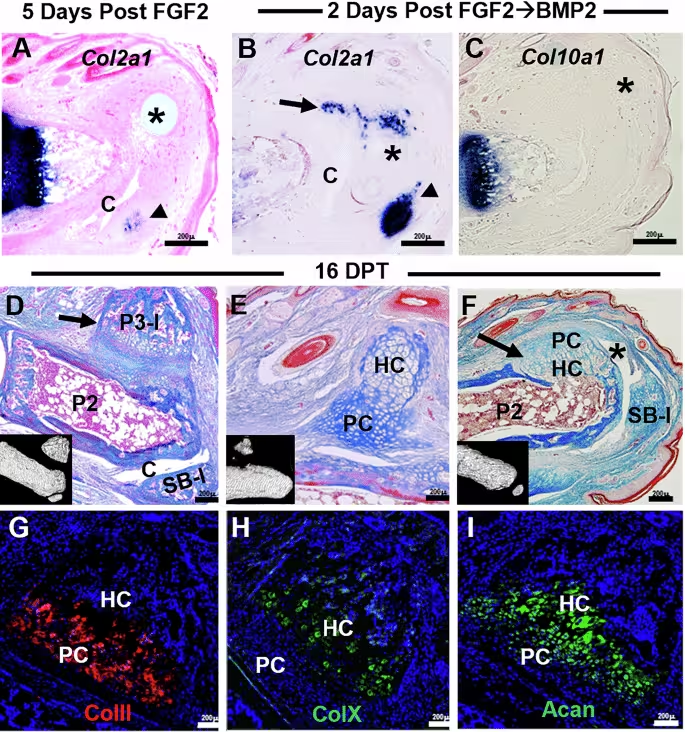
The protocol began with a factor that encouraged blastema formation, followed by a second cue that steered the nascent tissue toward organized bone, tendon, ligament and joint elements. Although the regenerated structures were not perfect copies of the original anatomy, they displayed functional architecture not typically seen in mammalian repair.
“We regenerated what you would expect to see at that level of injury,” Muneoka said. “The structures are there — just not in a perfect form.”
Clinical Outlook and Next Steps
The authors caution that full limb regeneration remains out of reach for humans, but the ability to steer scar formation toward more functional tissue could reshape postoperative care and chronic wound management. The study’s senior authors suggest that applying these molecular cues during the normal healing process may already confer measurable benefits.
“The cells that we thought to be unprogrammable, in fact are,” Suva said. “The capacity is not absent — it’s just obscured.” He also noted, “People should start thinking about using these signals during the healing process,” Muneoka said. “Even shifting the response slightly away from scarring could have real benefits.”
“This changes the way we think about what’s possible,” Suva added. “Once you show that regeneration can be activated, it opens the door to asking entirely new questions.” The findings, published in Nature Communications, present a model for probing latent regenerative capacity in mammals and lay groundwork for future therapeutic exploration.
This article has been fact checked for accuracy, with information verified against reputable sources. Learn more about us and our editorial process.
Last reviewed on .
Article history
- Latest version
Reference(s)
- Yu, Ling. “Digit regeneration in mice is stimulated by sequential treatment with FGF2 and BMP2 - Nature Communications.”, vol. 17, no. 1, April 17, 2026, pp. 5346 Nature, doi: 10.1038/s41467-026-72066-8. <https://www.nature.com/articles/s41467-026-72066-8>.
Cite this page:
- Posted by Hassan Raza