Scientists Find Slow Blink Lets You Talk to Your Cat
Discover how a simple gesture can improve cat communication and strengthen your bond with your feline friend.
For decades, domestic cats have been portrayed as independent, hard‑to‑read companions. A recent study, however, shows that a straightforward human gesture can prompt cats to approach, interact, and even “talk” with their owners, offering fresh insight into feline‑human bonds. Published in Scientific Reports, the work demonstrates that cats are far more sensitive to subtle human cues than previously believed, challenging the notion that they are detached or unresponsive.
Why a Gentle Blink Can Open a Dialogue with Your Cat
Cats are often described as solitary and inscrutable, yet new findings suggest they possess a nuanced communication repertoire. Researchers observed that felines frequently employ a slow blink—a gradual narrowing and closing of the eyes—as a friendly signal. Humans can mimic this expression to convey safety and openness.
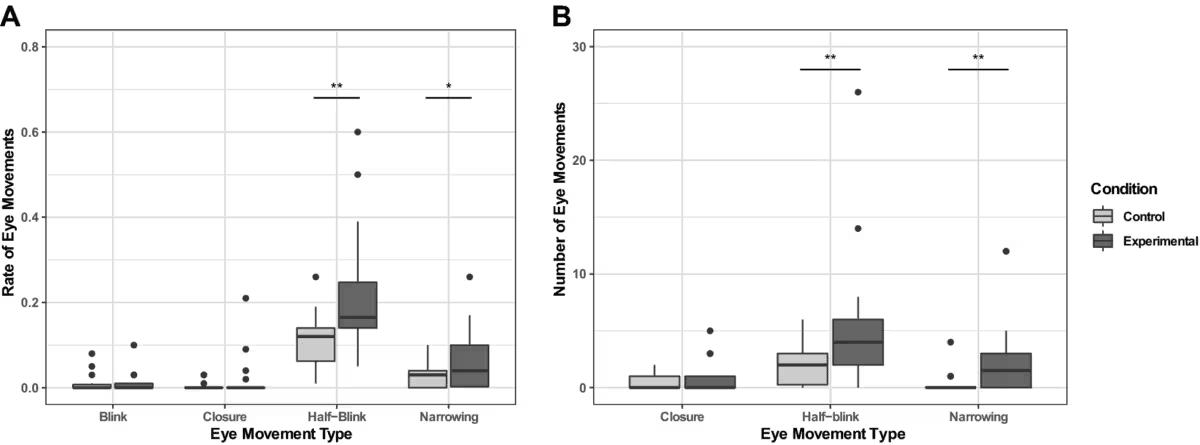
In a series of controlled observations, a group of psychologists examined the response of twenty‑one house cats when their owners performed a deliberate slow blink. Video recordings captured both human and feline facial cues, revealing a marked increase in reciprocal blinks by the cats. A follow‑up test with twenty‑four cats that did not know the experimenters yielded comparable results when the researchers paired a slow blink with an outstretched hand, indicating that the gesture functions as a general communicative cue rather than a product of prior familiarity.
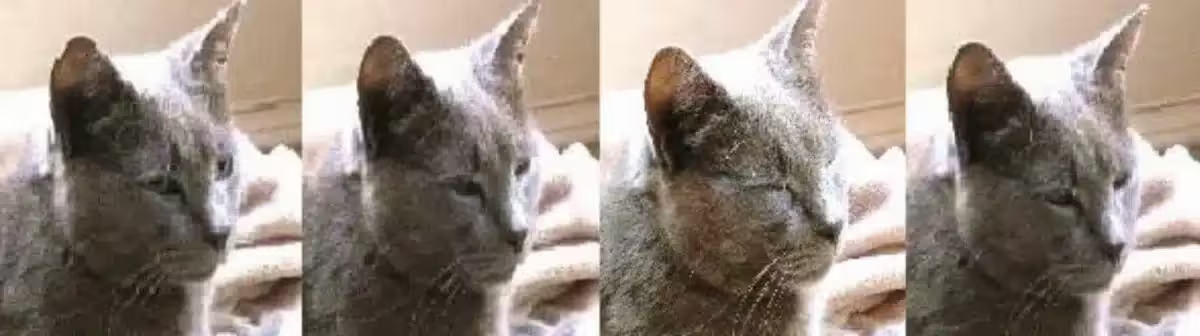
Researchers Reveal How Cats Read Human Eye Movements
The capacity of cats to exchange signals with people has long intrigued both pet owners and scientists. In a paper featured in Scientific Reports, investigators designed two experiments to assess how subtle human gestures shape feline behavior. The first trial observed twenty‑one cats in their own households as owners executed a gentle, intentional eye movement. The second involved twenty‑four cats introduced to unfamiliar individuals performing the same gesture. In both scenarios, the felines were more inclined to approach and interact compared with control conditions lacking any human cue.
“As someone who has both studied animal behavior and is a cat owner, it’s great to be able to show that cats and humans can communicate in this way,” said University of Sussex psychologist Karen McComb in 2020. “It’s something that many cat owners had already suspected, so it’s exciting to have found evidence for it.”
Try the Slow‑Blink Technique in Your Own Home
Perhaps the most practical takeaway is that cats positively respond to a human‑initiated slow blink, providing owners with an easy method to build trust. McComb advises,
“Try narrowing your eyes at them as you would in a relaxed smile, followed by closing your eyes for a couple of seconds. You’ll find they respond in the same way themselves, and you can start a sort of conversation.”
The method works with both resident cats and strangers, making it suitable for private homes, animal shelters, or even street encounters. Beyond its charm, such exchanges can deepen emotional connections and help owners attune to subtle feline signals that have often been missed.
Broader Impact on Feline Care and Scientific Understanding
The ramifications of these results extend beyond domestic settings. “Understanding positive ways in which cats and humans interact can enhance public understanding of cats, improve feline welfare, and tell us more about the socio‑cognitive abilities of this understudied species,” said psychologist Tasmin Humphrey of the University of Sussex. She added that the slow‑blink technique could be incorporated into welfare assessments in shelters and veterinary clinics, potentially lowering stress and enriching environments for cats.
This article has been fact checked for accuracy, with information verified against reputable sources. Learn more about us and our editorial process.
Last reviewed on .
Article history
- Latest version
Reference(s)
- Humphrey, Tasmin. “The role of cat eye narrowing movements in cat–human communication - Scientific Reports.”, vol. 10, no. 1, October 5, 2020, pp. 16503 Nature, doi: 10.1038/s41598-020-73426-0. <https://www.nature.com/articles/s41598-020-73426-0>.
Cite this page:
- Posted by Hassan Raza