The Surprising Reason Your Dominant Hand Is Better: Practice, Not Brain Power
A quirky elbow‑writing test reveals that years of daily practice, not innate ability, make your dominant hand seem superior.

When a pen was strapped to the elbow, the typical performance gap between a person’s dominant and nondominant sides vanished. In the unfamiliar elbow‑writing task, both arms produced equally inaccurate letters and numbers, regardless of which hand participants usually favored.
The work appears in the Proceedings of the National Academy of Sciences (June 30 2026). Led by UCLA neurologist Ahmet Arac, the study probed why the dominant hand generally outperforms the opposite side in writing, throwing, and tool use.
Findings separate the innate preference for one side of the body from the skill gap that emerges later. While a side may be favored before birth, the later advantage appears to stem largely from repetitive practice with specific movements.
Reaching Tasks Show Little Arm Asymmetry
Researchers recorded three‑dimensional arm trajectories of healthy adults as they reached for targets under three conditions: normal reaching, reaching while holding a four‑pound wrist weight, and reaching with a light stick attached to the forearm.
In the first two scenarios, the dominant and nondominant arms performed at comparable levels. Adding weight did not confer a clear benefit to the preferred side, according to the UCLA Health summary.
A measurable difference emerged only when the forearm stick was used. The tool‑like attachment required participants to guide a curved trajectory, and the dominant arm traced these complex paths more accurately than the nondominant arm.
Thus, the performance gap relates to the precision of familiar movement patterns rather than to raw physical effort. Writing, racket swings, and similar activities depend on controlling both an object and its path.
Elbow‑Based Writing Eliminates Handedness Edge
In a second experiment, participants first wrote letters and numbers with a pen held in the hand, then repeated the task with the pen fixed to the elbow—an area never trained for writing.
When using the hand, the expected dominant‑hand advantage was evident. When the elbow was employed, the advantage disappeared, and both sides started with similarly poor performance because neither elbow had prior experience with handwriting movements.
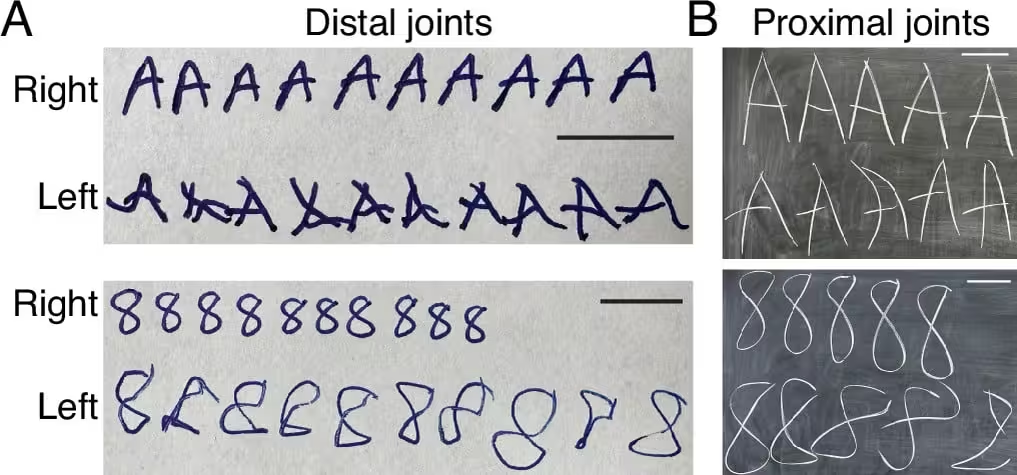
A neural‑network analysis of the traced “A” and “8” shapes found no initial superiority for the right elbow, even among strong right‑hand users.
Subsequent training of either the dominant‑side elbow or the opposite elbow led to comparable improvements. After practice, the trained elbow outperformed the participant’s untrained nondominant hand.
Skill Development Drives Tool Mastery
The experiments distinguish hand preference (the side a person chooses) from arm dominance (the skill gap that develops). Repeatedly selecting the same hand provides that side with more opportunities to practice writing, eating, throwing, drawing, and other object‑handling tasks, gradually refining precise control over movement trajectories.
“The dominant arm isn’t inherently more capable because one brain hemisphere is superior at motor control,” Arac explained in the UCLA Health report. “It is the lifetime of practice on complex, tool‑related movements that creates the advantage.” The elbow experiment confirmed this view by moving the task to an untrained body part, where the usual dominant‑side benefit vanished.
These results challenge the notion of a built‑in hemispheric superiority in motor control while acknowledging a biological basis for the initial side choice. Long‑term practice emerges as the primary driver of the later performance disparity.
Task Specificity Shapes Motor Dominance
The nondominant arm did not consistently lag across all tests. It performed on par with the dominant arm during simple reaching and weighted reaching, but fell behind when the task demanded precise control of a tool‑like object.
This pattern underscores that motor skill is highly task‑specific. Strength or general coordination alone could not explain the observed differences; the gap appeared only in actions mirroring years of familiar tool use.
The study involved collaborators from UCLA, Johns Hopkins University, and the Santa Fe Institute. Co‑author Nicolas Y.H. Jeong Lee contributed alongside senior author John W. Krakauer. Funding came from the National Institutes of Health, the US‑Israel Binational Science Foundation, NVIDIA, and UCLA’s Department of Neurology.
Across both reaching and writing experiments, repeated practice reliably predicted which side would excel when the task required a learned, precisely controlled movement.
This article has been fact checked for accuracy, with information verified against reputable sources. Learn more about us and our editorial process.
Last reviewed on .
Article history
- Latest version
Reference(s)
- Arac, Ahmet., et al. “Arm dominance is an emergent effect of practice executing complex trajectory shapes required by tools and objects.” Proceedings of the National Academy of Sciences, vol. 123, no. 27, June 30, 2026 National Academy of Sciences, doi: 10.1073/pnas.2601569123. <https://www.pnas.org/doi/10.1073/pnas.2601569123>.
- “Study explains why your dominant hand is better at everyday tasks.” <https://www.uclahealth.org/news/release/study-explains-why-your-dominant-hand-better-everyday-tasks>.
Cite this page:
- Posted by Zara Tariq