Scientists Found Evidence The Mediterranean Sea Completely Dried Out for 600,000 Years, Creating a Basin Nearly Two Miles Deep
Ancient megaflood reshaped the Mediterranean 5 million years ago, geologists reveal
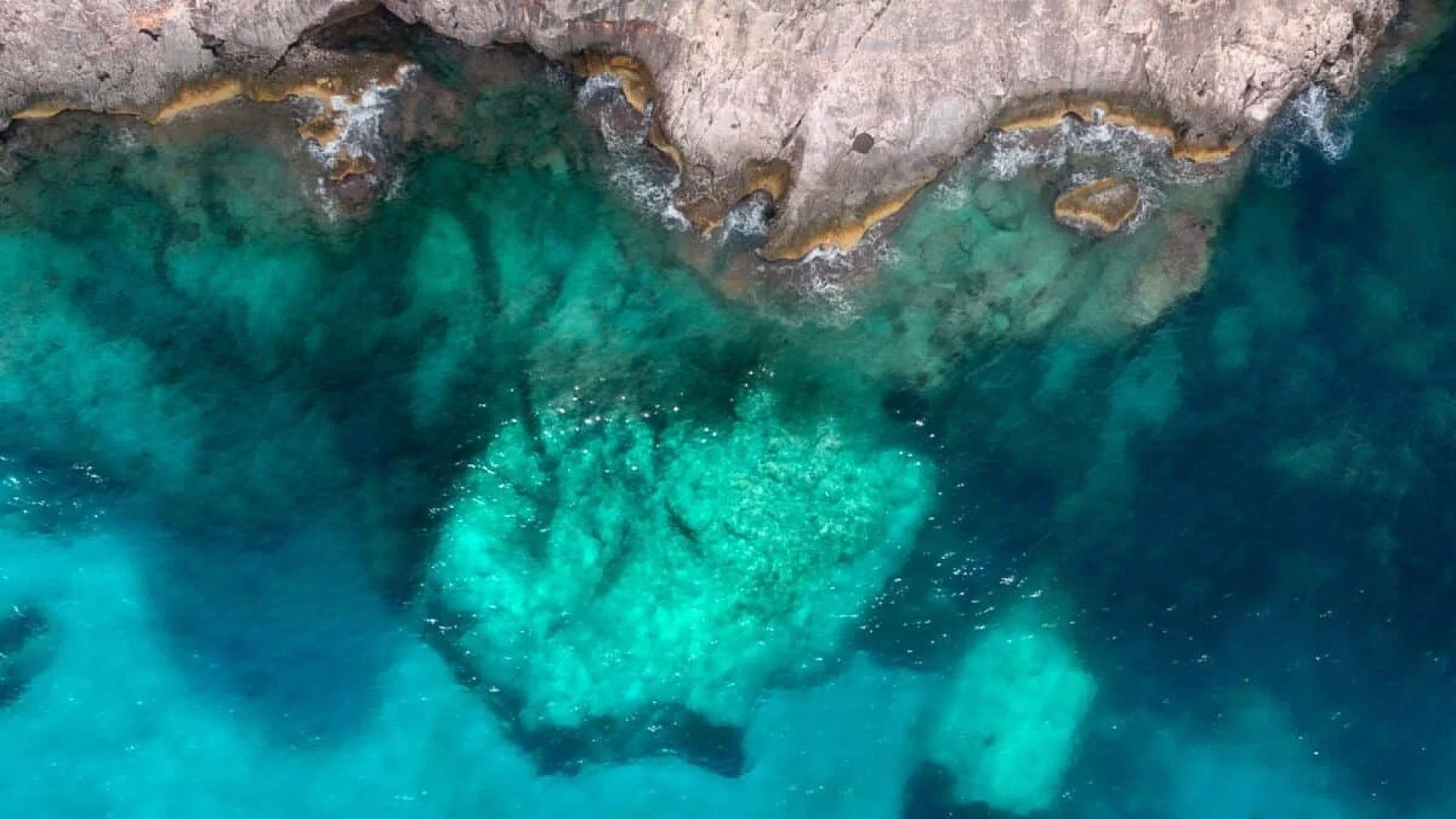
About 5.6 million years ago, the Mediterranean basin underwent a dramatic transformation. Cut off from the Atlantic, the sea progressively evaporated, leaving behind a vast, salty plain etched by ancient rivers. Tens of thousands of years later, Atlantic waters surged back, flooding the basin in an event that may rank among the planet’s most colossal deluges.
Researchers have long examined this episode, yet key questions persist about the extent of desiccation and the speed of the subsequent refill. While the core evidence is well‑documented, scientists continue to debate just how dry the Mediterranean became and how rapidly it was re‑submerged.
Today the Mediterranean is a familiar sea flanked by Europe, Africa and the Middle East, but its geological record preserves a chapter when the region resembled a sprawling desert more than a marine environment. This interval, known as the Messinian Salinity Crisis, has left a signature that can still be traced beneath the present‑day seafloor.
Massive Salt Deposit Beneath the Modern Sea
The first compelling clues emerged in 1970 when the drillship Glomar Challenger penetrated the Mediterranean crust. Instead of ordinary sediments, scientists encountered thick sequences of salt and gypsum overlain by younger layers.
A recent Nature article reports that more than one million cubic kilometres of evaporite accumulated during the crisis, ranking it among the planet’s largest salt formations. Such volumes can only be produced by extensive evaporation, where water loss concentrates dissolved minerals until they precipitate onto the basin floor.
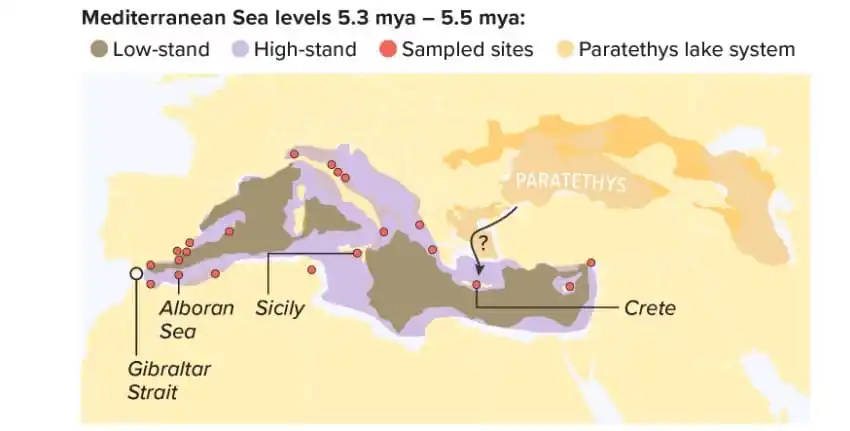
Further fieldwork uncovered fossil soils, plant remnants and traces of ancient river courses, reinforcing the view that the Mediterranean landscape during the crisis was radically different from today’s oceanic setting.
River Valleys Carved When Water Receded
For roughly 600,000 years, the basin was largely a network of salt flats, isolated lakes and deep valleys incised by flowing rivers. The Nile, for example, gouged a canyon more than a kilometre deep beneath its current trajectory in Egypt, while comparable features were produced by the Rhône in France and the Po in Italy.
Toward the end of the desiccation phase, a stage termed the Lago Mare phase gave rise to shallow, brackish lakes that hosted fauna resembling that of the modern Caspian Sea.
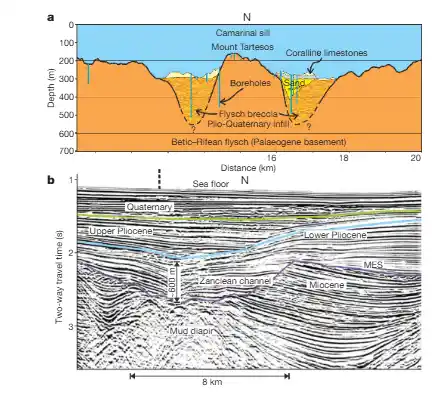
Bottom‑zone conditions were likely extreme, with some sections lying several kilometres beneath sea level, generating high pressure and scorching temperatures that may have rivalled today’s hottest environments.
Ongoing Debate Over the Refill Flood
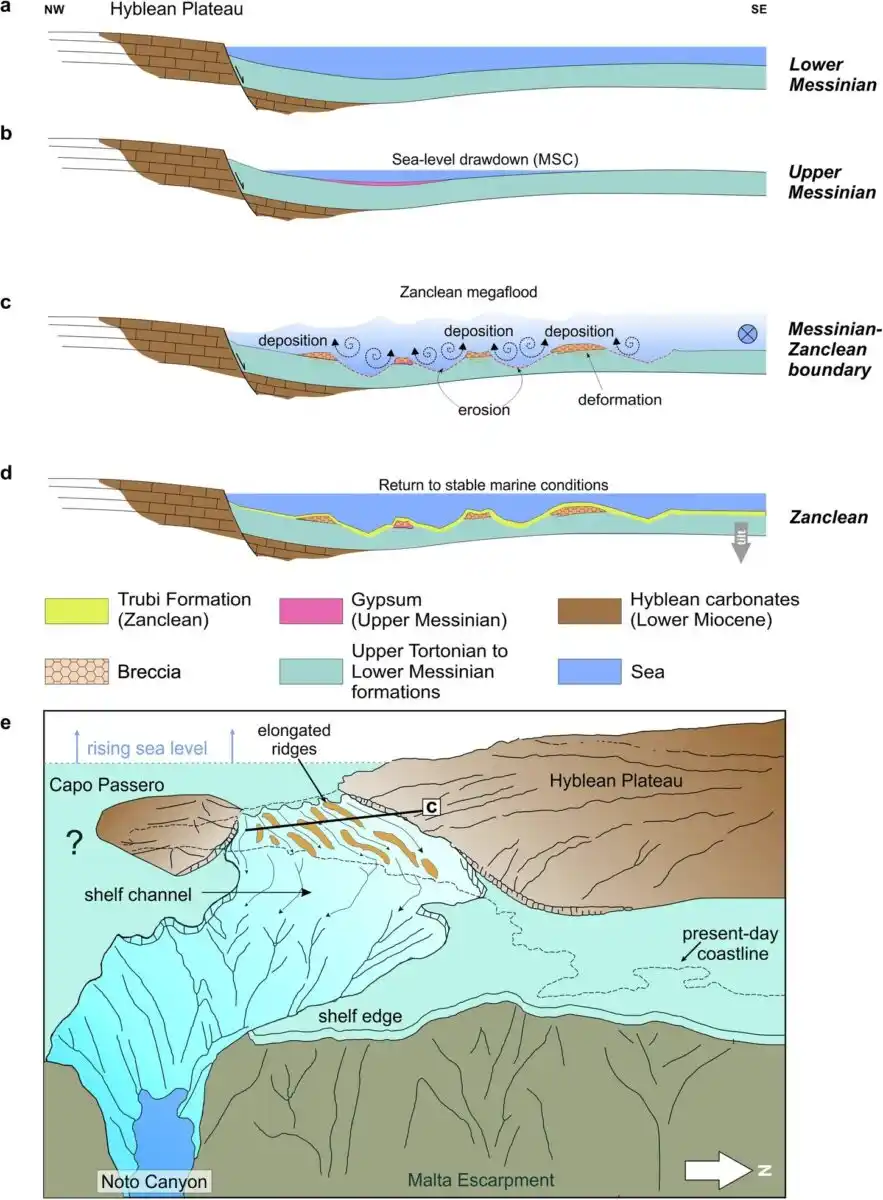
The basin eventually refilled, but the mechanics of that resurgence remain contested. A 2009 Nature study led by Daniel Garcia‑Castellanos and colleagues argued that the reopening of the Strait of Gibraltar unleashed the Zanclean Flood, rapidly restoring the sea. Their models suggest that roughly 90 % of the basin could have been replenished within months to two years.
More recent work supports a high‑energy influx. Research published in Communications Earth & Environment identified over 300 erosional ridges and a 20‑kilometre‑wide channel in southeastern Sicily, interpreted as scars left by powerful floodwaters.
“These findings not only shed light on a critical moment in Earth’s geological history but also demonstrate the persistence of landforms over five million years,” said Aaron Micallef, who led the study. “It opens the door to further research along the Mediterranean margins.”
A February 2026 review in Knowable Magazine highlighted newer analyses that question whether the basin ever became completely dry, suggesting that a limited Atlantic connection may have persisted throughout the crisis. Some investigators now propose that the refill process unfolded over several millennia rather than a few years.
This article has been fact checked for accuracy, with information verified against reputable sources. Learn more about us and our editorial process.
Last reviewed on .
Article history
- Latest version
Reference(s)
- Krijgsman, Wout. “Causes and consequences of the Messinian salinity crisis - Nature Reviews Earth & Environment.”, vol. 5, no. 5, pp. 335-350. Nature, doi: 10.1038/s43017-024-00533-1. <https://www.nature.com/articles/s43017-024-00533-1>.
- Garcia-Castellanos, D.. “Catastrophic flood of the Mediterranean after the Messinian salinity crisis - Nature.”, vol. 462, no. 7274, pp. 778-781. Nature, doi: 10.1038/nature08555. <https://www.nature.com/articles/nature08555>.
- “Daniel Garcia-Castellanos.” <https://scholar.google.com/citations?user=I4Bbic0AAAAJ&hl=en>.
- Micallef, Aaron. “Land-to-sea indicators of the Zanclean megaflood - Communications Earth & Environment.”, vol. 5, no. 1, December 28, 2024, pp. 794 Nature, doi: 10.1038/s43247-024-01972-w. <https://www.nature.com/articles/s43247-024-01972-w>.
- “Aaron Micallef • MBARI.”, May 8, 2023 MBARI <https://www.mbari.org/person/aaron-micallef/>.
- <https://knowablemagazine.org/content/article/physical-world/2026/case-against-zanclean-megaflood-filling-mediterranean>.
Cite this page:
- Posted by Hassan Raza