Inside the 1457 Court That Tried a Sow to Death: How Medieval Justice Handled Animals
Medieval French court tried a sow for a child’s death, revealing the grim fate of its piglets and a bizarre side of justice.
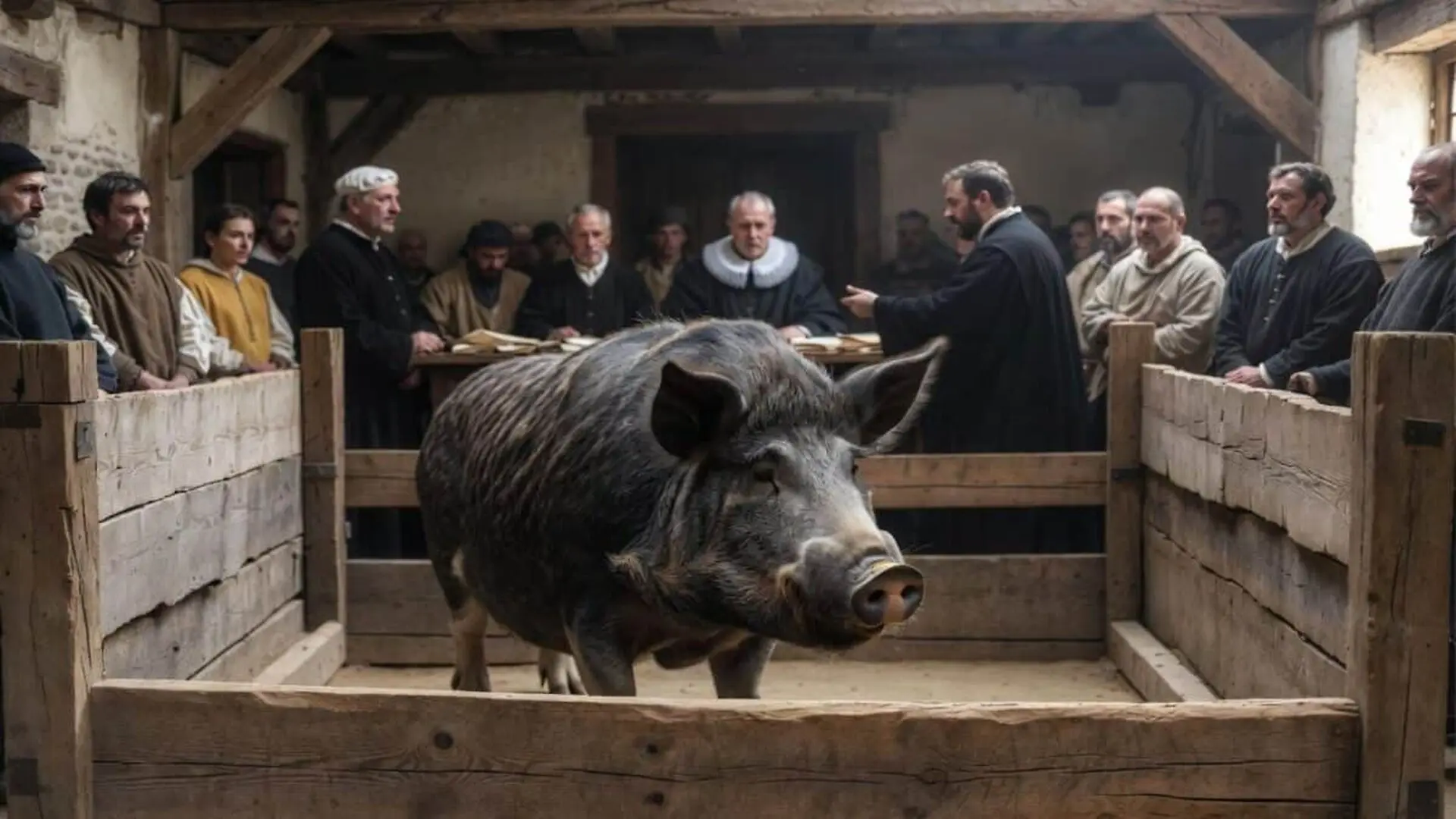
In early January 1457, a Burgundian tribunal in Savigny‑sur‑Étang faced a grim scene: the corpse of five‑year‑old Jehan Martin lay beside a sow and six piglets stained with blood. Witnesses claimed the sow had been feeding on the child, while the involvement of the piglets remained uncertain. The court sentenced the sow to death, but deferred judgment on the piglets pending further evidence.
The case forms part of a broader pattern of more than two hundred animal prosecutions recorded across pre‑modern Europe. Pigs dominate these records, representing over a quarter of all non‑human trials and more than half of the animal‑related cases in historic France, according to a recent article in Sophia[source].
Formal Courts Treated Pigs Like Criminal Defendants
The Savigny proceeding listed a full complement of judicial personnel—including judge Nicolas Quarroillon, prosecutor Huguenin Martin representing Lady Katherine de Barnault, a legal adviser linked to the Duke of Burgundy, a notary, witnesses, and an executioner—demonstrating that the trial followed the same procedural rigor as any civil case of the era.
Although the original docket left the animals unnamed, historian Sven Gins later coined the fictional name “Sustitia” for the sow, explicitly noting that the label was his own invention and not part of the historic record.

The tribunal differentiated between the sow and its offspring. While the sow received a sentence of hanging upside down, the piglets avoided automatic execution because the court could not definitively link them to the child’s death. Their keeper, Jehan Bailly, was offered a chance to assume responsibility; after his refusal, the piglets were placed under the Lady of Savigny’s custody rather than being put to death.
Free‑Roaming Swine Posed Everyday Dangers
In medieval settlements, pigs were valued for meat and for consuming organic waste, often roaming streets and courtyards in search of food. Their size, powerful jaws, and omnivorous habits made them capable of inflicting serious injury, especially to children.
A Popular Science overview notes that medieval pigs resembled wild boars more closely than many modern breeds, explaining why incidents of fatal attacks on youngsters were not uncommon.
Similar prosecutions appear in French archives: a 1379 case in Saint‑Marcel‑lès‑Jussey involved a sow after a swineherd’s child died, and a 1386 trial in Falaise recorded a sow dressed in human clothing before its public execution, a vivid episode that has become emblematic of medieval animal courts.
These proceedings also served to assess owner responsibility. By documenting the incident, authorities could determine whether neglect or improper supervision contributed to the tragedy, providing a formal mechanism for community accountability.

Distinct Judicial Paths for Different Species
Secular tribunals typically prosecuted individual domestic animals—such as pigs, horses, dogs, or cattle—accused of harming people, with penalties ranging from execution to confiscation. In contrast, ecclesiastical courts addressed collective nuisances, like swarms of insects or other creatures damaging crops, often issuing religious directives rather than physical punishments.
Gins emphasizes that these varied procedures reflect differences in the alleged offense, the animal’s nature, the local legal framework, and the period in question. Some cases centered on a single violent act, while others dealt with broader ecological threats that could not be attributed to a specific individual.
The Sophia article rejects a single motive for all trials, describing them instead as “local laboratories” where Christian communities negotiated the boundaries of human‑animal relationships through law.
What the Trials Reveal About Human Legal Authority
Modern criminal law requires mens rea—an understanding of wrongdoing—to assign guilt, a concept medieval courts did not apply to animals. Nonetheless, the trials underscored a hierarchy: human participants were named, ranked, and held accountable, whereas the animals remained property, their legal fate tied to ownership.
Gins introduces the notion of “Homo Legifer” (the legislative human) to illustrate how societies distinguished themselves by creating moral statutes. Bringing an animal before a court did not dissolve the perceived divide between species; it reinforced the idea that legal order was a human construct applied to non‑human actors.
By documenting the Savigny case, authorities not only recorded a tragic death but also exercised a formal mechanism to regulate dangerous animals, reinforcing human exceptionalism and the belief in a uniquely rational, moral legal system.
This article has been fact checked for accuracy, with information verified against reputable sources. Learn more about us and our editorial process.
Last reviewed on .
Article history
- Latest version
Reference(s)
- Gins, Sven. “Casting Justice Before Swine: Late Mediaeval Pig Trials as Instances of Human Exceptionalism.” Sophia, vol. 62, no. 4, August 25, 2023, pp. 631-663. Springer Science and Business Media LLC, doi: 10.1007/s11841-023-00970-3. <https://link.springer.com/article/10.1007/s11841-023-00970-3>.
- “HomicidalHogs Baby Cradle2.” <https://cdn.zmescience.com/wp-content/uploads/2026/07/HomicidalHogs_baby_Cradle2.jpg>.
- Ewbank, Anne. “In medieval France, murderous pigs faced trial and execution.”, January 13, 2026 Popular Science <https://www.popsci.com/environment/pig-trials-medieval/>.
- “Cosmas Indicopleustess Medieval Boar Vepreslon Bestiary Mythical Creature.” <https://cdn.zmescience.com/wp-content/uploads/2026/07/Cosmas-Indicopleustess-medieval-boar-vepreslon-bestiary-mythical-creature.webp>.
Cite this page:
- Posted by Hassan Raza