80-Fold Surge in Loggerhead Turtle Nests on Boa Vista Shows Power of Decades-Long Conservation
Boa Vista transforms into a top loggerhead turtle nesting hotspot after decades of quiet conservation efforts.

Night‑time monitoring teams on Boa Vista’s coastline began spotting a shift around 2018. Where once they recorded five to ten nesting females per patrol, numbers swelled to 20‑30, and by 2021 some crews counted 30‑40 turtles in a single evening. The pattern hinted at a larger change, but only a systematic tally could reveal its true magnitude.
A comprehensive longitudinal analysis now quantifies that surge, showing an 80‑fold rise in loggerhead turtle (Caretta caretta) nesting activity across three key beaches between 1998 and 2024. The research, appearing in Biological Conservation, credits the recovery to two decades of coordinated effort by Cabo Verde Natura 2000 (CVN2), including anti‑poaching patrols, habitat safeguards, hatchery interventions, and community outreach. Lead author Cassandra Roch and colleagues describe the outcome as one of the most striking documented rebounds for a sea‑turtle population in the North‑East Atlantic.
Why a Decade‑Long Timeline Was Needed to See the Growth
Loggerhead turtles mature slowly. NOAA Fisheries notes that juveniles spend seven to fifteen years in the open ocean before shifting to coastal foraging grounds, and another decade or more before reaching reproductive age. This life‑history means that measurable population gains unfold over generations rather than seasons.
Marine‑turtle expert Jeanette Wynecken, who was not involved in the study, explained to Mongabay that hatchlings emerging at the start of the monitoring period would only have begun returning to Boa Vista as nesting adults around 2013‑2014. Consequently, conservation actions launched in the late 1990s produced no visible uptick for more than ten years, simply because the turtles required that time to mature.
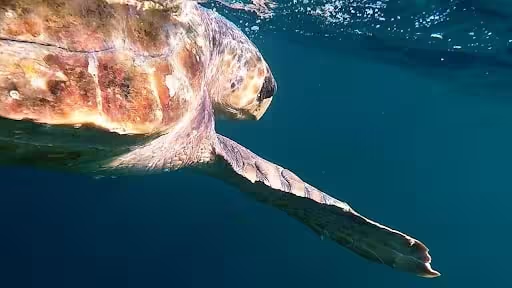
The Northeast Atlantic aggregation that includes the Cabo Verde nesting sites is classified as endangered under the U.S. Endangered Species Act, underscoring the significance of Boa Vista’s trends for regional conservation planning.
Boa Vista Surpasses Global Hotspots in Nest Density
When compared with the world’s largest loggerhead nesting locations—Florida and Oman, where densities approach 965 nests per mile—Boa Vista’s three biggest beaches recorded more than 35,000 nests per mile in 2021, according to the study. While such extreme figures are confined to specific stretches rather than the entire island, they illustrate how the archipelago has become a pivotal nesting hub for the species’ regional population.
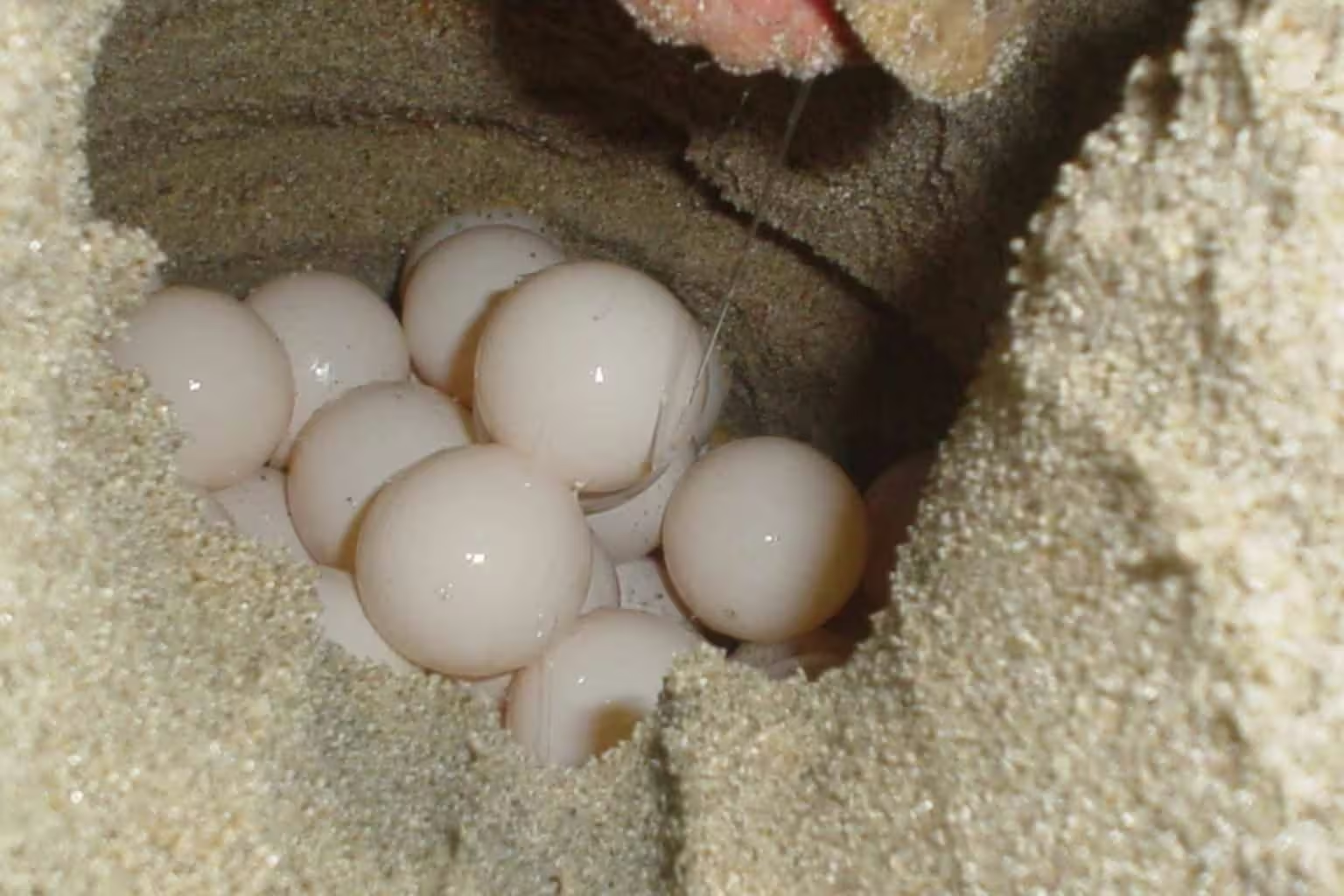
CVN2 assembled the dataset behind these numbers through disciplined, long‑term fieldwork. From June onward, staff and volunteers conduct nightly beach patrols, tally eggs in each clutch, and erase the female’s tracks to avoid double‑counting. In October they return to evaluate hatch‑success rates. This uninterrupted record, extending back to 1998, was essential for quantifying the scale of recovery with confidence.
Combined Protection Measures Drove the Turnaround
The analysis points to a suite of sustained actions rather than a single intervention. Over twenty years CVN2 curbed poaching, relocated vulnerable nests, and shielded nesting habitats from development. This continuous, multi‑pronged approach appears to have given the North‑East Atlantic loggerhead population the breathing room needed to rebound.
Equally important was the program’s focus on local involvement. CVN2’s workforce is predominantly Cape Verdean, and the initiative frames turtles as assets linked to the island’s cultural identity and economy, not merely as distant conservation symbols. This community buy‑in amplified the effectiveness of anti‑poaching efforts.

Co‑author Carlos Angulo‑Preckler, a marine researcher at King Abdullah University of Science and Technology, highlighted the study as a model of how long‑term NGO data can be transformed into scientific evidence that supports both local action and global understanding of sea‑turtle recovery. The case demonstrates that conservation timelines measured in decades can align with the slow life cycles of long‑lived species, something short‑term programs often miss.
High Densities Bring New Challenges
The same concentration of nests that signals success also raises vulnerability. When large numbers of females crowd a limited shoreline, a single disturbance—storm erosion, a surge in poaching, or coastal construction—can impact a substantial portion of a season’s reproductive output. At very high densities, turtles may inadvertently dig up existing nests while nesting, turning a thriving site into a logistical hurdle.
Temperature‑dependent sex determination adds another layer of risk. NOAA’s National Ocean Service explains that incubation temperature, not genetics, sets hatchling sex: eggs below about 27.7 °C tend to produce males, while those above 31 °C favor females. Rising sand temperatures therefore skew hatchling cohorts toward females.
Over multiple breeding seasons this bias can destabilize the population’s sex ratio, potentially compromising long‑term reproductive health even as nest counts remain high.
A Bright Spot Within a Species Still Under Threat
Boa Vista’s surge does not alter the global outlook for loggerheads. The IUCN classifies the species as vulnerable, noting a roughly 47 % decline over three generations. Ongoing pressures include bycatch in fisheries, habitat loss, marine debris, and illegal harvest, especially in regions with weaker protection.
Climate change compounds these challenges. Warmer sands affect hatchling sex ratios, while more frequent storms erode nesting beaches between seasons. Both factors introduce uncertainty into projections that rely solely on nest‑count trends.
Roch emphasized that sea turtles have endured past climate disruptions, but she cautioned that continuous monitoring remains crucial to detect emerging threats and guide adaptive conservation strategies.
This article has been fact checked for accuracy, with information verified against reputable sources. Learn more about us and our editorial process.
Last reviewed on .
Article history
- Latest version
Reference(s)
- Roch, Cassandra., et al. “Decades of conservation and monitoring reveal population recovery in a globally important loggerhead rookery.” Biological Conservation, vol. 317, May 1, 2026, pp. 111782 Elsevier BV, doi: 10.1016/j.biocon.2026.111782. <https://doi.org/10.1016/j.biocon.2026.111782>.
- “People.” TAJRC <https://tajrc.kaust.edu.sa/people>.
- <https://www.iucnredlist.org/species/pdf/83157651/attachment>.
Cite this page:
- Posted by Hassan Raza