Red Streetlights Guard Bat Colony on Danish Road While Keeping Traffic Safe
A Danish road glows red at night due to a hidden nighttime neighbor, not a design choice.
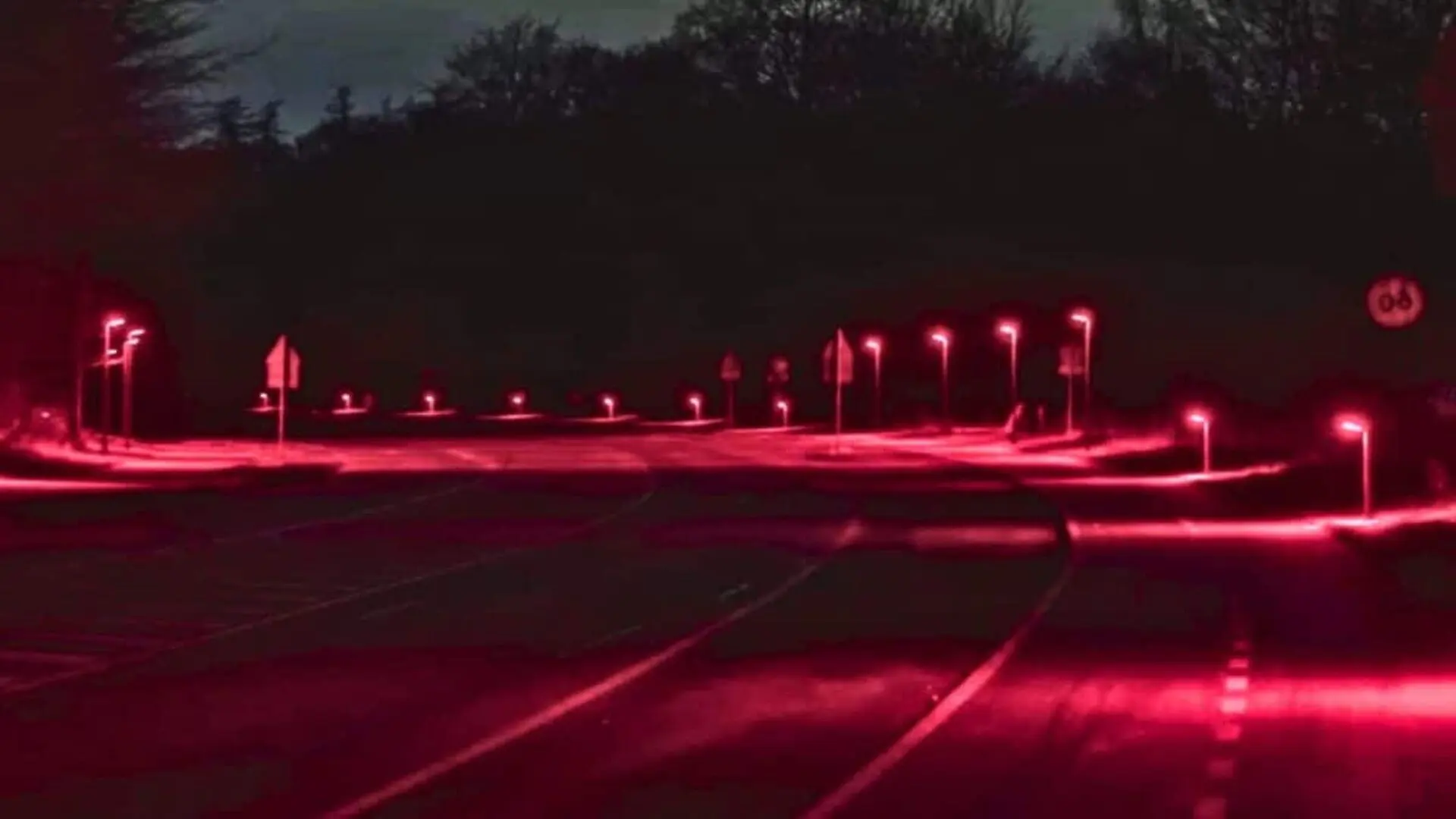
At night a segment of Frederiksborgvej near Skovbrynet in Gladsaxe, Denmark, glows a deep red instead of the usual white street lighting.
The hue is functional, not decorative. A bat colony occupies the area alongside the road, and when the municipality upgraded the lighting it needed a solution that protected the mammals while still providing enough illumination for motorists and cyclists.
Officials opted for red LEDs on the portion of the road that borders the bat habitat, citing research that shows longer‑wavelength red light disrupts the activity of most bat species far less than shorter‑wavelength blue, green or white light.
Seven bat species documented along the corridor
Gladsaxe Municipality reports that seven bat species have been recorded near Frederiksborgvej, none of which are listed as threatened or red‑listed.
Among them, the common pipistrelle – the most abundant bat in the region – and the long‑eared bat are considered most vulnerable to road‑related impacts, according to guidance prepared for the Danish Road Directorate by Julie Dahl Møller and Hans J. Baagøe.
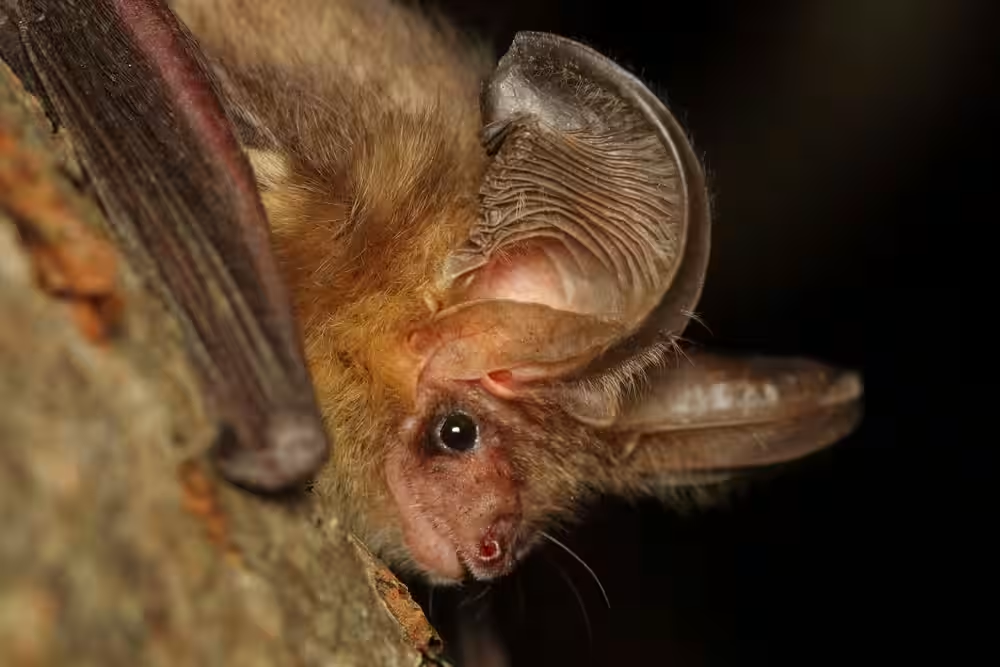
Denmark hosts 13 bat species in total. The municipality notes that serotine bats, common pipistrelles, parti‑coloured bats of North Zealand, and Daubenton’s bats are among the most frequently encountered, though local abundance can vary widely.
When the lighting upgrade was planned, the presence of the colony prompted a tailored design rather than a uniform replacement across the entire stretch of road.
Why red light was chosen
Studies show that artificial illumination can alter bat behaviour, but the impact depends on the light’s wavelength. A Dutch project referenced by Gladsaxe Municipality found that blue, green and white light—shorter wavelengths—have a stronger effect on bat activity than longer‑wavelength red light.
Red lighting also proved more suitable for bats while they forage, according to the municipality’s assessment.
Complete darkness would have been ideal for the bats, but the road still required illumination for safety. Red LEDs therefore offered the best compromise for the segment adjacent to the colony.
Road engineer Jonas Jørgensen of Gladsaxe’s Traffic and Mobility department explained that the goal was to minimize ecological impact while preserving safe travel conditions.
Light Bureau confirmed that the design follows bat‑friendly lighting guidelines, aiming to reduce behavioural disruptions for nocturnal species and to help drivers maintain dark‑adaptation for nighttime driving.
Warm white at intersections
Not every fixture along the route switched to red. At traffic junctions and cyclist crossing points, the municipality installed higher‑pole warm white LEDs to improve visibility.
This creates a variable lighting scheme: red LEDs protect the bat habitat, while warmer white light enhances safety where vehicle and cyclist traffic is heaviest.
Mayor Trine Græse framed the project as a balance between traffic safety, mobility, and biodiversity, linking it to the municipality’s broader commitment to the United Nations Sustainable Development Goals.
Red light as a visual cue for a protected area
Beyond its ecological function, the red illumination is intended to signal the special nature of the surroundings to road users.
Lighting designer Philip Jelvard of Light Bureau explained that the red hue helps drivers recognize the area as a protected natural zone.
“We hope the new lighting is welcomed by everyone,” Jelvard said. “The red glow should not only serve a practical purpose but also remind passers‑by that this is a special natural area worth protecting.”
Gladsaxe acknowledges that both drivers and bats will need to adjust to the change, and Light Bureau expects the red LEDs to benefit the colony.
The installation forms part of a larger modernization effort that replaced roughly 5,000 street‑light fixtures across the municipality, with Frederiksborgvej showcasing a dynamic lighting layout that responds to the presence of local wildlife.
This article has been fact checked for accuracy, with information verified against reputable sources. Learn more about us and our editorial process.
Last reviewed on .
Article history
- Latest version
Reference(s)
- “Ny vejbelysning i Gladsaxe udviklet til flagermus | Gladsaxe Kommune.”, December 14, 2021 <https://via.ritzau.dk/pressemeddelelse/13638658/ny-vejbelysning-i-gladsaxe-udviklet-til-flagermus?publisherId=13559514>.
- Welcome, “Gladsaxe Municipality in Denmark switches to bat-friendly lighting.”, April 14, 2022 Light Bureau <https://lightbureau.com/gladsaxe-municipality-in-denmark-switches-to-bat-friendly-lighting/>.
Cite this page:
- Posted by Hassan Raza