Hidden 400,000-Year-Old Cave in Israel Yields Flint Tools, Fire Evidence and Ancient Bones
Archaeologists finally breach a sealed cave hidden for hundreds of thousands of years, revealing its mysterious interior and potential discoveries.

A newly uncovered cave near the Israeli town of Fureidis, sealed for hundreds of thousands of years, holds artifacts that date back roughly 250,000 to 400,000 years.
Archaeologists from the Israel Antiquities Authority and the University of Haifa report that the site remains remarkably intact, offering a glimpse into a poorly understood epoch. The deposit includes stone implements, animal bones, and indications that early humans may have inhabited the cave for extended periods.
Because Lower Paleolithic locations of this age are scarce and often degraded, the find provides a valuable window into how prehistoric groups lived and adapted long before modern societies emerged.
Ancient Shelter Locked for Millennia
Situated south of Haifa near the Zikhron Ya’akov interchange, the cave is believed to date between 400,000 and 250,000 years ago and was sealed during the era associated with the Acheulo‑Yabrudian culture, according to the excavation team.
Initial discoveries include flint handaxes, scrapers and blades that illustrate increasingly sophisticated stone‑working techniques at the closing stages of the Lower Paleolithic.
“The culture we are investigating here was characterized by a variety of advanced methods for producing flint tools, including small sharp handaxes, scrapers, and blades,” said Dr. Kobi Vardi, co‑director of the excavation and head of the Prehistory Branch at the Israel Antiquities Authority.

Researchers emphasize that sites preserved to this degree are extremely rare, making the cave an exceptional resource for studying early human behavior.
Shifts in Early Human Behavior
The layers represented in the cave predate the emergence of Neanderthals and modern humans as dominant groups, a period marked by major transformations in technology, social organization and daily life.
Professor Ron Shimelmitz of the University of Haifa notes that only a handful of sites from this interval have been identified in Israel and the broader Levant, many of which are difficult to examine in detail.
He adds that the innovations of this era anticipate behavioral patterns later seen in both Neanderthals and modern humans, suggesting the cave could illuminate how those developments unfolded.
“We have been fortunate to excavate a unique site of global importance that has been protected from the ravages of time thanks to the exceptional conditions that existed here,” he said.
Finds Inside the Sealed Chamber
Excavators have uncovered clear evidence of fire use, a discovery that has sparked considerable interest and points to prolonged human occupation of the shelter.
The assemblage suggests a “complex and rich camp life,” with researchers now analyzing how these groups organized their activities and exploited the surrounding environment.
Animal remains recovered from the cave include bones of fallow deer, gazelles and an ancient horse species, along with a fallow‑deer tooth. The presence of water evidence alongside these finds may explain why hunter‑gatherers were attracted to the locale.
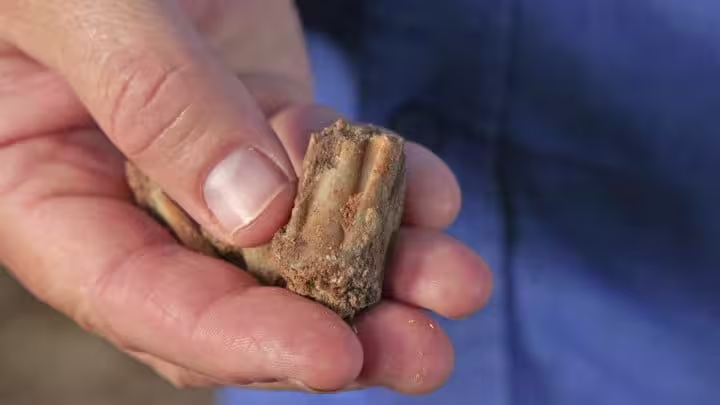
The team has launched an expanded research program to reconstruct how these early humans lived, adapted to their surroundings and pioneered new technologies during a pivotal stage of human evolution.
This article has been fact checked for accuracy, with information verified against reputable sources. Learn more about us and our editorial process.
Last reviewed on .
Article history
- Latest version
Reference(s)
- <https://www.researchgate.net/profile/Jacob-Vardi>.
- “Ron Shimelmitz.” University of Haifa <https://cris.haifa.ac.il/en/persons/ron-shimelmitz/>.
Cite this page:
- Posted by Hassan Raza