Forgotten 1666 Manuscript Reveals Secret Details About Galileo’s Mysterious Telescope Work
A long-forgotten manuscript has surfaced, revealing new clues that could challenge historical understanding of Galileo’s pioneering work with telescopes.

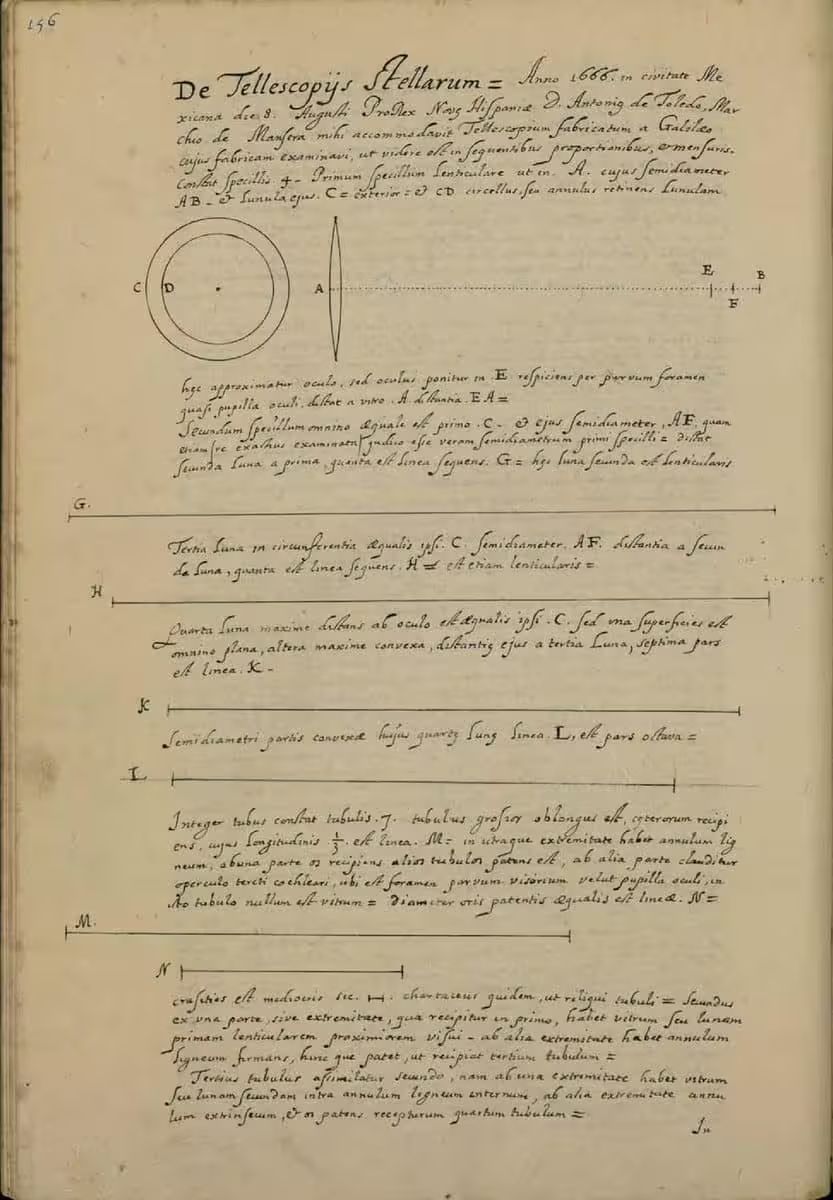
A long-lost manuscript dating back to 1666 is shedding new light on the technical evolution of early optical instruments, potentially forcing historians to rethink the timeline of Galileo Galilei’s contributions to telescope design. The document, which provides a detailed account of a four-lens terrestrial telescope attributed to the famous astronomer, suggests he may have been experimenting with complex lens configurations decades earlier than previously documented.
The discovery was made by Dr. José María Moreno Madrid, a researcher at the University of Limerick’s School of History and Geography. While examining a text titled De Tellescopiis Stellarum, authored by the Spanish Dominican friar Ignacio Muñoz, Moreno Madrid identified a specific reference to an instrument described as “fabricatum a Galilaeo,” or “manufactured by Galileo.” The findings, recently detailed in the journal Annals of Science, represent perhaps the most granular technical description currently known of a device associated with the polymath.
A Scholarly Assessment from the 17th Century
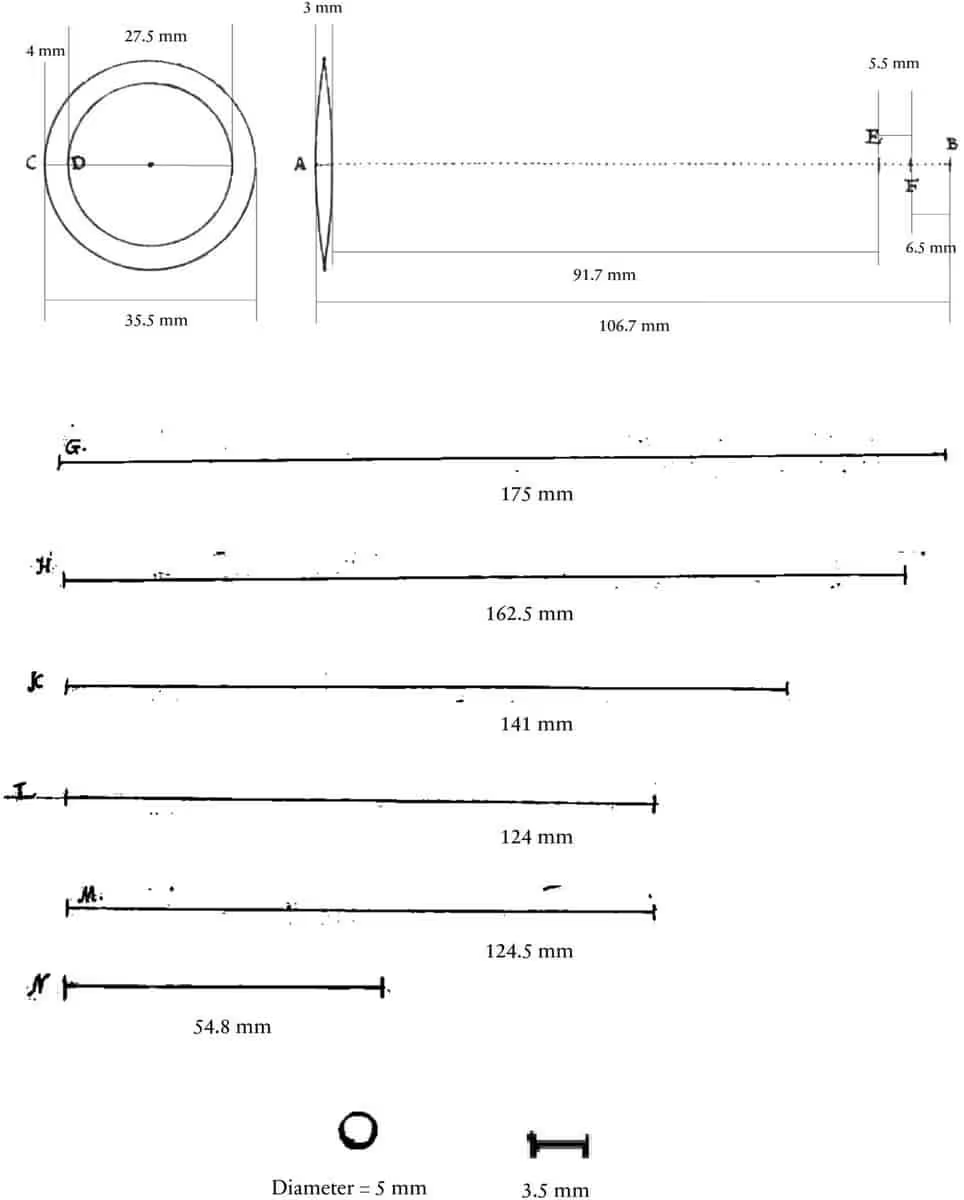
The provenance of the manuscript is tied to a test of intellect. Ignacio Muñoz, having spent time in exile, sought to return to Spain and gain favor with the monarchy by presenting a scientific proposal intended to enhance the efficiency of the Spanish fleet. To prove his credibility, the Marquis of Mancera, Antonio Sebastián de Toledo Molina y Salazar, tasked the friar with analyzing a high-quality telescope in his possession. Muñoz responded with a meticulous technical breakdown, complete with diagrams, identifying the device as a four-lens terrestrial telescope featuring an erecting eyepiece and convex lenses positioned at twice their focal length.
According to Moreno Madrid, if this telescope was indeed a product of Galileo’s workshop, it would indicate that he was actively working on four-lens designs as early as 1630. This discovery bridges a significant gap in the historical record, as Galileo left behind very few technical specifications regarding the construction of his instruments.
The Mystery of the Vanished Instrument
Confirming the existence of authentic Galileo-built telescopes has long been a challenge for historians. Galileo himself maintained that he did not sell his instruments, and very few examples from the early 17th century have survived to the present day. While two telescopes housed in a Florence museum are traditionally linked to him, their origins remain a subject of academic debate.
The Muñoz manuscript offers a rare, albeit indirect, connection. It is plausible that the telescope mentioned in the document reached the Marquis of Mancera through the Spanish royal court, as historical records confirm that Galileo gifted instruments to King Philip IV in his ongoing efforts to secure funding for his research into the “problem of longitude.” Despite this, the physical instrument described by the friar has not been located, and no further records exist to clarify its ultimate fate.
Paving the Way for Future Discovery
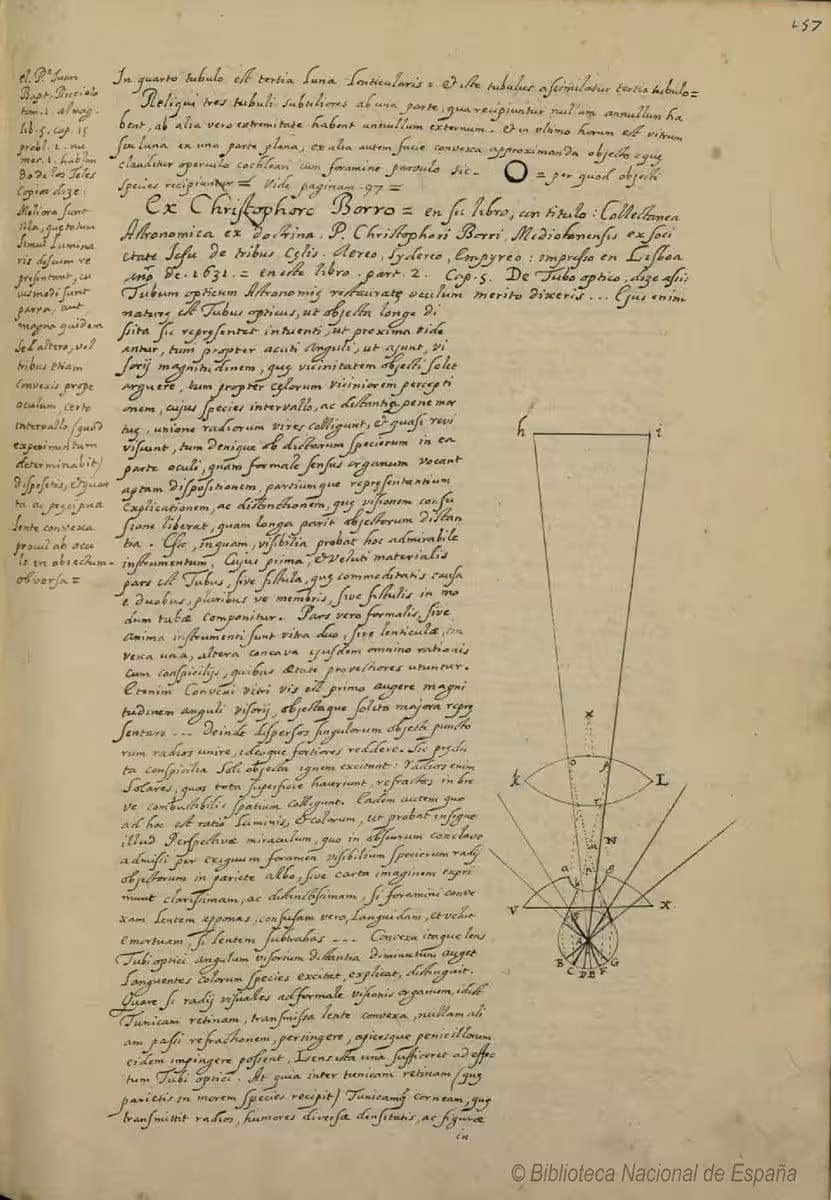
Beyond the potential link to Galileo, the manuscript serves as a valuable resource for understanding the technical sophistication of optical design in the 1600s. The optical system described by Muñoz provides a unique window into the period’s experimental methodologies, highlighting a configuration not documented in other known contemporary records.
Moreno Madrid emphasizes that the author’s background in mathematics adds weight to the accuracy of the account, providing historians with a clearer view of how scientific objects were scrutinized and exchanged during that era. “It is to be hoped that new documentary or material evidence will soon emerge to confirm the telescope’s attribution and further enhance our understanding of it,” he noted.
This article has been fact checked for accuracy, with information verified against reputable sources. Learn more about us and our editorial process.
Last reviewed on .
Article history
- Latest version
Reference(s)
- Moreno Madrid, José María. “De Tellescopiis Stellarum (1666). Was Galileo experimenting with four-lens terrestrial telescopes by 1630?.” Annals of Science, May 12, 2026, pp. 1-12. Informa UK Limited, doi: 10.1080/00033790.2026.2661195. <https://dx.doi.org/10.1080/00033790.2026.2661195>.
Cite this page:
- Posted by Aisha Ahmed