JWST spots galaxy‑killing wind 1 billion years after Big Bang, solving early‑universe mystery
Massive galaxies die fast due to galaxy-killing winds spotted in the early universe by astronomers
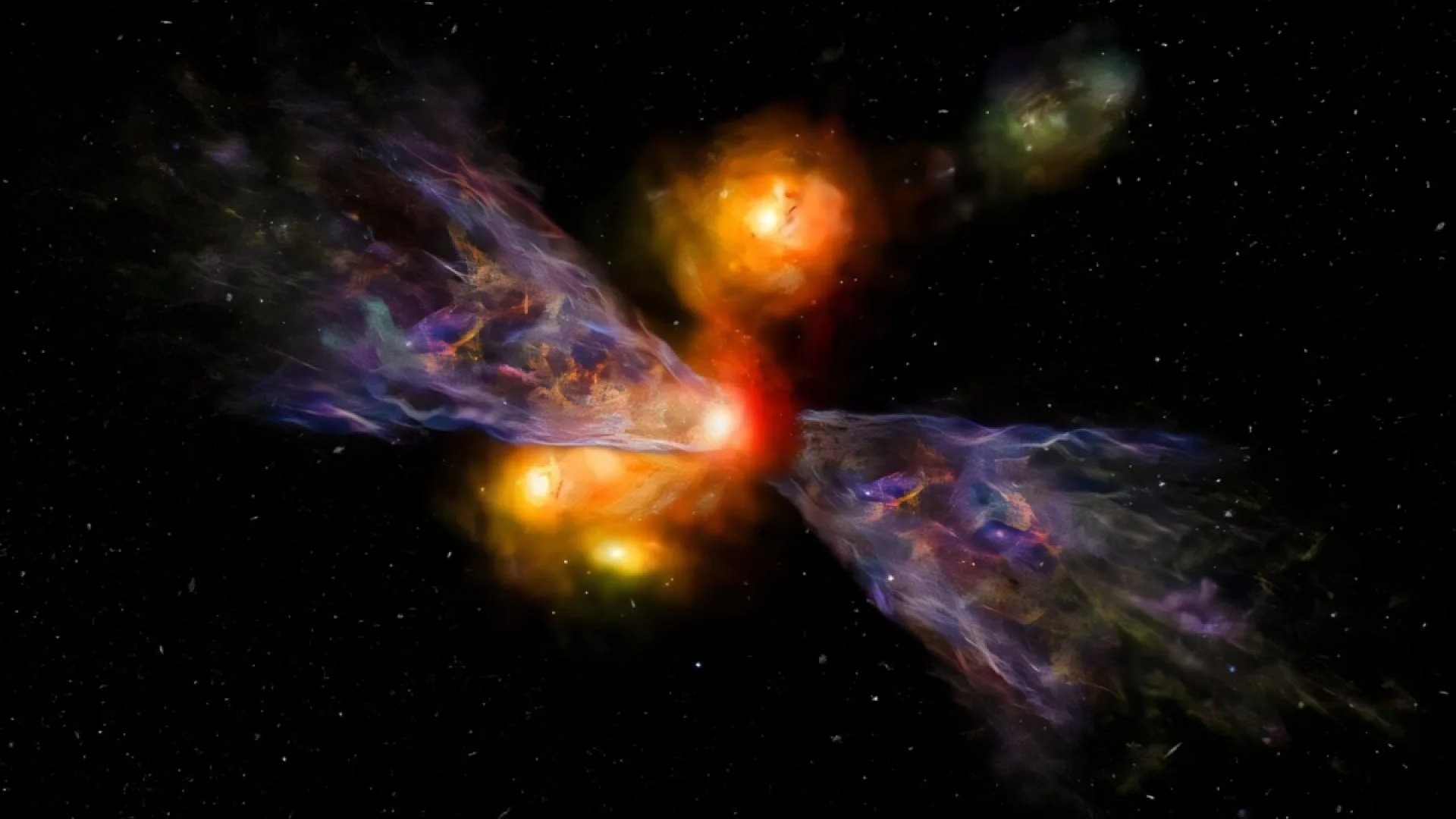
A team of astronomers has identified a powerful outflow that appears to extinguish star formation in a galaxy observed just one billion years after the Big Bang. The discovery, made with the James Webb Space Telescope (JWST) and the Atacama Large Millimeter/submillimeter Array (ALMA), offers direct evidence of a mechanism that could explain why massive galaxies cease to grow so early in cosmic history. The results were released today in the Monthly Notices of the Royal Astronomical Society.
How Galaxy Collisions Spark Violent Winds
In the young universe, galaxies were packed into dense regions where mergers were frequent and star‑formation rates were exceptionally high. These interactions drove gas toward galactic nuclei, igniting rapid starbursts that set the conditions for energetic winds to develop.
“Dense regions of the universe are like very active cities,” said lead author Dr. Rebecca Davies of Swinburne University of Technology in Melbourne, who conducted the study with Associate Professor Deanne Fisher. “Galaxies collide and undergo frenzied bursts of star formation. But when the biggest stars burn out, they explode as supernovas, launching powerful winds that blast away the very gas galaxies need to keep forming stars.”
These winds function as a galactic exhaust system, expelling the fuel needed for further star creation. Observations of the merging system CRISTAL‑02 reveal a long, cold‑gas plume extending nearly the full size of the galaxy, a clear sign of rapid gas removal.
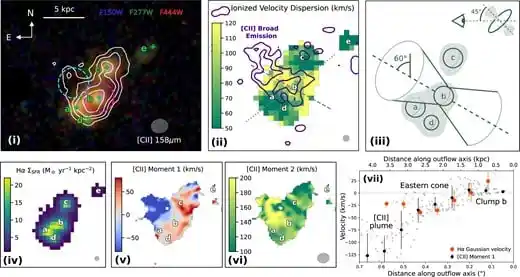
Credit: Monthly Notices of the Royal Astronomical Society.
CRISTAL‑02: A Glimpse of Early Massive Galaxies in Decline
CRISTAL‑02 is not a solitary galaxy but a cluster of interacting systems caught in the late stages of a merger, forming stars at roughly twice the rate of comparable objects. By exploiting the combined sensitivity of JWST and ALMA, the team captured the massive gas outflows streaming from the system, providing a vivid illustration of a galaxy‑quenching wind.
“The galaxy has a powerful wind that is ejecting material twice as fast as the galaxy forms stars,” Dr. Davies explained. “If this rapid blowout continues, the galaxy could be dead in less than 50 million years, explaining the origin of the mysterious massive dead galaxies in the early universe.”
This observation supports a scenario in which early massive galaxies experience brief, intense growth phases before their star‑forming reservoirs are expelled, offering a natural explanation for the prevalence of quiescent massive galaxies at high redshift.
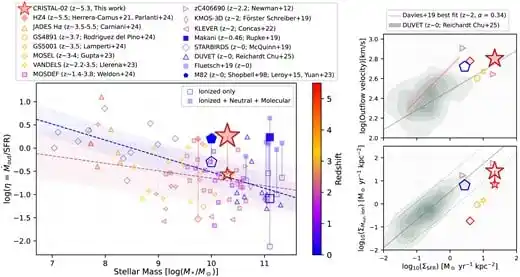
Credit: Monthly Notices of the Royal Astronomical Society.
Broader Consequences for Galaxy Formation Theory
The study, published in Monthly Notices of the Royal Astronomical Society, implies that such quenching winds were common during the epoch of early galaxy assembly rather than rare anomalies. Roughly half of massive galaxies observed at these early times show signs of ongoing interactions, suggesting that violent mergers and rapid starbursts were the rule rather than the exception.
“Almost half of early massive galaxies are interacting with other nearby galaxies, suggesting this isn’t a quirk but a widespread cosmic phenomenon,” Dr. Davies added. “If many early galaxies collide and experience rapid growth, then it may not be surprising that we see so many dead galaxies in the early universe. CRISTAL‑02 offers a natural solution to the mystery of why these massive galaxies live fast and die young.”
These findings add a vital piece to the puzzle of how the first massive structures formed, evolved, and ultimately quenched, refining models that must now accommodate both swift assembly and abrupt termination.
The JWST–ALMA Era Opens a New Window on Cosmic History
The detection underscores the combined power of JWST and ALMA for probing the universe’s formative stages. By directly imaging phenomena such as galaxy‑killing winds, astronomers can now trace the full life cycle of the earliest massive galaxies, from rapid growth through violent merger‑driven outflows to eventual quiescence.
CRISTAL‑02 illustrates that the first generation of massive galaxies burned brightly but briefly, their lifespans cut short by self‑generated winds that clear out the material needed for further star formation.
This article has been fact checked for accuracy, with information verified against reputable sources. Learn more about us and our editorial process.
Last reviewed on .
Article history
- Latest version
Cite this page:
- Posted by Aisha Ahmed