Astronomers Discover Two Massive Stars That Collided in a Chaotic Cosmic Dance
Astronomers have reconstructed a massive protostellar encounter, revealing an unexpected new way that close binary star systems are formed in space.
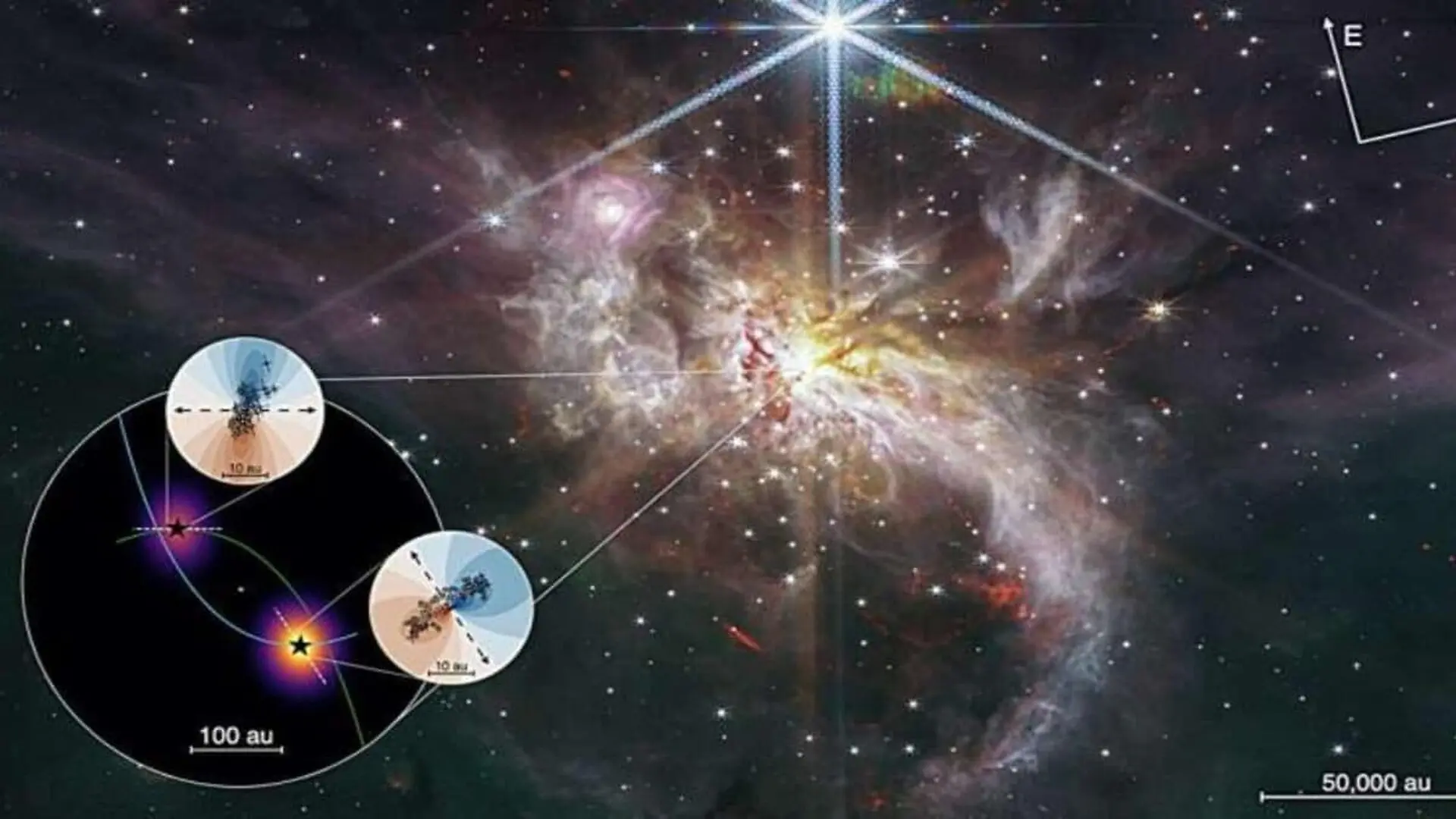
Astronomers have unveiled the turbulent origins of a massive binary star system, providing new evidence that some stellar pairs are born independently before being thrust together by gravitational chaos. The study, published in Nature Astronomy, offers a rare, three-dimensional look at the protostellar system IRAS 07299−1651 while it is still actively accumulating mass.
Tracking Stellar Development in Real Time
While massive binary stars are prevalent throughout the Milky Way, researchers typically study them long after their initial formation has smoothed out their structural quirks. IRAS 07299−1651 is different. Because its two massive protostars are still growing, they provide a window into the formative processes that usually vanish as a system matures.
Led by Yichen Zhang of Shanghai Jiao Tong University, an international research team utilized the Atacama Large Millimeter/submillimeter Array (ALMA) to monitor the precise movements of these protostars over an eight-year period. This extended timeline allowed the team to map the system’s orbital dynamics with enough precision to resolve its architecture in three dimensions, challenging earlier assumptions that the pair originated from the simple fragmentation of a single, uniform rotating disk.
A Multi-Observatory Synthesis
To fully reconstruct the system, the scientists synthesized data from ALMA, the U.S. National Science Foundation’s Very Large Array (VLA), the James Webb Space Telescope (JWST), and the Very Large Telescope (VLT). By integrating radio and infrared observations, the team could correlate three critical markers: the orbital trajectory of the stars, the orientation of their individual disks, and the direction of their energetic outflows.
Co-author Rubén Fedriani noted that each facility contributed a vital piece of the puzzle. By combining different wavelengths, the team could differentiate between what appeared to be aligned on the sky and the true, complex geometry of the system in space. This depth of data was essential to debunking the theory of a shared, orderly birth.
Evidence of a Recent Gravitational Dance
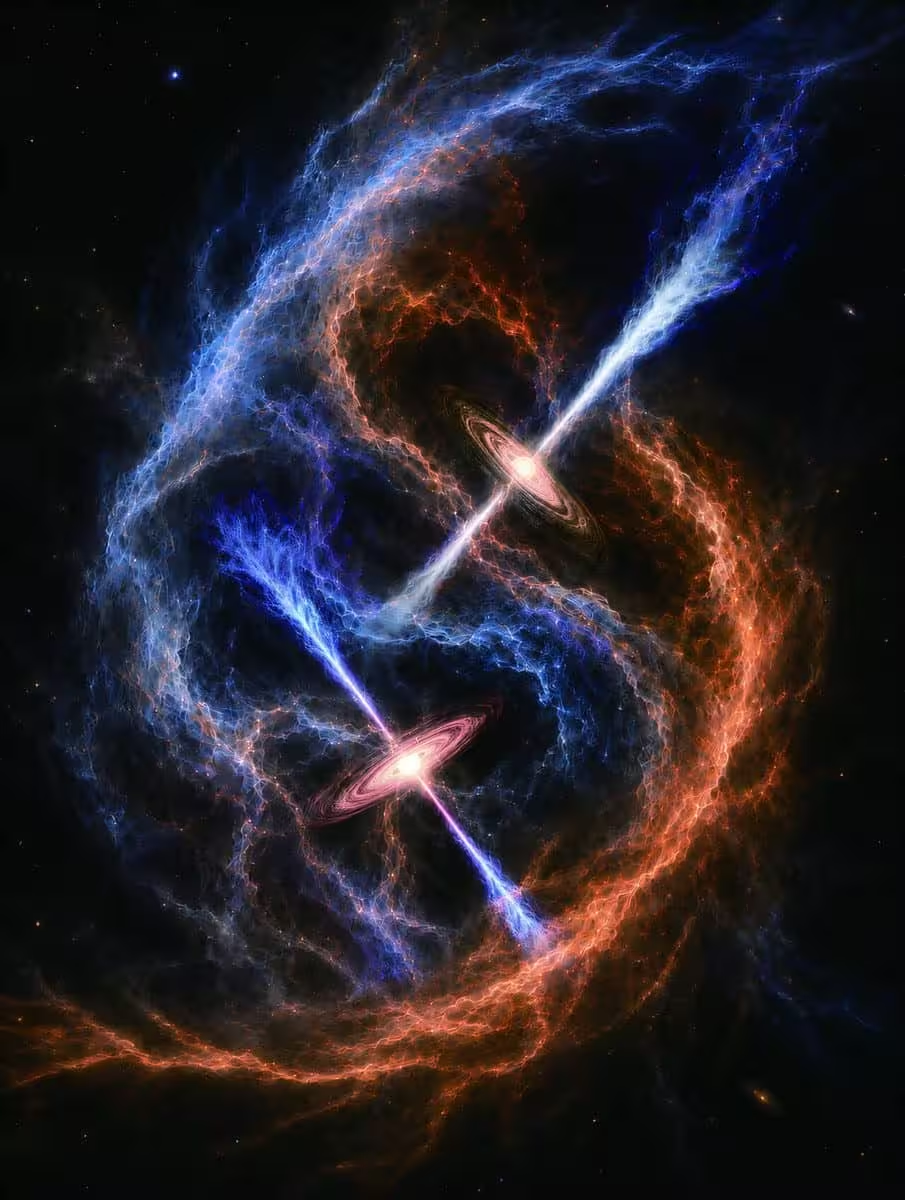
The findings indicate that the stars follow a highly eccentric, nearly parabolic orbit. Furthermore, the small disks surrounding each protostar are significantly tilted, both relative to each other and to the orbital plane. If the stars had shared a single parent disk, one would expect a much higher degree of geometric symmetry. The observed misalignment and eccentric path instead suggest that the two stars acquired their angular momentum in isolation.
“It felt like solving a three-dimensional puzzle,” said lead author Yao Wang. “Each new observation added another piece, and eventually the orbit, disks and jets all came together into a single, coherent picture.”
The data suggests that a close gravitational encounter between the two independently forming protostars likely occurred only about 60 years ago—a mere blink of an eye in astronomical terms. This implies that astronomers are observing the aftermath of a dynamic collision or near-miss that reorganized the system’s architecture without destroying the individual disks surrounding the protostars.
This discovery provides a compelling alternative to the standard model of binary formation. Given that roughly 90% of massive stars exist within binary or multiple systems, understanding how these chaotic encounters shape their evolution is fundamental to grasping the life cycle of the most massive stars in the universe. As co-author Jonathan C. Tan remarked, the study confirms that the early stages of stellar growth can be surprisingly volatile, driven by chance interactions that dictate the future of entire systems.
This article has been fact checked for accuracy, with information verified against reputable sources. Learn more about us and our editorial process.
Last reviewed on .
Article history
- Latest version
Reference(s)
- Wang, Yao. “An eccentric massive protobinary assembled via a core-merger parabolic encounter - Nature Astronomy.”, September 7, 2026, pp. 1-14. Nature, doi: 10.1038/s41550-026-02953-z. <https://www.nature.com/articles/s41550-026-02953-z>.
Cite this page:
- Posted by Aisha Ahmed