Astronomers Discover Massive Hot Jupiter That Will Vanish From View by 2033
Astronomers have discovered TOI-1355 b, a massive, eccentric hot Jupiter that will vanish from our view by 2033, limiting our window to study its system.

Astronomers have identified a rare and volatile exoplanet, TOI-1355 b, that is currently providing a front-row seat to the dramatic orbital evolution of a gas giant. Located approximately 805 light-years from our solar system, the planet orbits an early A-type star in a highly elliptical path that is rapidly drifting out of our line of sight.
The planet, which is roughly 5.8 times the mass of Jupiter and 1.4 times its radius, completes a full orbit around its host star every 2.17 days. Unlike the majority of “hot Jupiters” found circling hot stars, which typically maintain near-circular paths, TOI-1355 b features an orbital eccentricity of 0.2203. This distinct behavior makes it a primary candidate for studying high-eccentricity migration, a process where gravitational forces push a planet into an elongated orbit before tidal interactions eventually force it to stabilize.
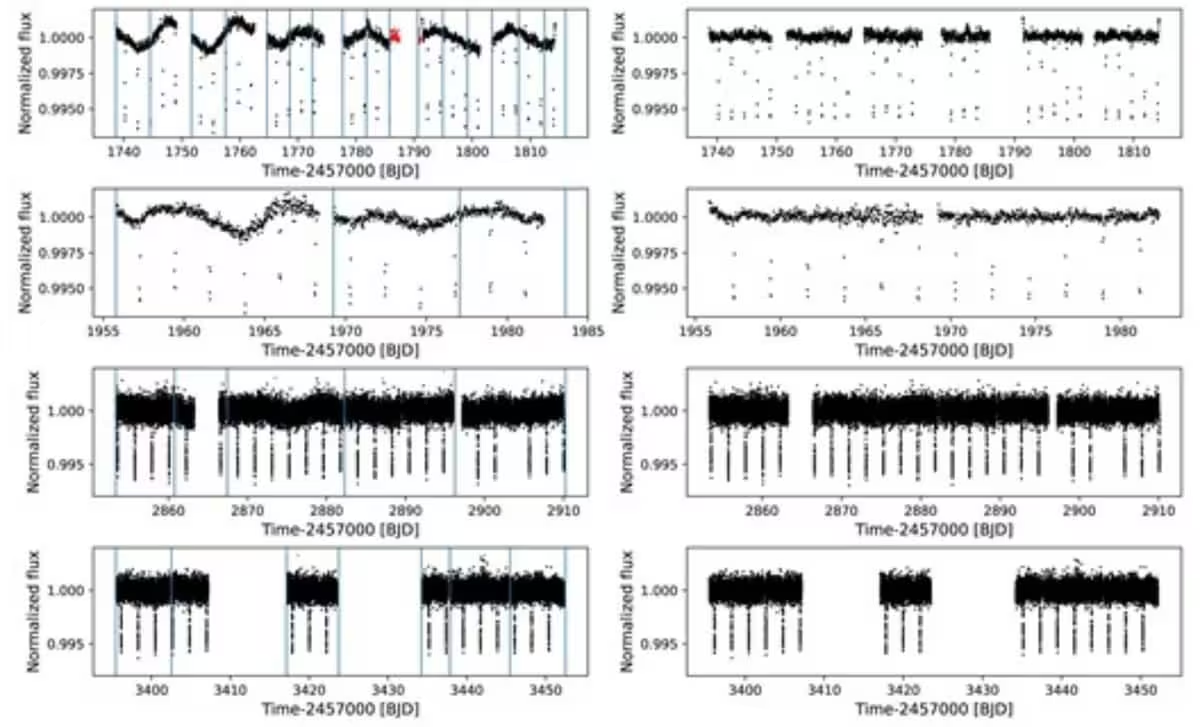
Data gathered by NASA’s Transiting Exoplanet Survey Satellite (TESS) between 2019 and 2024 allowed researchers to map the shifting geometry of the planet’s transit. Their findings, published in the Publications of the Astronomical Society of Japan, indicate that the planet is undergoing nodal precession, causing its orbital plane to tilt over time.
A Closing Window for Observation
The impact parameter, which tracks the planet’s path across the face of the star, has been steadily increasing at a rate of 0.01633 per year. By early 2024, the planet reached a “grazing” configuration, skimming the very edge of the stellar disk. If this rate of movement remains consistent, TOI-1355 b will cease to transit its star entirely by mid-2033, effectively vanishing from our view until its orbit evolves again.
The system also presents a mystery regarding its atmospheric stability. Observations revealed significant, unexplained fluctuations in the planet’s brightness temperatures between 2019 and 2024. While some of these variations may stem from thermal inversions caused by chemical species like titanium or vanadium oxide, researchers noted that the phase shifts measured in 2020 and 2022 were statistically significant, suggesting potential atmospheric variability that requires further investigation.
Calculations regarding the planet’s circularization timescale suggest that if the system is as old as estimated—around 370 million years—it should have theoretically settled into a more circular orbit by now. The fact that it remains eccentric implies the planet may have reached its current configuration relatively recently, or that current models for tidal energy dissipation in gas giants require refinement.
For astronomers, TOI-1355 b serves as a time-sensitive laboratory. As the transit window narrows, researchers are racing to gather as much data as possible before the planet drifts out of sight, potentially offering the last clear look at this rapidly evolving world for the foreseeable future.
This article has been fact checked for accuracy, with information verified against reputable sources. Learn more about us and our editorial process.
Last reviewed on .
Article history
- Latest version
Cite this page:
- Posted by Karan Das