NASA Rover Finds Mysterious Leopard Spots on Mars That Could Be Evidence of Ancient Life
A rock sample collected by the Perseverance rover may finally hold the key to solving a long-standing mystery about Mars’ geological history.
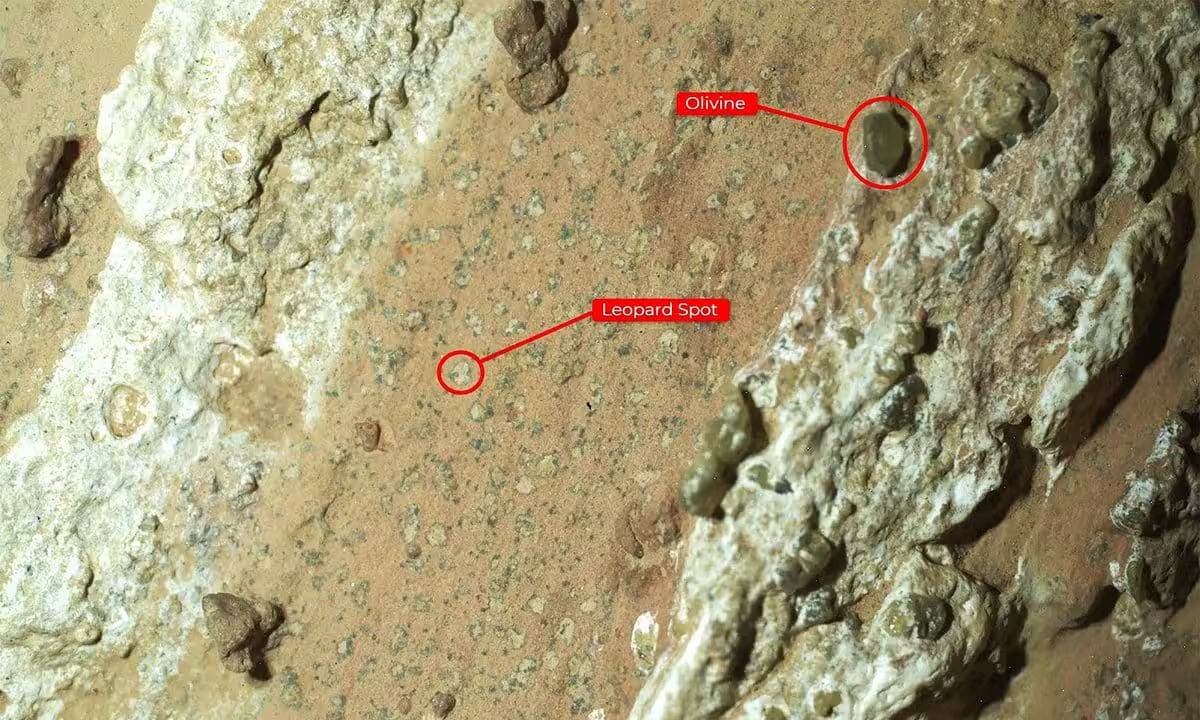
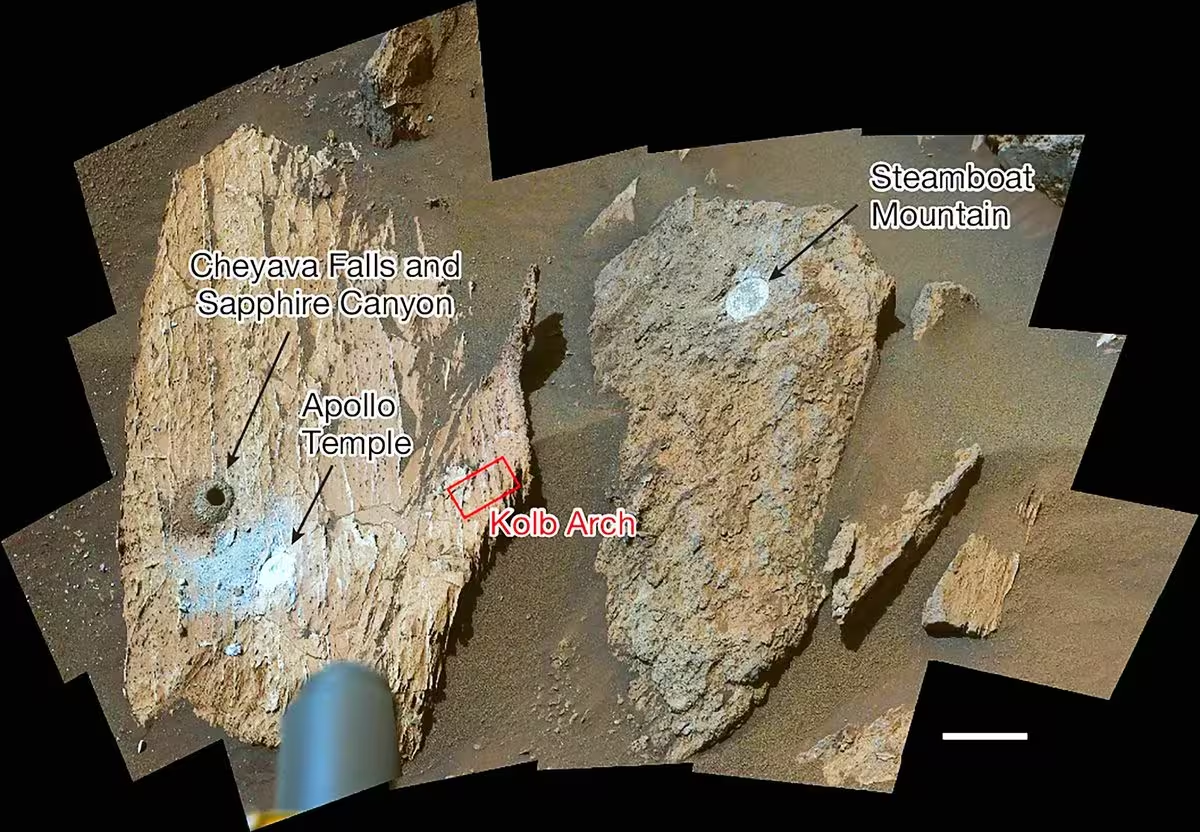
NASA’s Perseverance rover has uncovered a mysterious, arrowhead-shaped rock on the floor of a dried-out Martian valley that has sparked intense scientific debate regarding the potential for ancient life. The specimen, dubbed Cheyava Falls, was discovered in July 2024 at the edge of Neretva Vallis, a channel that once fed water into Jezero Crater. Measuring roughly 3.2 by 2 feet, the rock features distinct, reddish surfaces marked by intriguing “leopard spots” and tiny, millimeter-wide specks, leading researchers to extract a core sample now known as Sapphire Canyon.
In a study published in Nature on September 10, 2025, a research team led by Joel Hurowitz of Stony Brook University identified these markings as being enriched with iron minerals, specifically vivianite and greigite. Crucially, the surrounding mudstone contains organic carbon, which appears to have reacted with the sediment at low temperatures long after the material was deposited on the lake bottom.
Biological Mimicry or Microbial Metabolism?
While the team is careful not to confirm the discovery of alien life, they suggest that the chemical signatures observed in Cheyava Falls are characteristic of metabolic processes performed by microbes on Earth. Geobiologist and co-author Michael Tice of Texas A&M University noted that the rock exhibits patterns that are relatively simple to explain through ancient biological activity but extremely difficult to replicate through geological processes alone. NASA has officially categorized these findings as a potential biosignature, indicating that further investigation is required before any definitive conclusions can be drawn.
The rock originates from the Bright Angel formation, a region composed of light-toned mudstone rich in sulfur, phosphorus, oxidized iron, and organic carbon. According to Hurowitz, this chemical environment would have provided a viable source of energy for microbial life. Tice emphasized that the specific arrangement of minerals within the spots points to the cyclical processing of iron and sulfur—a process often driven by microbes that “breathe” these compounds while consuming organic matter.
Eliminating Non-Biological Origins
The primary challenge for researchers is that non-biological factors can also produce vivianite and greigite, typically through high-temperature reactions or acidic conditions. However, the data gathered by Perseverance suggests that the Bright Angel rocks were never subjected to the intense heat required for these inorganic chemical pathways. “If that is the case,” Tice stated, “we have to seriously consider the possibility that they were made by creatures like bacteria living in the mud in a Martian lake more than three billion years ago.”
Despite the compelling evidence, the team remains cautious. Project scientist Katie Stack Morgan of NASA’s Jet Propulsion Laboratory stated that while abiotic explanations are considered less probable, they cannot yet be entirely ruled out. The difficulty lies in the fact that terrestrial rocks of a similar age (3.2 to 3.8 billion years old) have been subjected to plate tectonics, which effectively cooks and alters the geological record, making direct comparisons between Earth and Mars challenging.
The Need for Sample Return
To move beyond these preliminary observations, scientists require the advanced analytical capabilities of laboratories on Earth, which can search for microfossils and analyze isotopic signatures. The Sapphire Canyon sample, currently stored in a tube aboard the rover, remains the key to unlocking this mystery. As Reuters reported, the future of the Mars Sample Return mission faces ongoing budgetary scrutiny, yet the scientific community remains focused on the potential to finally answer whether these Martian features are the remnants of ancient life or a clever imitation by nature.
This article has been fact checked for accuracy, with information verified against reputable sources. Learn more about us and our editorial process.
Last reviewed on .
Article history
- Latest version
Reference(s)
- Hurowitz, Joel. “Redox-driven mineral and organic associations in Jezero Crater, Mars - Nature.”, vol. 645, no. 8080, pp. 332-340. Nature, doi: 10.1038/s41586-025-09413-0. <https://www.nature.com/articles/s41586-025-09413-0>.
- Reuters, “NASA rover finds potential sign of ancient life in Martian rocks.”, September 13, 2025 Citizen Digital <https://citizen.digital/article/nasa-rover-finds-potential-sign-of-ancient-life-in-martian-rocks-n369599>.
Cite this page:
- Posted by Karan Das