NASA Gravity Data Reveals Mysterious Hidden Structure Beneath The Surface Of Mars
New gravity measurements have uncovered a hidden structure deep within Mars, potentially rewriting our understanding of the Red Planet’s evolutionary history.
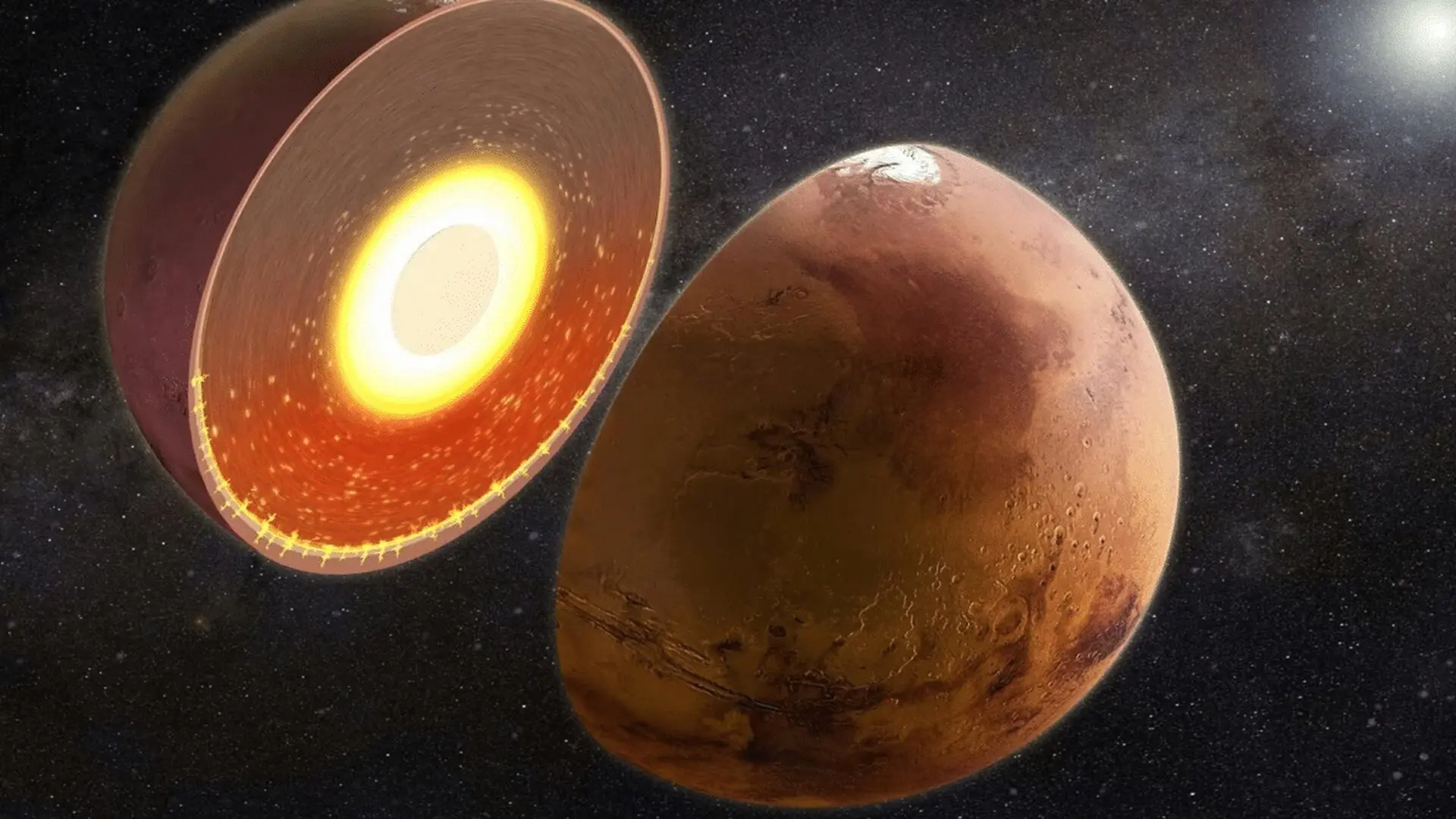
New data gathered from NASA’s retired InSight mission has revealed that the interior of Mars is far more asymmetric than scientists previously envisioned. By mapping subtle gravitational fluctuations across the planet, researchers have uncovered a complex, three-dimensional internal structure that challenges long-standing models of how rocky planets evolve beneath their crusts.
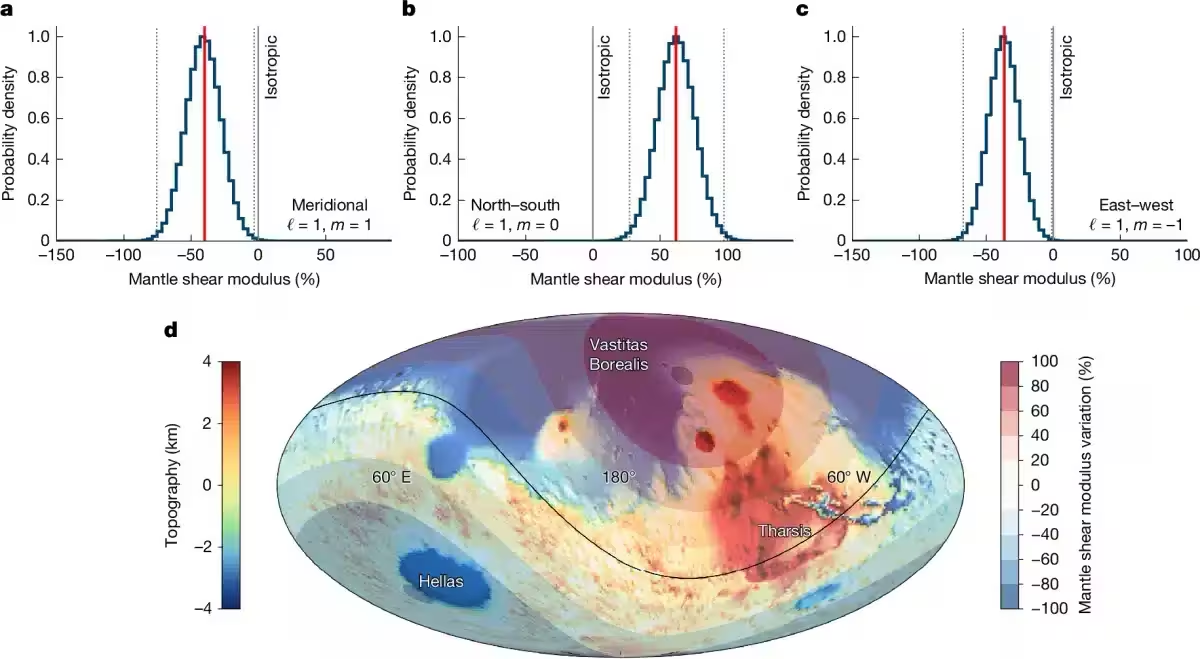
The findings, published in Nature, provide a fresh perspective on the Martian dichotomy—the stark, visible difference between the planet’s cratered southern highlands and its relatively smooth northern lowlands. While this surface contrast has been a subject of study for decades, this new geophysical analysis suggests that the divide extends deep into the Martian mantle, pointing to a history of violent geological processes and uneven cooling that shaped the planet billions of years ago.
Moving Beyond Simple Planetary Models
For years, the standard assumption in planetary science has been that rocky worlds are largely spherically symmetric in their interior composition. However, the latest gravitational modeling suggests this is an oversimplification. By analyzing how density variations deep within the mantle influence the planet’s gravitational pull, researchers have identified distinct, asymmetrical layers that indicate Mars did not develop as a uniform sphere.
“Scientists usually assume that the interiors of planetary bodies are generally spherically symmetric, but this is not necessarily true,” says Berne, a researcher associated with the study. “As we get more gravity data, we can determine the three-dimensional intricacies of a planet’s interior structure. These inferences in turn give us a blueprint for designing future missions and scientific exploration of these worlds.”
Clues to Ancient Hydrology
The internal asymmetry may also provide a critical missing piece of the puzzle regarding Mars’ ancient climate and water history. The Martian dichotomy is not just a surface curiosity; it appears to be tied to thermal and compositional differences deep underground that likely influenced how water accumulated and moved across the surface eons ago.
Amirhossein Bagheri, a postdoctoral scholar at Caltech and co-author of the study, notes that the interior structure likely dictated the formation of massive basins, some of which are believed to have harbored liquid water. “The dichotomy that we see between north and south is important to understand because it gives information about processes that may have influenced the hydrology of Mars, including the formation of basins that may have held water,” says Bagheri, who previously served on the InSight mission team.
A Roadmap for Future Exploration
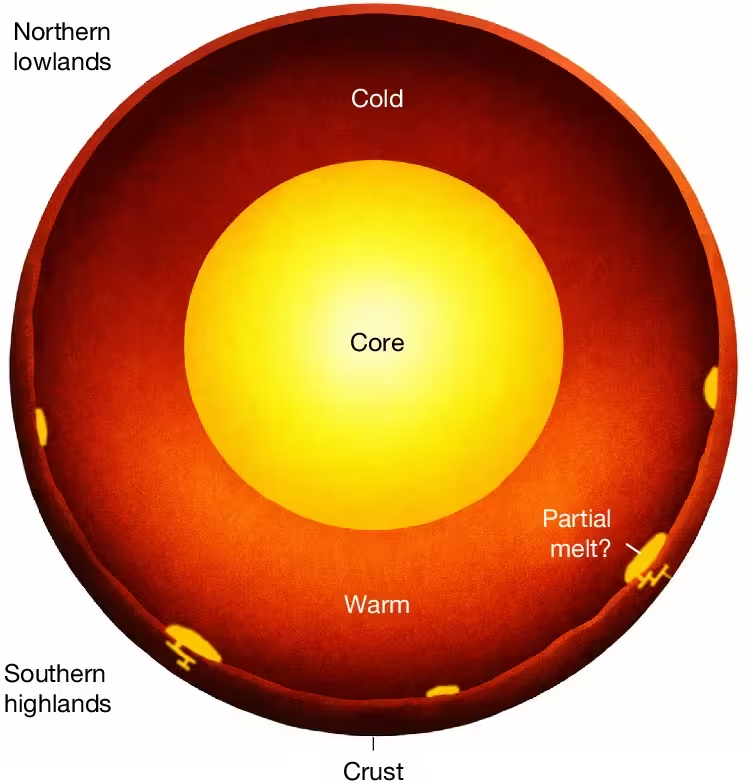
The implications of this study reach beyond the Red Planet, offering a new framework for comparing Mars with Earth, the Moon, and other terrestrial worlds. By confirming that Mars possesses significant internal thermal anomalies—such as a warm mantle region beneath the southern highlands that may have driven ancient volcanic activity—scientists can better interpret why certain planets maintain geological activity while others become dormant.
These revelations essentially provide a new, high-resolution map for future exploration. As international space agencies look toward potential landing sites for robotic or human missions, understanding the subsurface geological and thermal landscape becomes paramount. By combining the data legacy of the InSight lander with next-generation orbital sensors and seismic arrays, researchers are finally beginning to see that the most significant secrets of Mars are not just written on its dusty surface, but are buried deep within its core.
This article has been fact checked for accuracy, with information verified against reputable sources. Learn more about us and our editorial process.
Last reviewed on .
Article history
- Latest version
Reference(s)
- “S41586 026 10893 X.” <https://www.nature.com/articles/s41586-026-10893-x>.
Cite this page:
- Posted by Karan Das