Mars Gullies Are Not Formed By Water And Scientists Finally Know Why
Scientists once believed flowing water carved Mars’ mysterious channels. New research reveals the surprising, icy truth behind these alien landscapes.
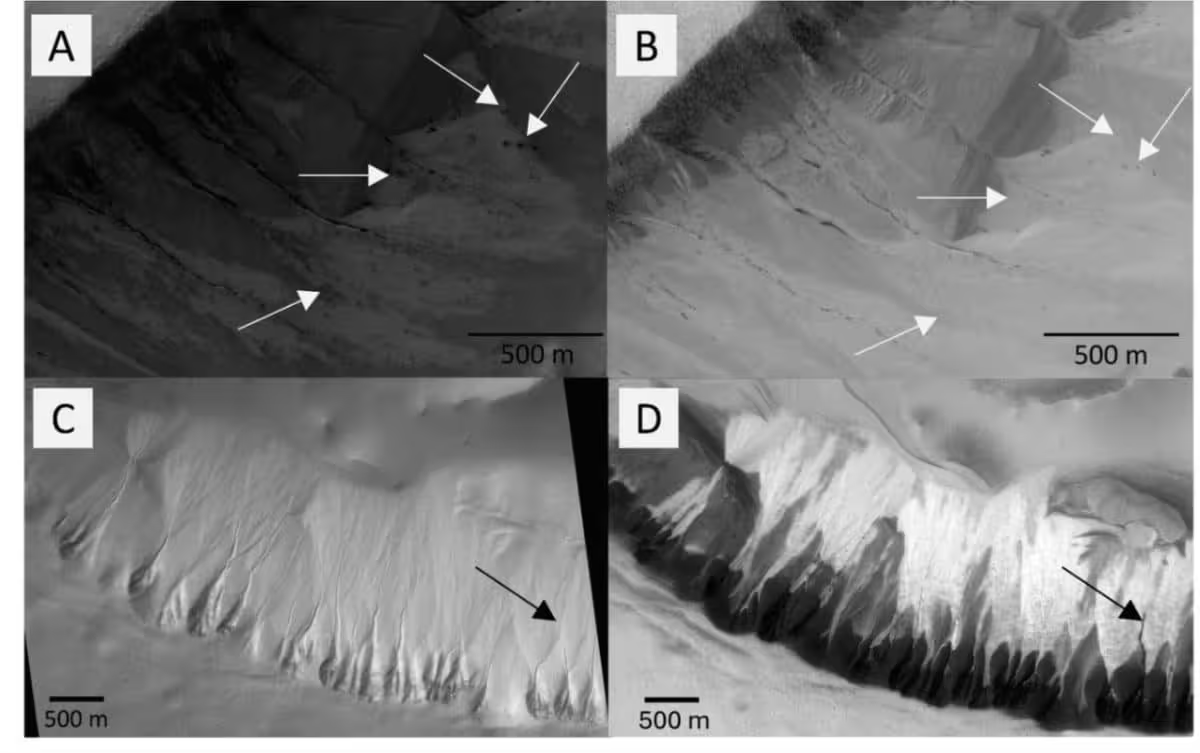
For years, the rugged, carved terrain of Mars has teased planetary scientists with the suggestion of flowing water. These gullies bear an uncanny resemblance to the channels and debris fields sculpted by rain and rivers on Earth, prompting decades of debate over whether liquid water could still be actively reshaping the Martian surface. However, new evidence suggests that the primary architect behind these features is not water, but a volatile dance of seasonal carbon dioxide ice.
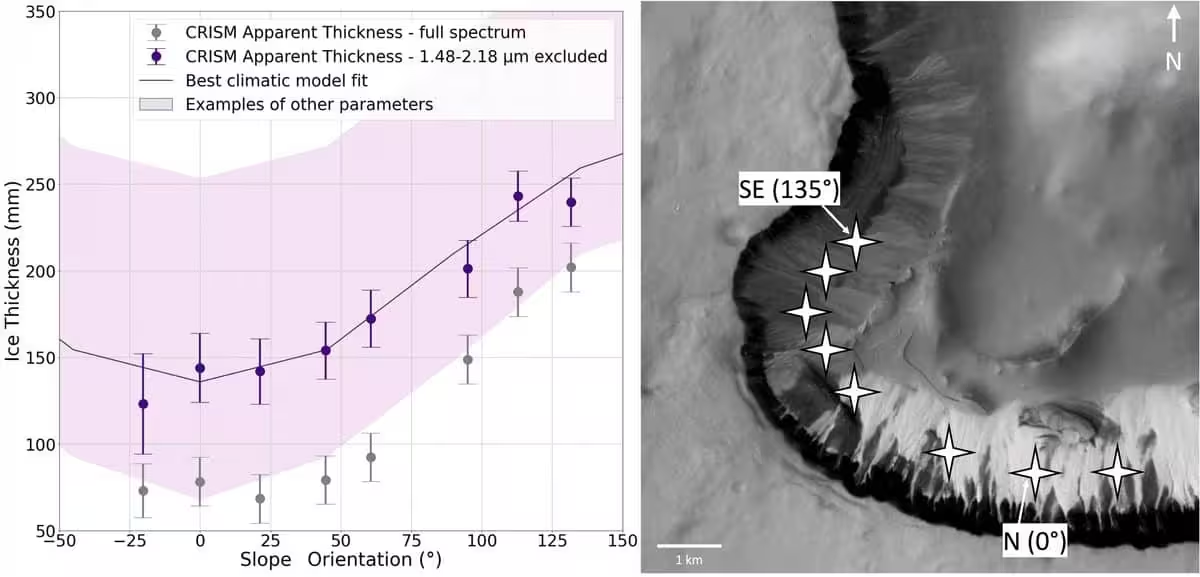
A study led by Apolline Leclef of the Institut d’Astrophysique Spatiale at Université Paris-Saclay, recently released as a preprint on arXiv, shifts the focus toward the extreme polar environment of the Sisyphi Cavi region. By analyzing data from NASA’s Mars Reconnaissance Orbiter (MRO) and the European Space Agency’s Mars Express, the research team sought definitive proof of liquid water. Using high-resolution spectroscopy from the MRO’s Compact Reconnaissance Imaging Spectrometer and the Mars Express OMEGA instrument, they searched for the distinct spectral signature of water at 1.5 micrometers. That signal remained conspicuously absent during the crucial spring thaw, effectively ruling out water as the primary catalyst for the observed gully activity.
Challenging the Geyser Hypothesis
Early theories suggested that Martian gullies might be the work of seasonal geysers. On Mars, sunlight can penetrate translucent layers of dry ice, warming the dark soil trapped beneath. This process causes the subterranean carbon dioxide to sublimate into gas, eventually building enough pressure to crack the surface and launch jets of dark dust and sand into the air. While these explosive events clearly occur, their timing does not align with the formation of the gullies. Satellite imagery confirms that these geyser eruptions peak during the spring equinox, whereas the active carving of gullies occurs later in the spring season, indicating a different physical mechanism at play.
A Mechanism Based on Frost Fluidization
The research team proposes an alternative: carbon dioxide frost fluidization. As the seasons shift, the escaping gas from sublimating frost beneath the surface may create a frictionless, pressurized cushion. Much like a puck gliding across an air hockey table, this process allows mixtures of dry ice and Martian sediment to slide down steep slopes with minimal resistance. This “lubricated” flow creates enough geological momentum to carve out distinct channels and deposit mounds of material that appear, at a distance, to be the product of water erosion.
This finding suggests that the Martian landscape is far more dynamic than previously assumed, driven by the unique interplay of its thin atmosphere, seasonal temperature fluctuations, and the physical properties of carbon dioxide. By identifying this frost-driven process, scientists have uncovered a way for the Red Planet to sculpt its own surface without requiring the presence of liquid water.
This article has been fact checked for accuracy, with information verified against reputable sources. Learn more about us and our editorial process.
Last reviewed on .
Article history
- Latest version
Reference(s)
- “arXiv.org e-Print archive.” <https://arxiv.org/>.
- Cermak, Alicia. “Mars Reconnaissance Orbiter - NASA Science.”, December 5, 2017 NASA <https://science.nasa.gov/mission/mars-reconnaissance-orbiter/>.
- Cermak, Alicia. “Mars Express - NASA Science.”, December 5, 2017 NASA <https://science.nasa.gov/mission/mars-express/>.
Cite this page:
- Posted by Karan Das