Scientists Discover Mercury Has Been Shrinking More Than We Ever Imagined
Mercury is shrinking faster than previously thought, as new research reveals that impact debris masked signs of the planet’s ongoing geological contraction.
New evidence suggests Mercury has undergone significantly more structural contraction than previously estimated. A study published on September 10, 2026, in Geophysical Research Letters indicates that the innermost planet of our solar system may have shrunk by 10% to 30% more than earlier models predicted. Lead researcher Gaku Nishiyama, from the German Aerospace Center’s Institute of Space Research, estimates that the planet’s diameter has decreased by as much as 14.5 miles (23 kilometers) since its formation.
Impact Debris Obscured the Planet’s Shrinking History
As Mercury cooled over eons, its rocky mantle compressed, forcing the crust to buckle and fold. This process created distinct geological markers known as shortening structures, including ridges and scarps. Historically, researchers mapped these features to calculate the extent of the planet’s volume loss. However, this method appears to have underestimated the true scale of the contraction.
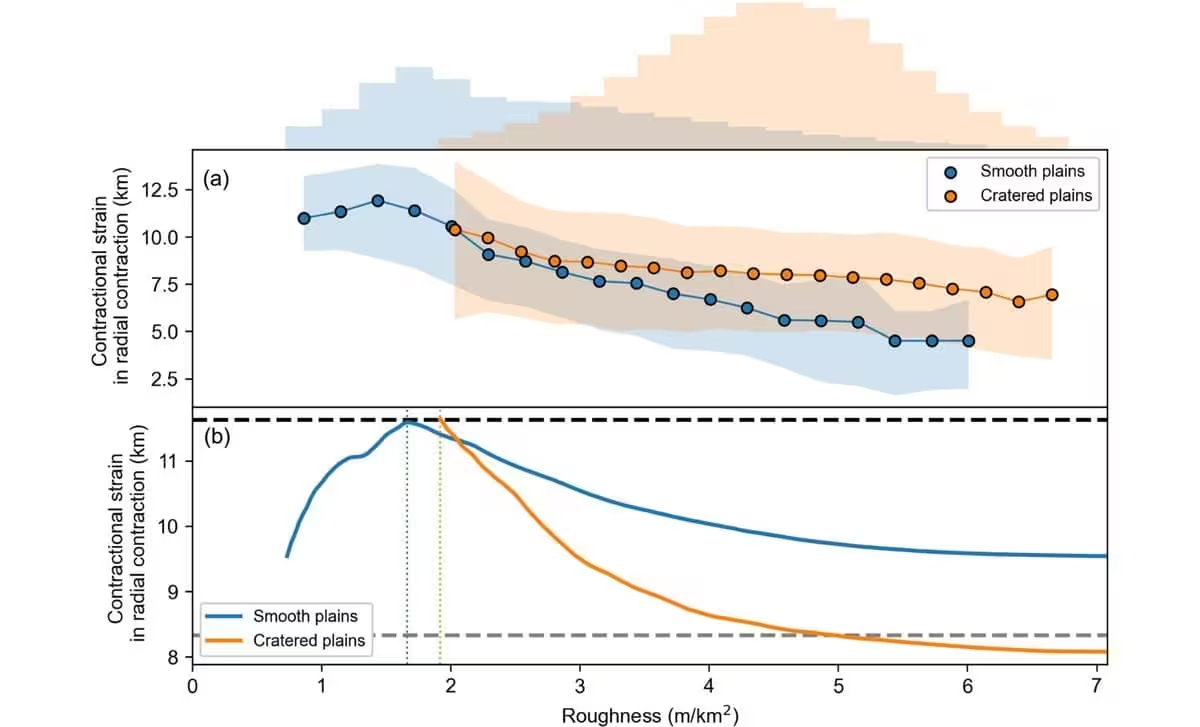
Nishiyama and his team discovered that significant portions of this tectonic record are buried under debris from ancient asteroid impacts. By comparing a global map of surface roughness with the distribution of known tectonic structures, the researchers identified a correlation: areas with highly fragmented, rough terrain showed a marked absence of visible ridges and scarps. Near major impact sites, such as the Rachmaninoff crater, debris appears to have blanketed the tectonic evidence. “Mercury appears to have shrunk considerably more than what the visible tectonic record alone suggested,” noted Nishiyama in the study.
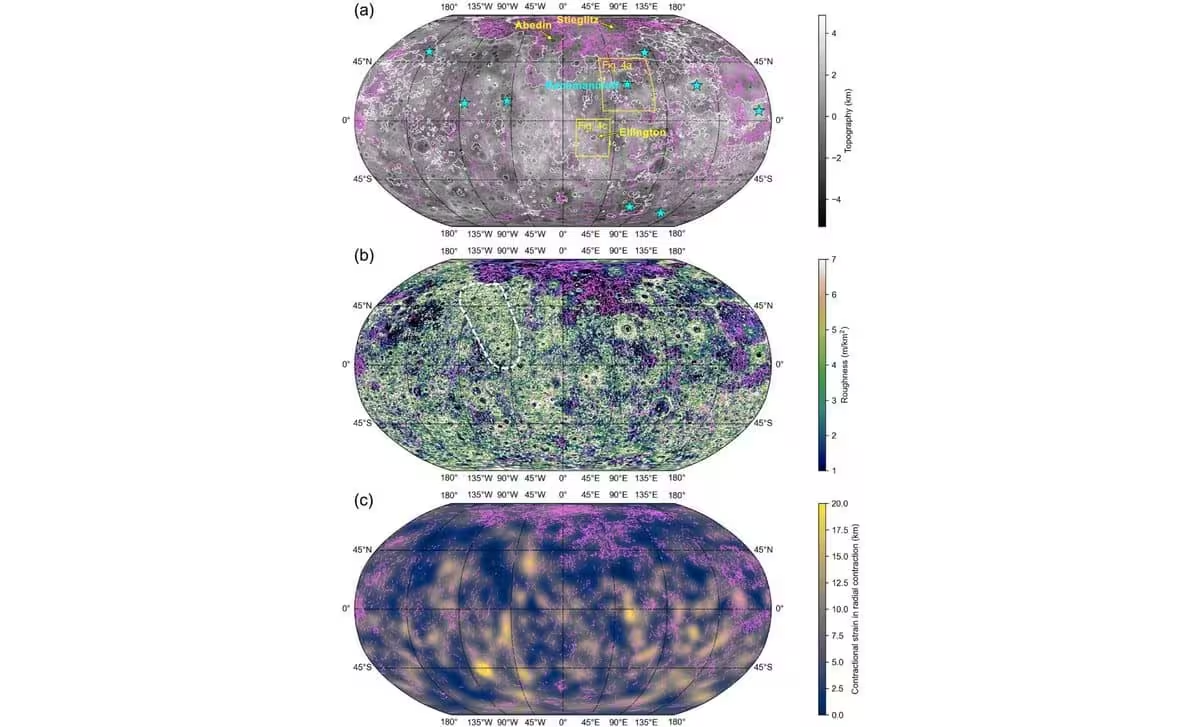
This revision aligns Mercury’s observed state more closely with existing thermal evolution models. Understanding the precise extent of this shrinkage is crucial for planetary scientists, as it provides indirect data regarding the size of Mercury’s metal core, the concentration of light elements like silicon, and the planet’s initial heat state shortly after the solar system formed.
Anticipating High-Resolution Data from BepiColombo
While the findings offer a more accurate picture, current datasets remain limited. Data gathered by NASA’s MESSENGER mission, which concluded in 2015, only allows for the identification of surface features larger than 5 kilometers (3 miles). This technological ceiling suggests that even more subtle evidence of contraction may still be hidden from view.
The scientific community is now looking toward the BepiColombo mission, a collaborative effort between the European Space Agency and Japan’s JAXA. As the craft prepares to enter orbit around Mercury in November 2026, its advanced laser instrumentation is expected to provide high-resolution imaging of the planet’s ridges and scarps. These upcoming measurements should clarify whether further undiscovered features exist.
The implications of this research extend beyond Mercury. The methodology developed by Nishiyama’s team suggests that surface roughness may be masking similar tectonic histories on other rocky celestial bodies, including our own Moon. By refining how we account for impact-related interference, geologists may gain a clearer understanding of how planetary crusts respond to the long-term cooling of their interiors.
This article has been fact checked for accuracy, with information verified against reputable sources. Learn more about us and our editorial process.
Last reviewed on .
Article history
- Latest version
Reference(s)
- Nishiyama, G.., et al. “Underestimation of Planetary Contraction Due To Obscuration by Surface Roughness: The Case of Mercury.” Geophysical Research Letters, vol. 53, no. 17, September 10, 2026 American Geophysical Union (AGU), doi: 10.1029/2026GL124067. <https://agupubs.onlinelibrary.wiley.com/doi/10.1029/2026GL124067>.
- “BepiColombo.” <https://www.esa.int/Science_Exploration/Space_Science/BepiColombo>.
Cite this page:
- Posted by Karan Das