Why Black Phosphorus Is Finally Crossing From Lab Curiosities to Real Devices
Recent advances in interface engineering, reversible passivation, and cross-application metrics are transforming fragile phosphorene nanosheets into stable, functional materials.
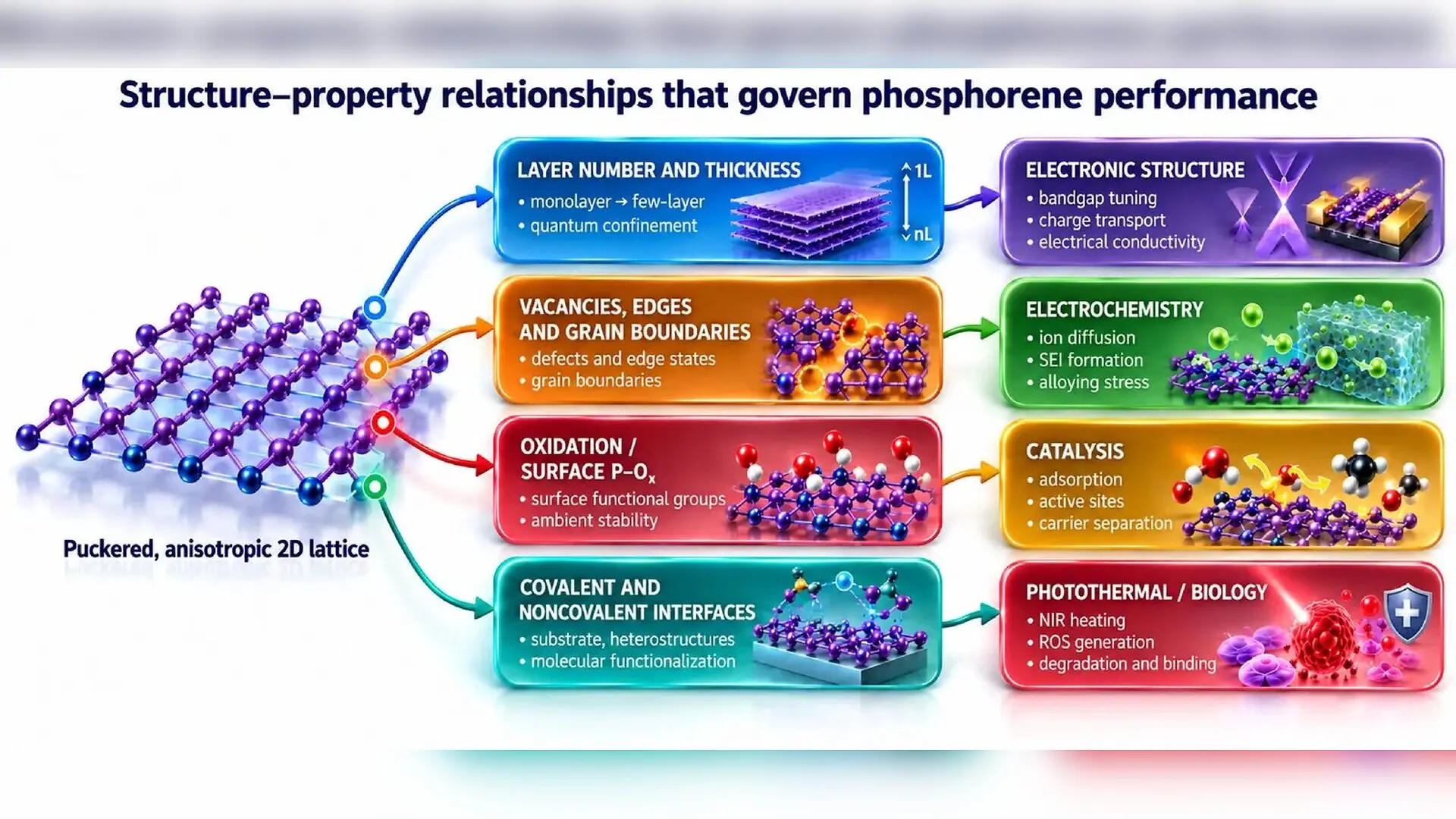
Black phosphorus stands out among two-dimensional materials because its biggest strengths and its main weakness come from the same surface chemistry. The puckered phosphorus lattice gives rise to anisotropic charge transport, a thickness-dependent bandgap, a large accessible surface area, and highly reactive lone-pair electrons. Those features are exactly why black phosphorus and phosphorene have been explored for ion storage, catalysis, photothermal conversion, drug loading, and interfacial charge transfer. They are also the reason the material is difficult to preserve. Exposed phosphorene can oxidize quickly in the presence of oxygen and water, especially under light, meaning the relevant material is not just phosphorene in the abstract, but phosphorene with a particular thickness, defect density, oxidation state, adsorbate history, interfacial environment, and storage record.
How Controlled Interface Engineering Transformed Phosphorene Research
By 2021, most of the foundational exfoliation routes had already been demonstrated, and black phosphorus had been shown to work as an active material in batteries and supercapacitors. A previous review summarized liquid-phase exfoliation, anodic and cathodic electrochemical routes, bipolar electrochemistry, and the early electrochemical energy-storage literature. That earlier review also highlighted several unresolved issues, including ambient degradation, incomplete control over size and thickness, large alloying-induced volume changes, limited full-cell validation, and an incomplete picture of how phosphorene interfaces evolve during operation. The more useful question today is therefore not whether phosphorene can be prepared or whether it can store charge. The real question is what has changed enough to make the field more convincing today than it was during the first wave of proof-of-concept studies, a progression detailed in research published in Nanomaterials.
A number of recent reviews have tackled important parts of this landscape, covering passivation strategies for battery anodes, broad synthesis, defect tailoring, and photocatalysis. Other surveys examined environmental, energy, and biomedical applications, cancer-oriented nanoplatforms, and general biomedical uses. More recently, energy-storage reviews consolidated black phosphorus across battery and supercapacitor chemistries, while dedicated stability reviews organized physical and chemical passivation strategies. These contributions are valuable, but they also make a conventional catalogue of properties and applications increasingly redundant. The present work is instead organized around a cross-application question: how does the chemical and structural state of the phosphorene interface evolve from synthesis to operation, and which measurements are needed to show that an apparent performance gain is physically meaningful and practically relevant?
Why Atomic Structure and Thickness Dictate Material Behavior
The orthorhombic black phosphorus lattice is built from puckered phosphorus sheets. In-plane bonding is covalent, whereas adjacent sheets are held together by weaker van der Waals interactions. Exfoliation therefore produces a high-area surface without destroying the basic phosphorus-phosphorus framework, provided that the mechanical, chemical, or electrochemical driving force is controlled. The armchair and zigzag directions are not equivalent, an anisotropy that affects charge transport, phonon propagation, mechanical deformation, and ion diffusion. Thickness is the first important design variable, as reducing bulk crystals to a few layers increases the fraction of exposed atoms and changes the electronic structure. That can shorten ion-transport distances and improve coupling to catalysts, polymers, or biomolecules, but it also accelerates surface reactions.
Defects represent the second major variable. High-resolution transmission electron microscopy work on bipolar-exfoliated phosphorene identified monovacancies, divacancies, adatoms, grain boundaries, and local amorphous domains while the remaining lattice retained orthorhombic order. Density-functional calculations in the same study linked oxygen chemisorption and bond breaking to the observed amorphization. This is an important reminder when interpreting defect engineering, because a vacancy can create a favorable adsorption site or redistribute charge, but an uncontrolled vacancy population can also be the entry point for oxidation and structural loss. Surface oxidation is not simply a binary distinction between pristine and degraded material, as phosphorus-oxygen species can passivate reactive sites, modify hydrophilicity, and create binding sites for metal species or polymers.
What Scalable Synthesis and Smart Passivation Reveal
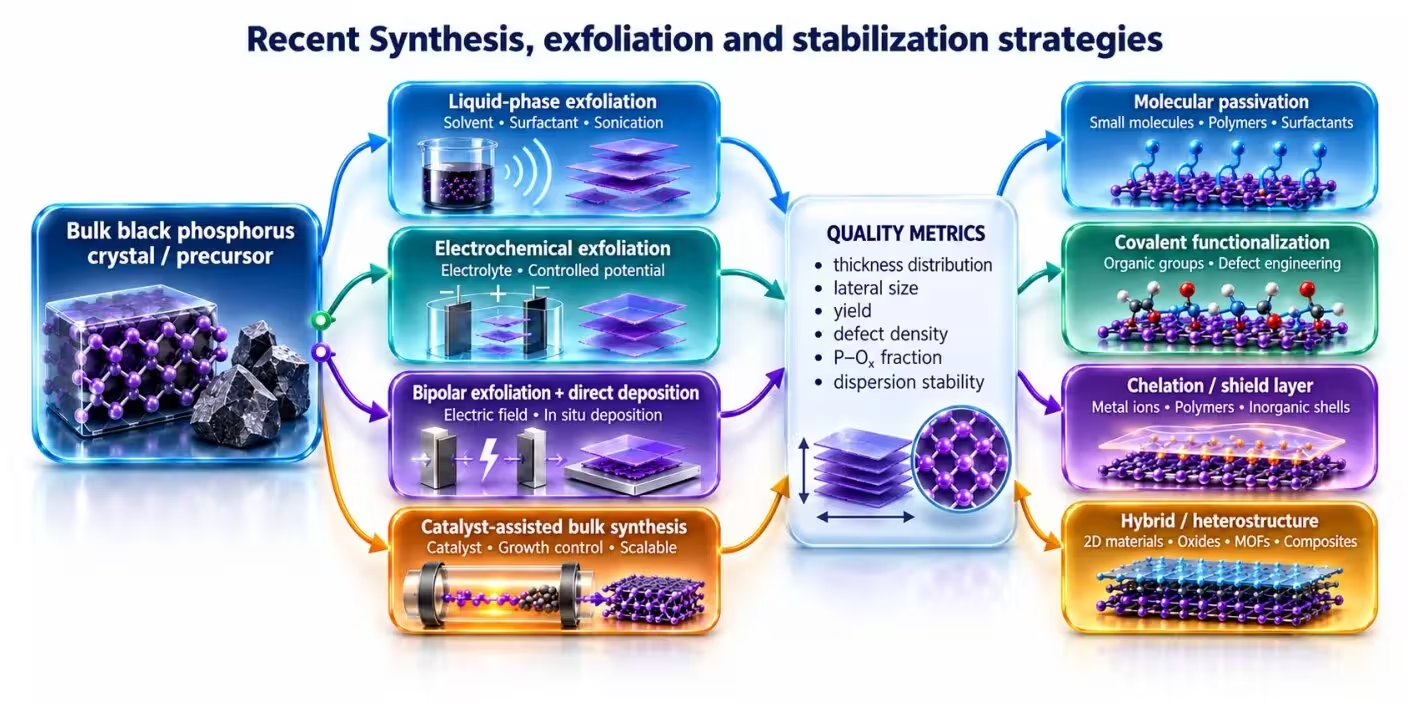
Liquid-phase exfoliation remains attractive because it can process gram-scale feedstock without the small-area limitations of mechanical exfoliation. The recent emphasis, however, is less about proving exfoliation and more about controlling the product distribution. Researchers optimized N-based sonication and reported nanosheets with lateral dimensions up to about 5.37 micrometers, while nanoparticle fractions averaged roughly 68 nanometers. This work illustrates a recurring tradeoff where aggressive sonication increases exfoliation but also fragments sheets and generates edge defects. Centrifugation conditions then become part of the synthesis rather than a simple purification step because they determine which size and thickness population is ultimately tested.
Electrochemical routes offer advantages that are difficult to obtain simultaneously by sonication, allowing an electric field to drive specific intercalating ions while coupling surface chemistry directly to the exfoliation step. Investigators used cathodic exfoliation in the presence of iodomethane to generate methyl radicals and form carbon-phosphorus bonds during nanosheet production. Solid-state nuclear magnetic resonance indicated a functionalization degree near 9.7 percent, demonstrating that exfoliation and covalent modification do not have to be sequential operations. This type of one-pot chemistry is attractive because a freshly created surface is protected before prolonged exposure to air or water.
How Performance Metrics Drive Advances in Energy Storage
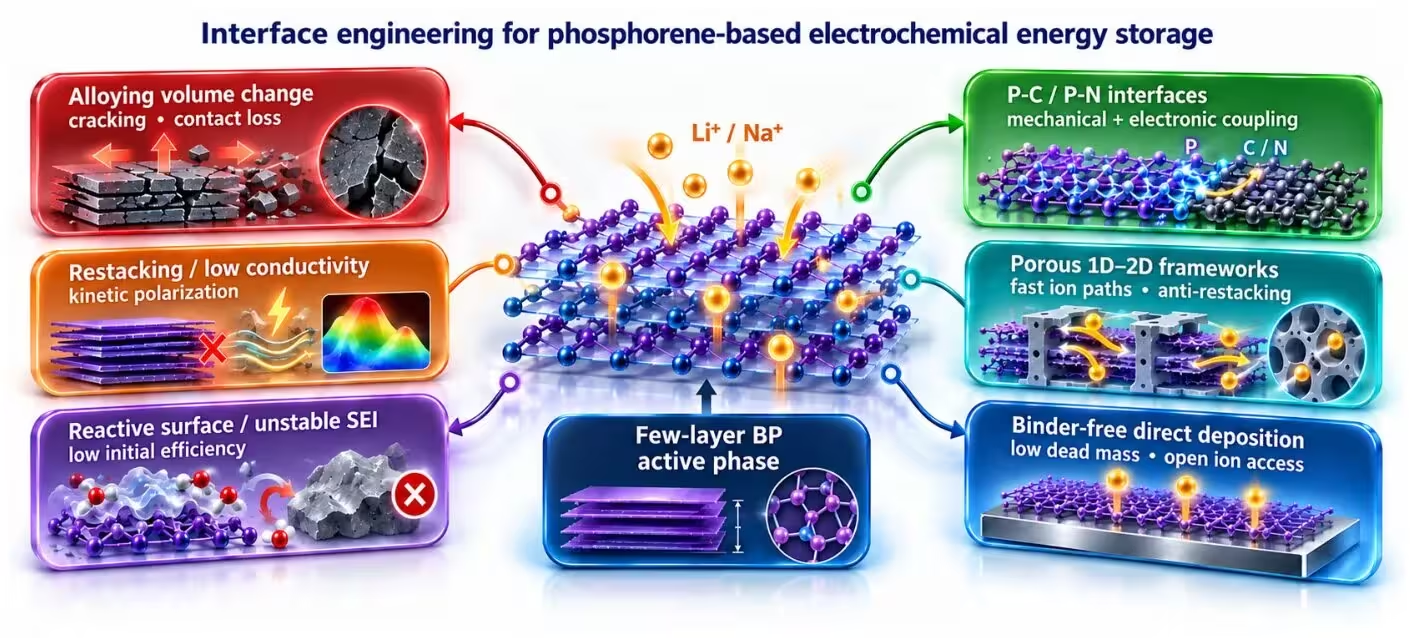
The theoretical capacity of phosphorus makes black phosphorus attractive as an alloying-type anode, but recent work reinforces a point visible in early studies, namely that demonstrating high capacity in a low-loading half-cell is comparatively easy. Retaining electrical contact, controlling first-cycle loss, and preserving the interface at practical loading are much harder. The structural anisotropy adds another variable because deformation and ion motion are direction-dependent. Accordingly, the most convincing recent electrodes use covalent bonding, conductive scaffolds, confinement, or direct deposition to preserve electron pathways while maintaining ion access.
Sodium-ion batteries remain one of the strongest use cases because the high phosphorus capacity can offset the lower cell voltage and energy density of sodium chemistries. The challenge involves severe volume change together with slower transport and unstable interfaces. Scientists used a black-phosphorus and hard-carbon nanocomposite containing stable covalent bonds to achieve a high initial capacity and retain more than 1800 milliampere-hours per gram after 50 cycles at 0.1 amperes per gram. The interface was not merely a conductive contact, as chemical bonding helped maintain the composite during repeated cycling.
What Controls Catalytic Activity and Biomedical Potential
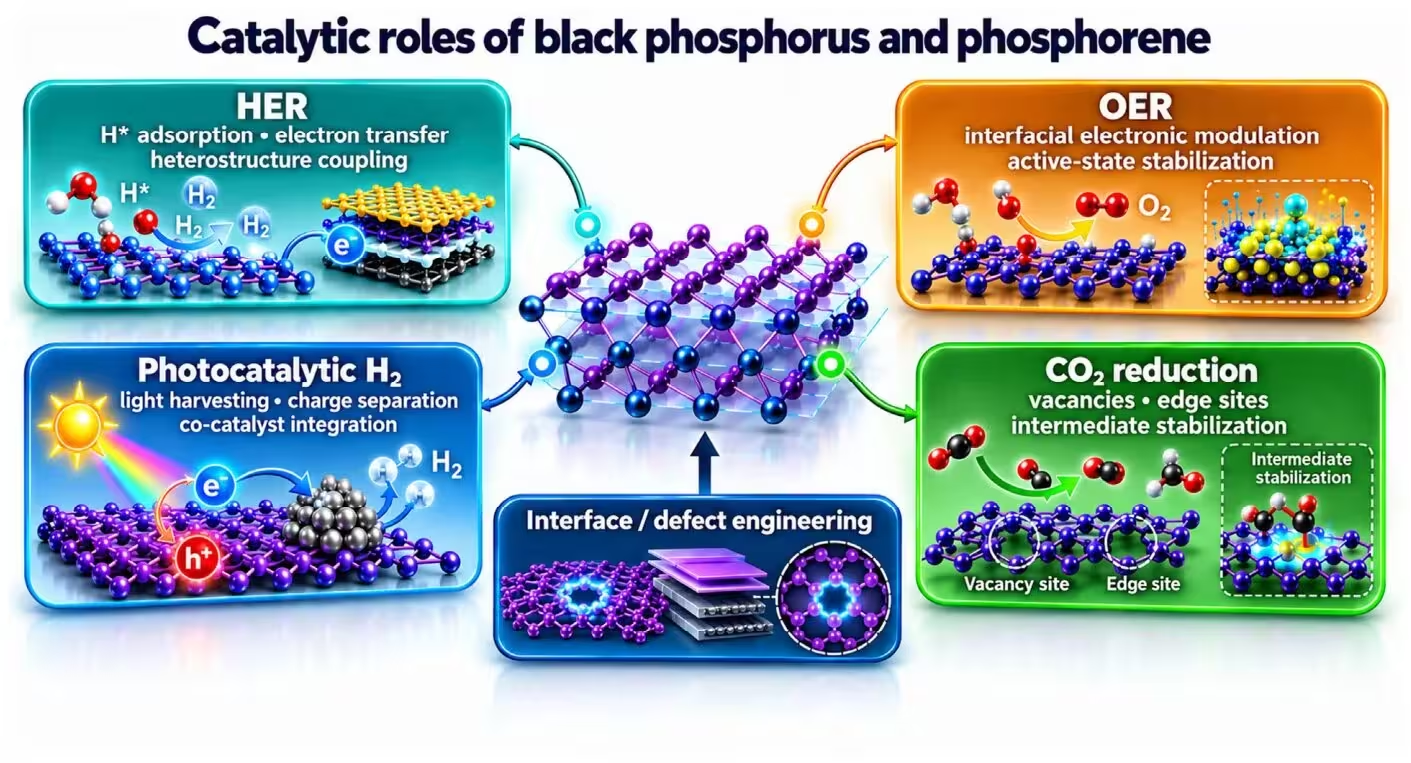
Catalysis makes the dual nature of black phosphorus particularly obvious. Lone-pair electrons can bind metals, intermediates, and adsorbates, which helps create active sites, but that same electron density makes the material vulnerable under oxidative potentials. Good catalyst design must therefore tune the electronic structure without simply converting the nanosheet into an uncontrolled oxide or phosphide. Recent studies increasingly use covalent metal-phosphorus bonds, heterostructures, and vacancies to redistribute charge and stabilize selected intermediates.
Biomedical research is driven by a combination that is difficult to reproduce with many inorganic two-dimensional materials: a high surface area for cargo adsorption, strong near-infrared absorption for photothermal therapy, the ability to participate in reactive-oxygen chemistry, and a phosphorus-based degradation pathway. The important shift in recent literature is that the material is increasingly embedded in multicomponent systems such as membranes, hydrogels, niosomes, cell-membrane coatings, or growth-factor scaffolds, rather than administered as an unmodified nanosheet. This design trend is sensible because bare nanosheets have little control over colloidal stability, protein corona formation, target-cell recognition, or residence time, making targeted surface engineering essential for successful clinical translation.
The research was published in Nanomaterials (Basel, Switzerland) on October 21, 2026.
This article has been fact checked for accuracy, with information verified against reputable sources. Learn more about us and our editorial process.
Last reviewed on .
Article history
- Latest version
Reference(s)
- Rabiei Baboukani, Amin., et al. “Recent Advances in Black Phosphorus and Phosphorene Nanosheets: From Interface Engineering to Energy Storage, Catalysis, and Biomedicine.” Nanomaterials, vol. 16, no. 20, October 21, 2026, pp. 1331 MDPI AG, doi: 10.3390/nano16201331. <https://doi.org/10.3390/nano16201331>.
Cite this page:
- Posted by Robert Brown