NASA Just Completed a Massive Power Upgrade to the International Space Station
NASA astronauts have successfully completed a major solar array upgrade on the ISS, significantly boosting the orbiting laboratory’s power generation capacity.
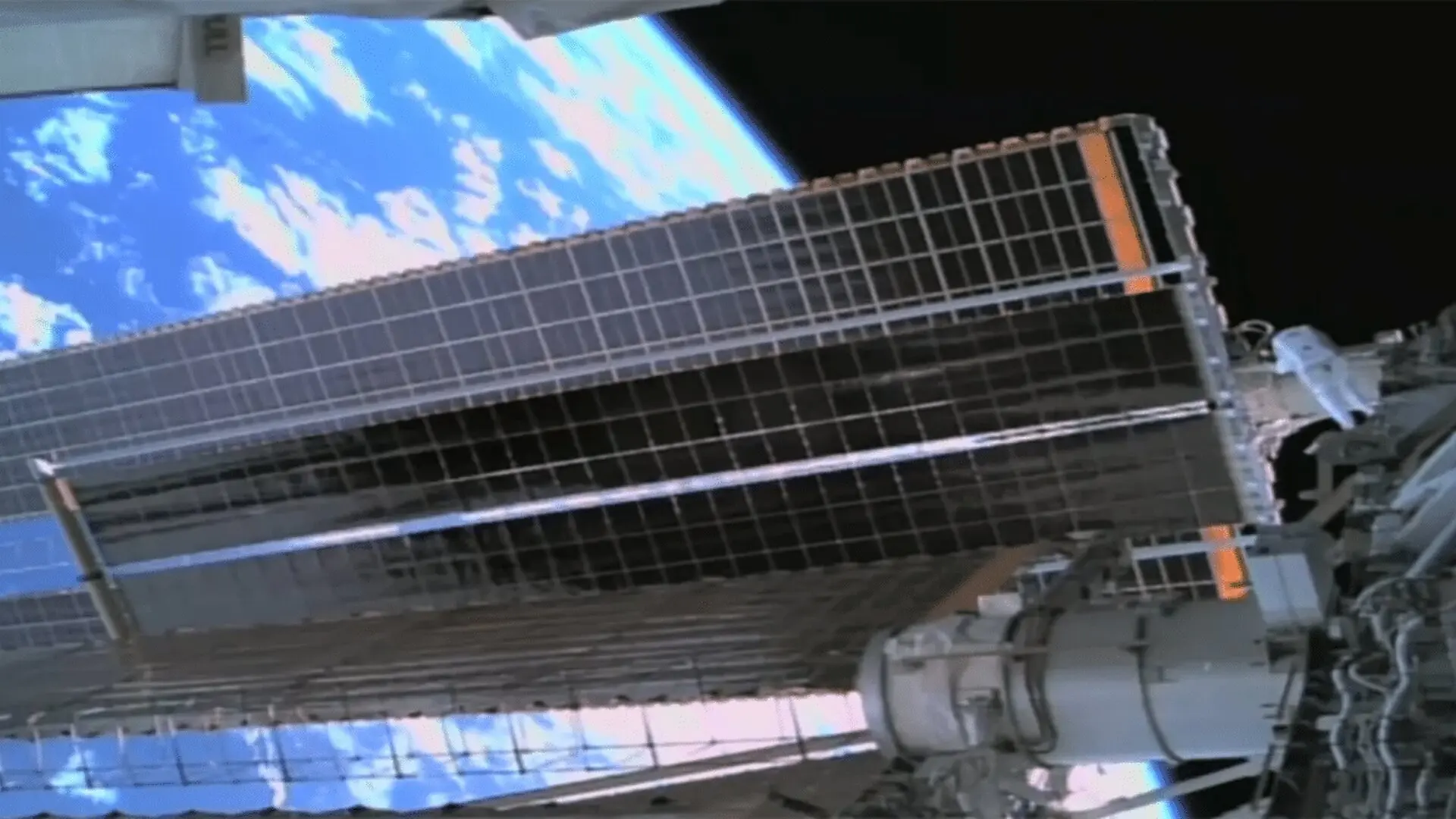
The International Space Station (ISS) has reached a critical milestone in its modernization, finalizing an extensive multi-year project to overhaul its energy grid. Following a nearly seven-hour spacewalk, astronauts successfully activated the eighth and final roll-out solar array, significantly boosting the orbiting laboratory’s total power output.
NASA astronaut Anil Menon and Canadian Space Agency astronaut Joshua Kutryk concluded the intensive mission at 3:35 p.m. EST, marking the end of a six-hour and 59-minute extravehicular activity. According to NASA, the duo finalized the installation of the final International Space Station Roll-Out Solar Array (IROSA) on the station’s 3B power channel, effectively wrapping up an ambitious upgrade effort that has been underway since early 2021.
.@Astro_Kutryk and @Astro_Anil completed their spacewalk at 3:35 p.m. EST today after installing the eighth and final roll-out solar array. This completes the upgrade of the International Space Station’s power generation system. More… https://t.co/JNTjNfzFld https://t.co/ysjIrvK47I
— International Space Station (@Space_Station) November 5, 2026
Boosting the Station’s Energy Output
The completion of this project provides a substantial increase in the facility’s electrical capacity. Prior to the rollout of these arrays, the ISS relied on a power system with a capacity of approximately 160 kilowatts. With all eight new arrays now operational, that figure has climbed to roughly 215 kilowatts—a gain of 55 kilowatts, or a 34% increase in energy production.
Unlike the traditional rigid panels used during the station’s early construction, these IROSA units utilize flexible, roll-out technology. This design allows for a much larger surface area to be compacted for transport during launch and unfurled once attached to the station’s exterior. Rather than replacing the existing power grid entirely, these arrays were designed to augment the current infrastructure, providing the necessary overhead for complex scientific experiments and the life support systems required for a permanently occupied space station.
A Testament to Orbital Maintenance
The successful installation highlights the vital role of human-led extravehicular activities in maintaining aging infrastructure in low Earth orbit. The project spanned 18 individual spacewalks, during which crews meticulously prepared external mounting sites, upgraded electrical components, and installed the arrays. For Menon, the operation represented his fifth career spacewalk, while it was the second for Kutryk. Their efforts accounted for the 286th spacewalk specifically dedicated to the ongoing assembly and upkeep of the ISS.
By opting for a phased augmentation strategy rather than a full system replacement, space agencies have demonstrated that the ISS can remain at the cutting edge of research and operational capability. With the energy grid now fully upgraded, the station enters a new phase of its mission with significantly enhanced electrical resources to support its scientific mandate.
This article has been fact checked for accuracy, with information verified against reputable sources. Learn more about us and our editorial process.
Last reviewed on .
Article history
- Latest version
Reference(s)
- Garcia, Mark. “Spacewalkers Install Final Roll-Out Solar Array - NASA.”, November 5, 2026 NASA <https://www.nasa.gov/blogs/spacestation/2026/11/05/spacewalkers-install-final-roll-out-solar-array/>.
Cite this page:
- Posted by Nida Rehman