NASA Is Inviting You to Send Your Name to Saturn’s Mysterious Moon Titan
Add your name to NASA’s Dragonfly mission and join the journey to Titan, a mysterious moon that could hold the secrets to the origins of life.
Your Name Could Soon Be En Route to Saturn’s Largest Moon
NASA is offering space enthusiasts a rare opportunity to leave a permanent mark on the next frontier of solar system exploration. The agency has officially opened its “Send Your Name to Titan” initiative, inviting the public to register their names for a journey to Saturn’s massive, haze-covered moon aboard the upcoming Dragonfly mission.
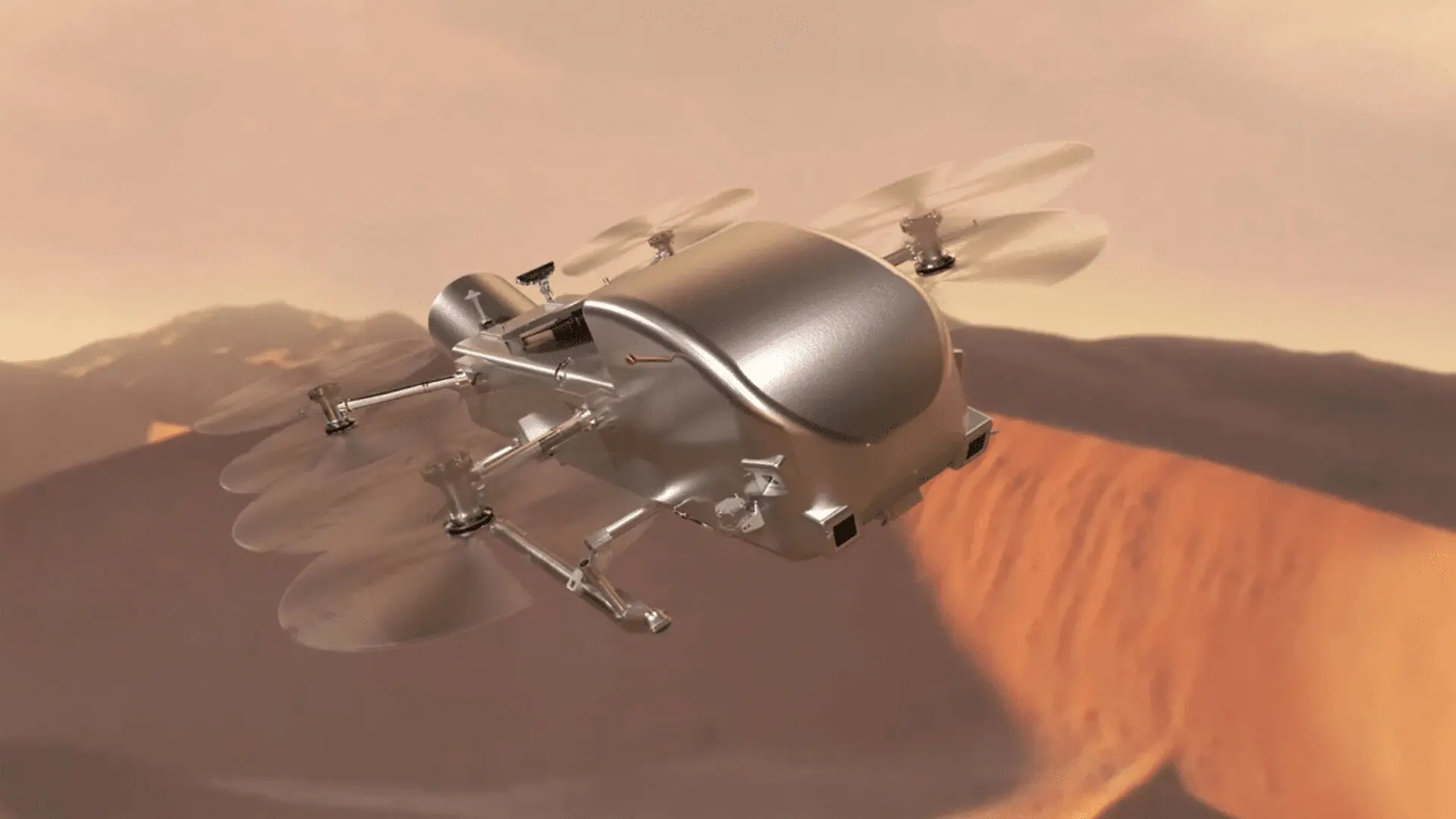
Those who participate will have their names digitally etched onto a microchip, which will be physically carried by the Dragonfly rotorcraft as it traverses the alien landscape of Titan. This mission represents a significant technological leap in planetary science, serving as the first time NASA has deployed a rotorcraft to conduct an entire scientific mission on another celestial body.
According to NASA, the craft is engineered to leverage Titan’s dense atmosphere and low gravity, using eight rotors to hop between various scientific points of interest. By moving through the air rather than across the ground, the mission can access geological features that would remain unreachable for traditional wheeled rovers.
“NASA’s Dragonfly mission will simply blow your mind,” said Nicky Fox, associate administrator, Science Mission Directorate, NASA Headquarters in Washington. “By flying the first-ever rotorcraft science mission, NASA will explore Saturn’s largest moon, Titan, as we search for signs of habitability on a distant world that is most similar to our own. We are excited to bring humanity along for the journey of a lifetime, and we invite everyone to send their names on this small, but mighty rotorcraft that will unlock the secrets of the universe in what is widely considered one of the most exciting space missions of our lifetime.”
Your name could fly on Saturn’s largest moon. NASA’s Dragonfly mission will launch in 2028 to explore the dunes, lakes, and rivers of Saturn’s moon, Titan, and your name can come along! Join the voyage and claim your boarding pass: https://t.co/iinCnJaqIP https://t.co/FQZvfBGUZo
— NASA (@NASA) October 29, 2026
Unlocking the Prebiotic Mysteries of a Frozen World
Titan is a world of extreme contrasts. While it possesses a thick, nitrogen-rich atmosphere and weather patterns reminiscent of Earth, its surface temperatures plummet to around minus 290 degrees Fahrenheit (minus 179 degrees Celsius). At these frigid levels, water ice takes on the structural integrity of rock, and methane replaces water in a complex cycle that includes clouds, rain, and surface lakes.
The scientific community views Titan as a prime laboratory for studying prebiotic chemistry. Because the moon is rich in carbon-based compounds, researchers hope the data returned by Dragonfly will offer insight into how life-essential chemistry might have emerged on early Earth. While the mission is not tasked with finding existing life, it will investigate whether the moon’s environment supports the chemical conditions necessary for biological processes to take hold.
Advanced Aerial Exploration
The mission strategy centers on mobility. Dragonfly is designed to hop across Titan’s equatorial dunes and visit the Selk impact crater, a location where liquid water and organic compounds may have historically converged to form chemically active environments. Powered by a radioisotope thermoelectric generator rather than solar cells, the craft will operate independently of the dim, distant Sun, allowing it to navigate through the thick, hazy atmosphere with precision.
By registering for the flight, the public is invited to become a symbolic part of this expedition, bridging the gap between deep-space research and the millions of people tracking the mission’s progress from Earth.
This article has been fact checked for accuracy, with information verified against reputable sources. Learn more about us and our editorial process.
Last reviewed on .
Article history
- Latest version
Reference(s)
- Taveau, Jessica. “Send Your Name to Titan Aboard NASA’s Dragonfly Mission - NASA.” NASA <https://www.nasa.gov/news-release/send-your-name-to-titan-aboard-nasas-dragonfly-mission/>.
Cite this page:
- Posted by Karan Das