Solar Storm Triggers Mysterious Radiation Surge Inside Earth’s Supposedly Impenetrable Shield
A powerful solar storm has revealed a surprising process within Earth’s radiation belts, challenging long-held theories about our planet’s space environment.
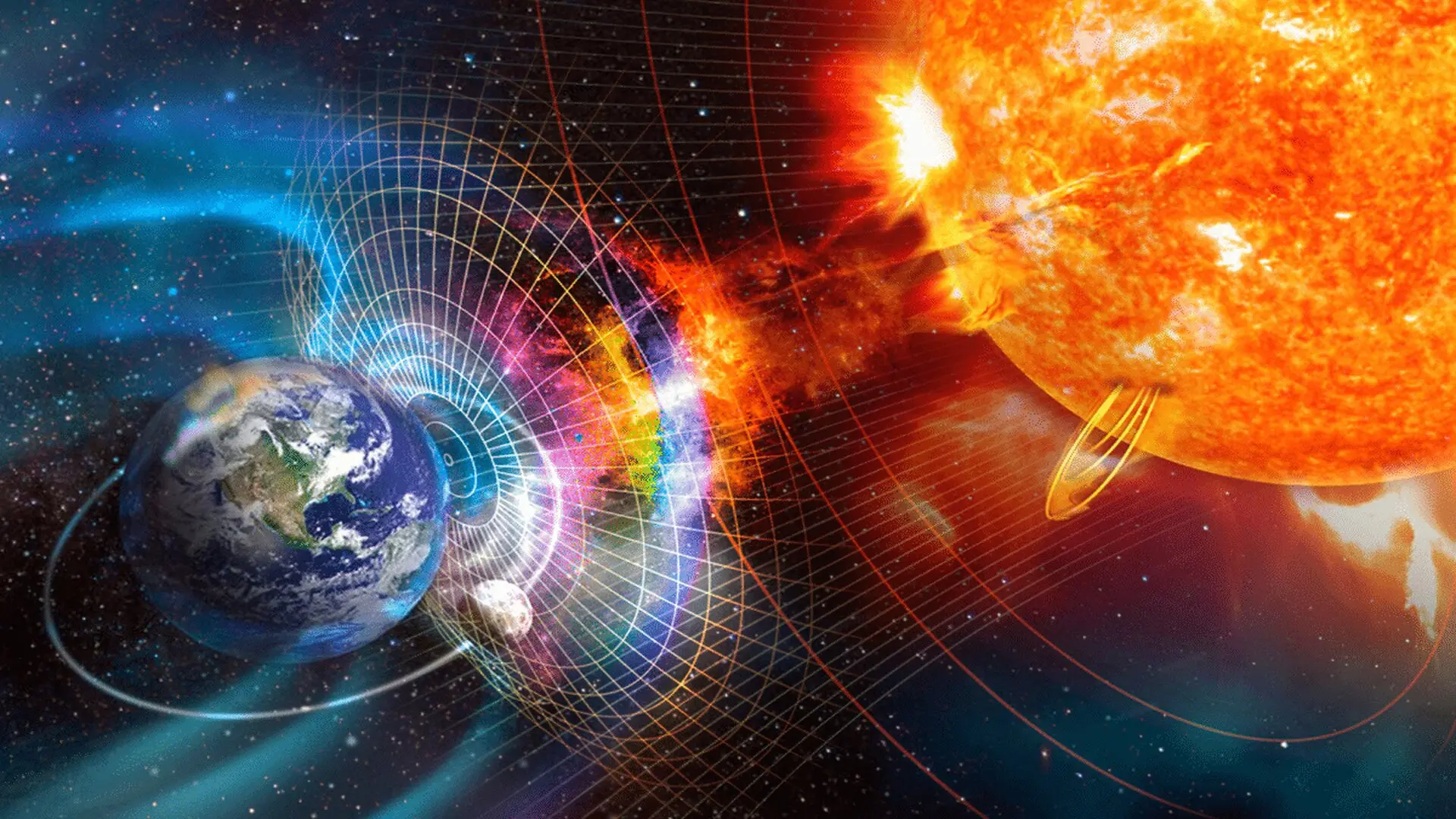
During the intense solar activity of May 2024, Earth’s magnetic field failed to act as the impenetrable shield scientists once imagined. New research published in Geophysical Research Letters reveals that a powerful geomagnetic superstorm triggered the rapid acceleration of high-energy electrons inside a protected zone of the inner magnetosphere, creating a previously underestimated radiation hazard for orbiting satellites.
Challenging the Notion of an Impenetrable Barrier
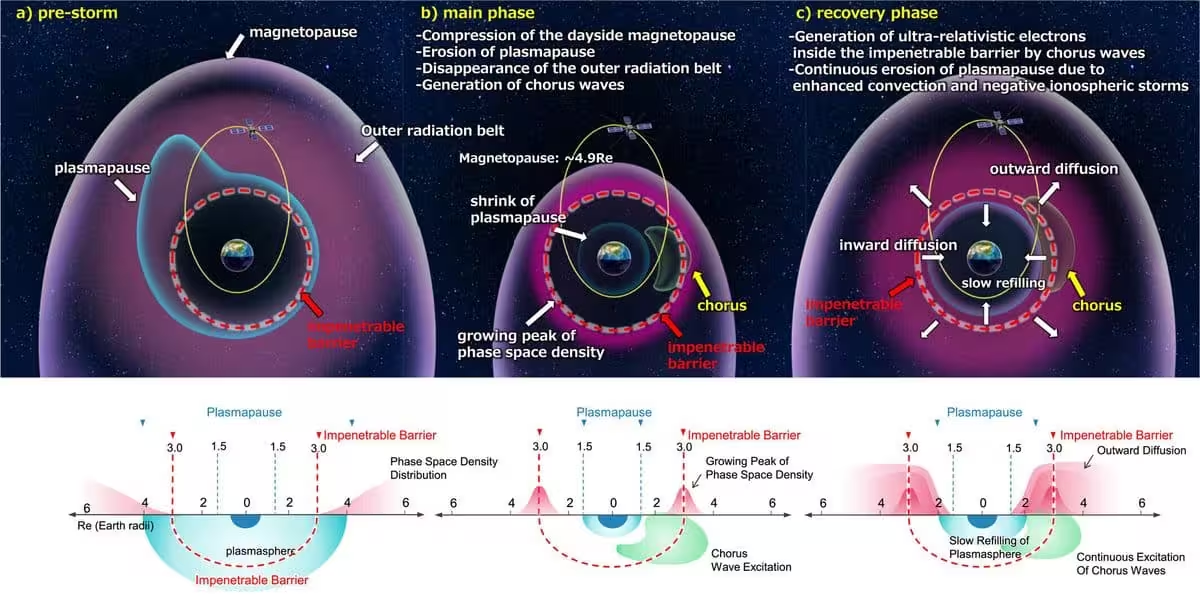
Earth’s radiation environment is dominated by the Van Allen belts, two massive, doughnut-shaped regions of trapped charged particles. Since 2014, researchers have observed a distinct boundary—located roughly three Earth radii from the planet’s center—that appeared to act as a physical wall, effectively blocking ultrarelativistic electrons from moving deeper toward the atmosphere. However, as the May 2024 solar storm intensified, this supposedly stable boundary became a site of unexpected particle activity.
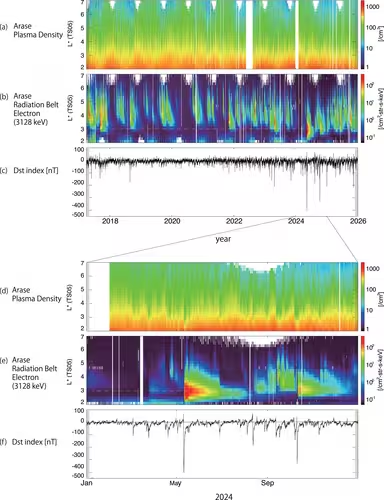
While the storm generated auroras visible at historically low latitudes, instruments aboard the Japanese Aerospace Exploration Agency’s Arase spacecraft were capturing data that contradicted established models. The probe detected a surge of electrons accelerated to near-light speeds, with energies surpassing three megaelectronvolts (MeV)—a threshold sufficient to penetrate and degrade satellite shielding.
Local Acceleration Over Inward Migration
A central question for the research team, led by Yoshizumi Miyoshi of Nagoya University, was whether these energetic particles had breached the outer barrier or had been energized through a localized process. By analyzing phase space density—a metric used to track the distribution and behavior of particle populations—the scientists identified a clear local maximum near the barrier, suggesting that the particles were not merely moving inward from outer regions.
“One of the key questions was how these highly energetic electrons appeared inside the barrier,” explained Miyoshi, a professor at the Institute for Space-Earth Environmental Research. “Were they transported inward from the outer radiation belt, or were they accelerated locally within this region?” The data concluded that the latter was the case, indicating that a barrier capable of stopping incoming radiation is not necessarily proof against the development of hazardous particles from within.
The Role of Atmospheric Birdsong
The acceleration mechanism was fueled by chorus waves, electromagnetic signals that vibrate in a way that sounds remarkably like a bird’s song when translated into audio. These waves, which propagate through the magnetosphere, can transfer energy to electrons through resonance, effectively boosting them to dangerous velocities.
The storm fundamentally altered the local environment, causing the plasmasphere—a region of cool, ionized gas surrounding Earth—to contract. This left the area around the radiation barrier unusually empty, creating the ideal low-density conditions for chorus waves to flourish and interact with electrons. According to the study, the plasmasphere’s recovery was significantly slower than expected, taking nearly five days to return to half its pre-storm density, which allowed the hazardous acceleration conditions to persist long after the peak of the solar event.
Rethinking Space Weather Risks
These findings suggest that current methods for predicting space weather must evolve to consider more than just incoming solar activity. Because the danger arises from a complex, delayed interaction between the plasmasphere, wave activity, and trapped particles, the threat to satellite infrastructure can remain acute even as a storm appears to subside.
“This discovery highlights the need to understand and predict how energetic electrons behave under extreme space weather conditions,” Miyoshi stated. For satellite operators, this means that regions once considered safe harbors may occasionally transform into high-radiation zones, underscoring the necessity for better, more granular predictive models to protect sensitive electronics in orbit.
This article has been fact checked for accuracy, with information verified against reputable sources. Learn more about us and our editorial process.
Last reviewed on .
Article history
- Latest version
Cite this page:
- Posted by Karan Das