James Webb Just Found Something Strange Hidden Inside an Interstellar Comet
The James Webb Space Telescope has detected an interstellar visitor hiding within a comet’s icy grains, challenging everything we know about space rocks.
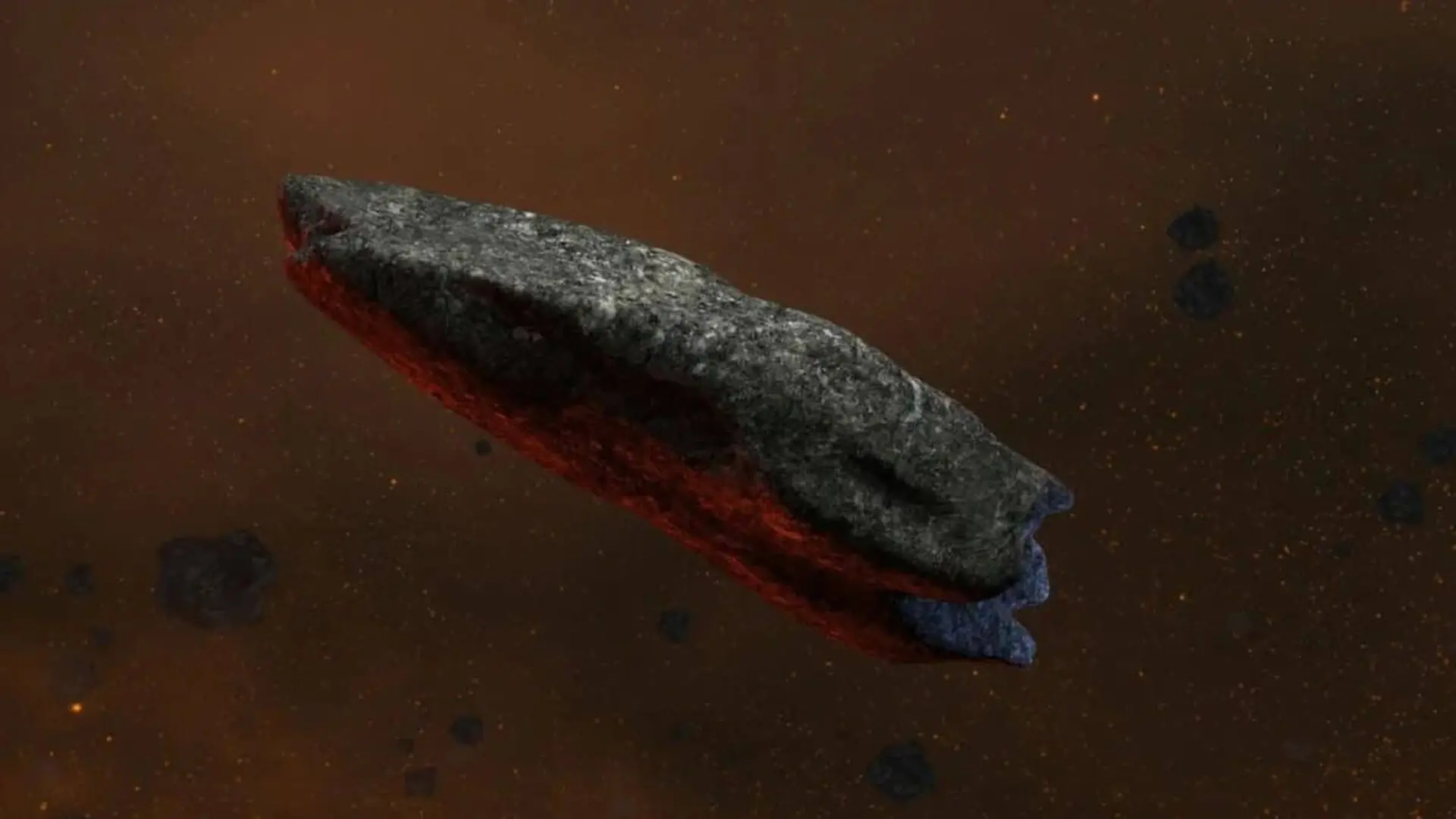
The James Webb Space Telescope has uncovered a distinct chemical fingerprint in the interstellar comet 3I/ATLAS, revealing that its icy composition is heavily saturated with rocky dust. This structural makeup sets the visitor apart from most comets native to our own Solar System, yet mirrors the characteristics of certain icy bodies orbiting in the cold, distant reaches beyond Neptune.
A research team led by Dr. Silvia Protopapa of the Southwest Research Institute utilized the telescope’s NIRSpec instrument to dissect the comet’s composition during its transit through our neighborhood. By analyzing light scattered by the comet’s coma—the cloud of gas and debris released as the object heated up during its 2025 perihelion—scientists were able to probe the nature of the material originating from another star system.
Data Reveals a Heavily ’Dust-Rich’ Composition
Observations conducted in August 2025, December 2025, and April 2026 provided a multi-stage look at the comet as it approached and eventually receded from the Sun. As reported in The Astrophysical Journal Letters, the data confirmed the presence of water ice alongside emissions of carbon dioxide and carbon monoxide gas.
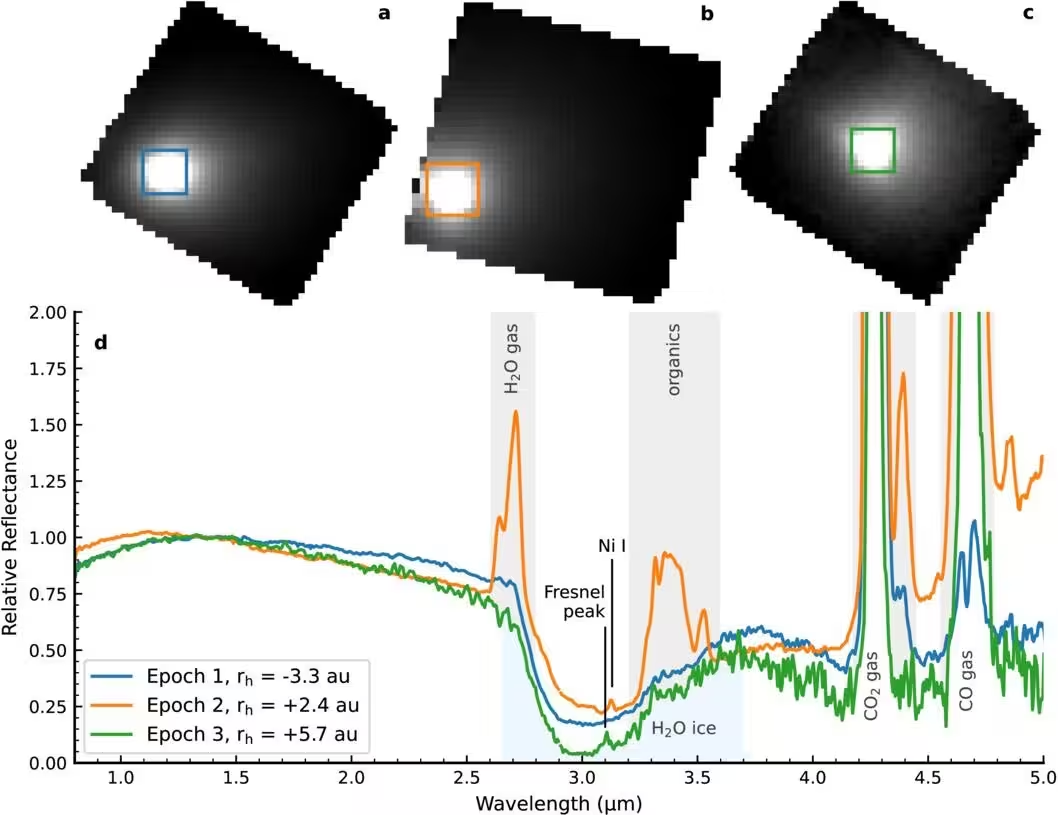
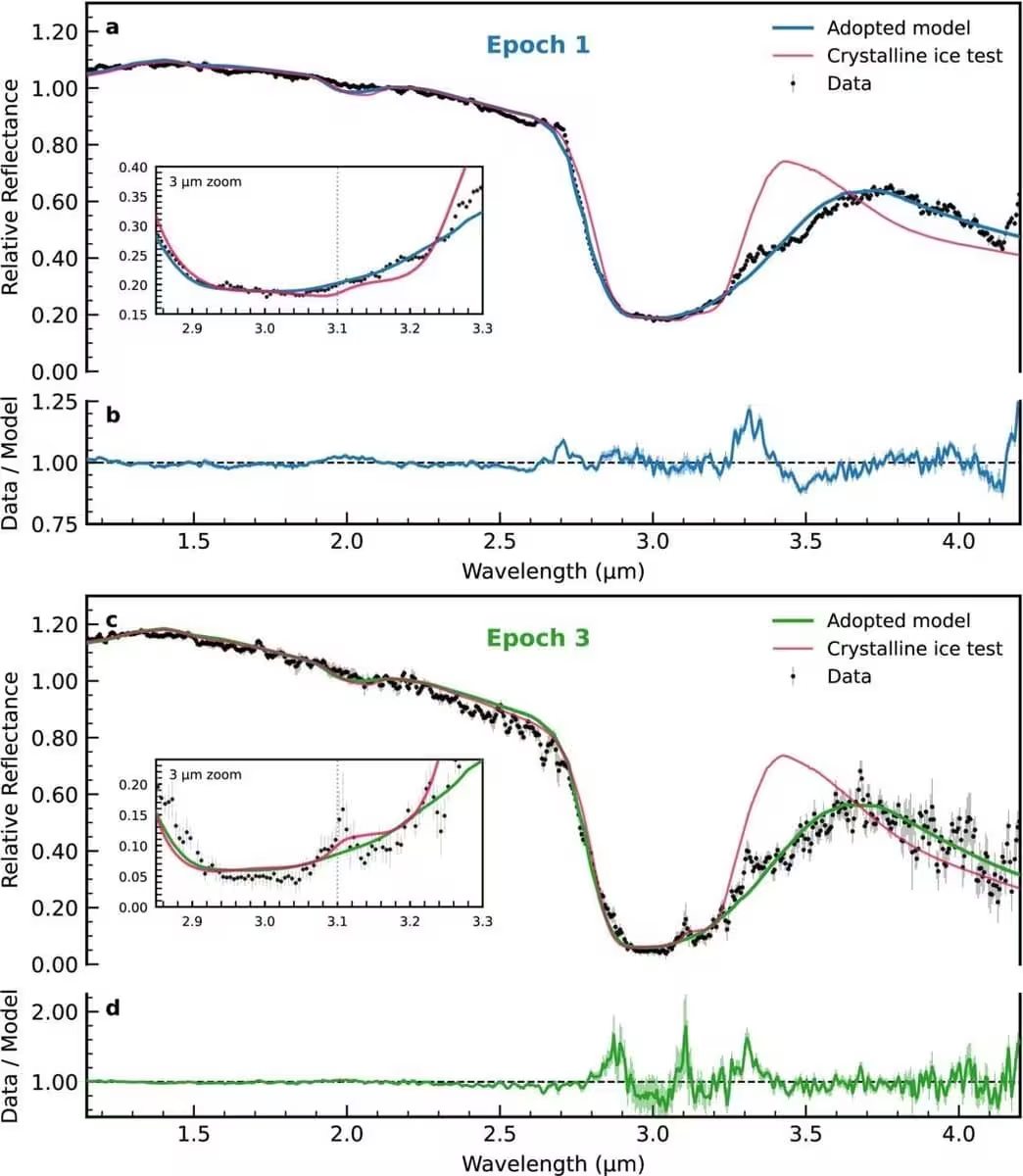
The spectral analysis presented a puzzle: while the comet showed a signature water-ice absorption feature near 3 micrometers, it lacked the expected signatures usually found near 1.5 and 2.0 micrometers. Through rigorous modeling, researchers concluded that these anomalies are best explained by grains measuring only a few micrometers across, consisting of a dense, dark mixture of water ice and rocky mineral dust.
Echoes of Distant Worlds
When the team compared 3I/ATLAS to trans-Neptunian objects—the frigid residents of the Kuiper Belt and beyond—the interstellar traveler felt less like an anomaly and more like a familiar, albeit distant, relative. These outer Solar System bodies frequently exhibit similar spectral signatures tied to carbon dioxide ice and organic compounds, suggesting a universal process in how icy materials are distributed during the formation of planetary systems.
This observation implies that the building blocks of planets across the galaxy might exist on a spectrum of purity. Some cometary grains may be relatively clean ice, while others, like 3I/ATLAS, represent the dustier end of the spectrum. Protopapa suggests that these ratios may be locked in during the early stages of planet-forming disks, preserving a snapshot of the chemical environment where these objects were born.
Evolving Dynamics Under Solar Influence
The study also captured subtle shifts in the comet’s composition over time. Spectra obtained in April 2026 hinted at the presence of larger, ice-rich grains not as clearly defined in earlier observations. Researchers are currently debating two primary theories for this evolution: either solar radiation is physically altering the surface grains as the comet journeys through the inner Solar System, or the comet is shedding its outer layers to expose fresher, different material underneath.

“Both explanations remain on the table,” noted Dr. Michael Kelley of the University of Maryland. For the time being, the precise mechanism driving these changes remains a subject for further investigation, highlighting the dynamic nature of these cosmic travelers as they interact with the stars they visit.
This article has been fact checked for accuracy, with information verified against reputable sources. Learn more about us and our editorial process.
Last reviewed on .
Article history
- Latest version
Reference(s)
- Sabia, Stephen. “NIRSpec - NASA Science.”, August 12, 2024 NASA <https://science.nasa.gov/mission/webb/nirspec/>.
- Protopapa, Silvia., et al. “JWST Reveals Refractory-rich Water Ice in Interstellar Comet 3I/ATLAS: Evidence for a Continuum of Grain Properties across Protoplanetary Disks.” The Astrophysical Journal Letters, vol. 1011, no. 1, October 26, 2026, pp. L11 American Astronomical Society, doi: 10.3847/2041-8213/aea60d. <https://iopscience.iop.org/article/10.3847/2041-8213/aea60d>.
- “Michael S Kelley | University of Maryland: Department of Astronomy.”, November 1, 2026 University of Maryland: Department of Astronomy <https://www.astro.umd.edu/people/michael-s-kelley>.
Cite this page:
- Posted by Karan Das