Scientists Discover Exotic Liquid State Of Hydrogen Deep Inside Earth’s Solid Core
Scientists have used extreme laboratory experiments to uncover strange, previously unobserved behavior hidden deep within Earth’s mysterious inner core.
Deep within the heart of our planet, the intense conditions of the inner core may be inducing a strange, exotic state of matter. New experimental data indicates that hydrogen atoms can flow through a solid iron lattice with surprising freedom, entering a phase known as the superionic state.
While the Earth’s inner core is primarily composed of iron, it is known to harbor smaller concentrations of lighter elements, including hydrogen, oxygen, and carbon. At the extreme pressures and temperatures found at the center of the Earth, these materials behave in ways that defy our surface-level expectations. In a superionic state, the iron atoms maintain a rigid crystalline structure while lighter elements, like hydrogen, transition into a fluid-like state, diffusing through the iron scaffold.
Recreating the Core in the Lab
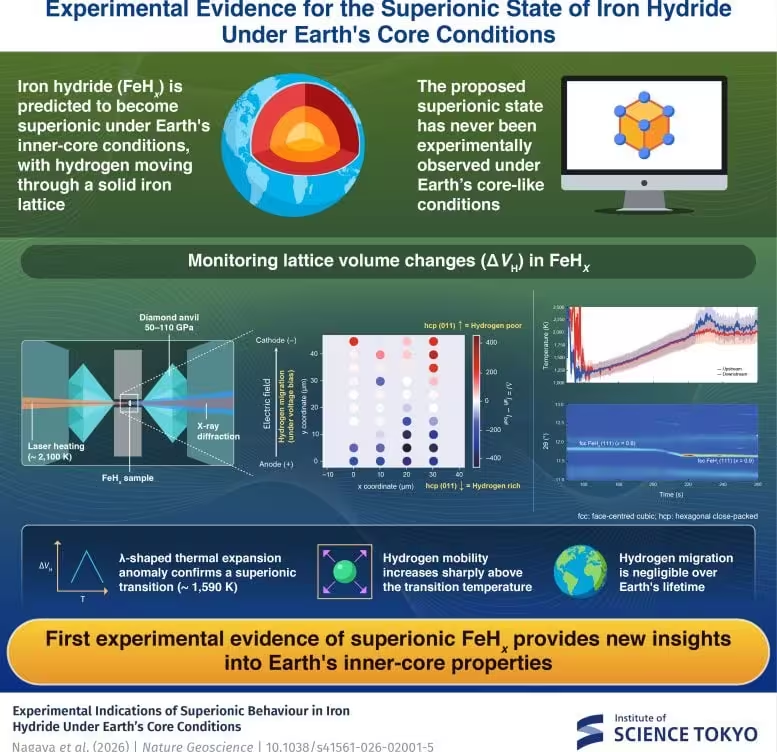
Scientists have long theorized that this superionic behavior could explain why seismic shear waves experience unexpected delays as they travel through the inner core. Previously, evidence for this phenomenon relied heavily on computer simulations. Now, a team from the Institute of Science Tokyo has provided the first concrete experimental evidence for this state in face-centered cubic iron hydride, or FeHₓ.
The study, published in Nature Geoscience, was spearheaded by doctoral candidates Yoshihiro Nagaya and Yusuke Okazaki, working under the guidance of Professor Kenji Ohta. By employing a laser-heated diamond-anvil cell, the researchers subjected samples of FeHₓ to extreme pressures ranging from 50 to 110 gigapascals and temperatures exceeding 2,000 Kelvin.
“Because the superionic state of iron–light-element alloys exists only under ultrahigh-pressure and ultrahigh-temperature conditions, it had never previously been observed experimentally. FeHX is expected to adopt either a hexagonal close-packed or an fcc structure under inner-core conditions, depending on the hydrogen content,” Professor Ohta noted.
Observing Atomic Mobility
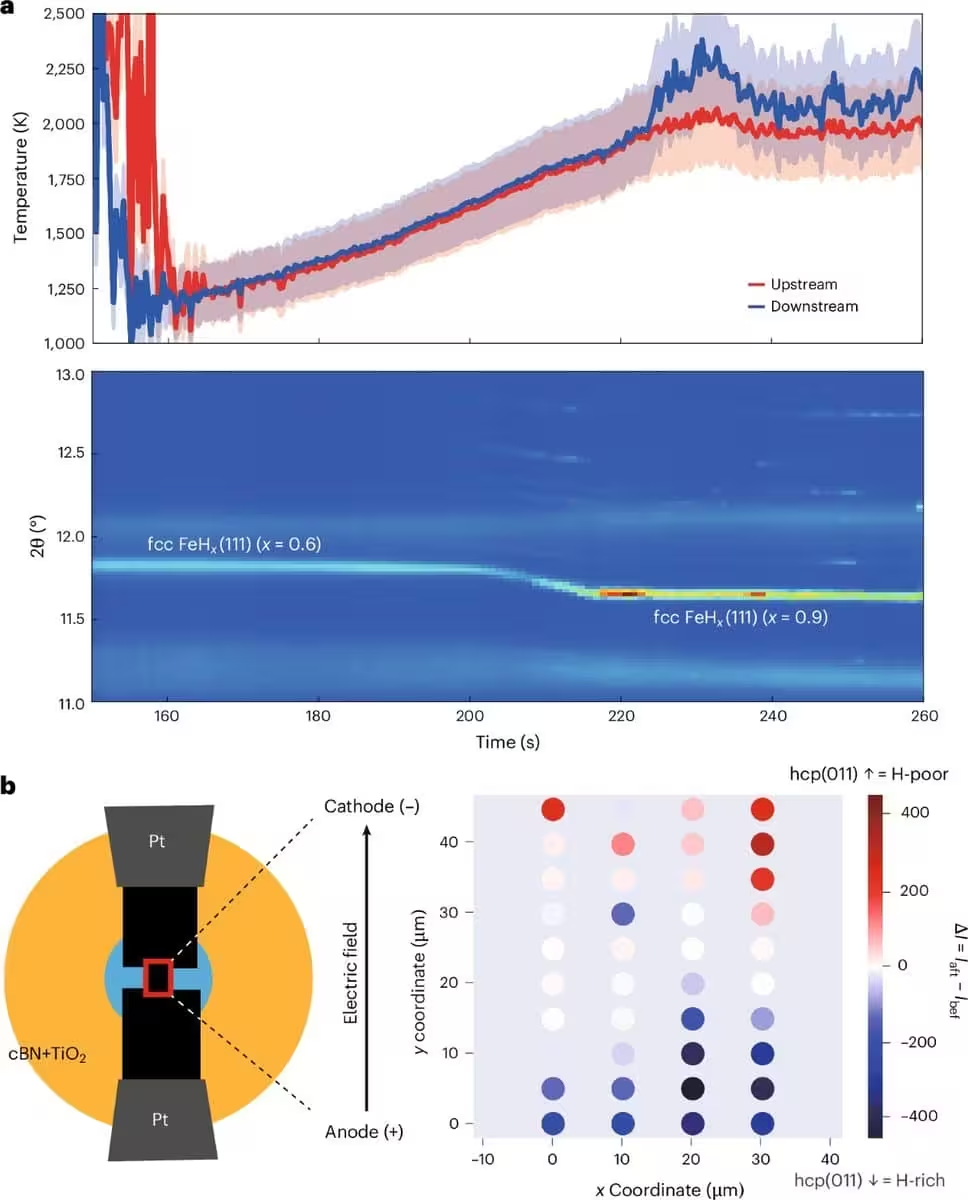
To track these changes, the team utilized time-resolved synchrotron X-ray diffraction, allowing them to monitor the crystalline structure in real-time. A pivotal transition occurred at approximately 1,590 Kelvin, where the team identified a λ-shaped anomaly in the material’s thermal expansion—a classic marker of a phase change to a superionic state.
Confirming this mobility, the researchers applied an electric potential across the samples while they were under extreme conditions. They observed a distinct redistribution of hydrogen within the iron lattice, further validating that the hydrogen was indeed behaving as a fluid. Once cooled, the material retained this redistributed signature.
Trapped by Geological Time
Despite the high mobility of hydrogen within this superionic state, the researchers emphasize that this does not necessarily translate into widespread migration of hydrogen through the Earth’s core. Calculations suggest that even under the influence of Earth’s geomagnetic field, hydrogen would only shift roughly 0.1 micrometers over 10,000 years.
Given the core’s 1,200-kilometer radius, such a sluggish rate means that hydrogen incorporated into the Earth during its initial formation would remain largely confined, trapped within the core’s dense metallic structure for billions of years. This discovery not only provides a mechanism for the unique seismic readings observed by geophysicists but also offers a clearer window into the long-term evolution of our planet’s deepest interior.
“These findings are expected to contribute to elucidating seismic-wave velocity anomalies in Earth’s inner core and the evolution of Earth’s interior,” Ohta concluded.
This article has been fact checked for accuracy, with information verified against reputable sources. Learn more about us and our editorial process.
Last reviewed on .
Article history
- Latest version
Reference(s)
- Nagaya, Yoshihiro. “Experimental indications of superionic behaviour in iron hydride under Earth’s core conditions - Nature Geoscience.”, vol. 19, no. 7, pp. 855-860. Nature, doi: 10.1038/s41561-026-02001-5. <https://www.nature.com/articles/s41561-026-02001-5>.
Cite this page:
- Posted by Zara Tariq