Scientists Finally Opened a Sealed Envelope to Solve a 225 Year Old Mystery About Gravity
Scientists have finally revealed a long-awaited measurement of gravity’s exact strength, and the surprising results defy previous expectations.
Physicists at the National Institute of Standards and Technology (NIST) have concluded a decade-long experimental effort to pin down the elusive value of big G, the universal gravitational constant. Rather than resolving the long-standing discord in modern physics, the team’s latest findings have deepened the mystery, highlighting a persistent discrepancy that continues to challenge our understanding of one of nature’s most fundamental forces.
The measurement produced a value of 6.67387 × 10⁻¹¹ meters³/kilogram/second². While this figure is remarkably precise, it remains 0.0235% lower than a major benchmark established by the International Bureau of Weights and Measures (BIPM) in France. In the realm of fundamental constants, such a variation—though seemingly microscopic—is significant enough to suggest that current experimental methodologies have not yet fully accounted for all variables governing gravity.
A Double-Blind Approach to Gravity
To eliminate potential bias, lead physicist Stephan Schlamminger and his team implemented a rigorous, blinded protocol. Throughout the data collection process, colleague Patrick Abbott introduced an undisclosed numerical correction to the raw measurements. This modified data remained locked inside a sealed envelope, ensuring that the researchers were unable to verify their proximity to expected values until the analysis was finalized.
Although the team intended to conclude the study in 2022, they opted for an extended period of scrutiny to account for subtle environmental factors, particularly air pressure fluctuations. The envelope was finally unsealed on July 11, 2024, at the Conference on Precision Electromagnetic Measurements in Aurora, Colorado, where the discrepancy with the BIPM data was officially confirmed.
Modernizing the Cavendish Legacy
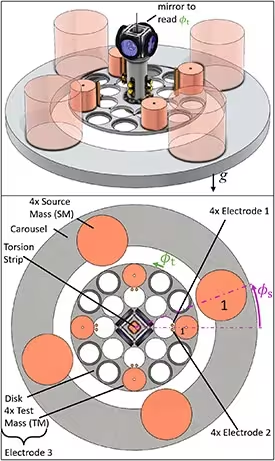
The NIST researchers utilized a sophisticated evolution of the torsion balance, a technique pioneered by Henry Cavendish in 1798. The setup involves suspending a beam with a fine fiber and measuring the minute gravitational torque exerted by nearby heavy masses. To modernize this, the team deployed eight cylindrical metal masses, using a copper-beryllium ribbon to suspend the internal test weights. Furthermore, the researchers utilized electrical feedback—applying precise voltages to electrodes—to counteract gravitational pull, providing an independent secondary method for calculating big G.
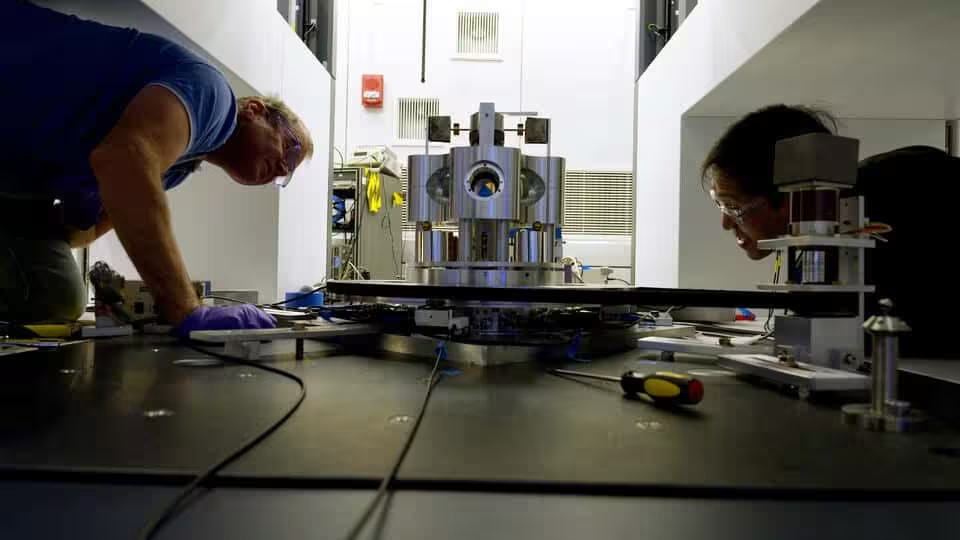
To verify if the experimental hardware itself was biasing the results, the team swapped components, utilizing both copper and sapphire test masses. These material variations yielded virtually identical results, indicating that the source of the persistent measurement gap lies elsewhere. The findings, detailed in the journal Metrologia, highlight that while the National Institute of Standards and Technology has provided a highly refined data point, the quest to reconcile measurements of Newton’s law of universal gravitation is far from over.
This article has been fact checked for accuracy, with information verified against reputable sources. Learn more about us and our editorial process.
Last reviewed on .
Article history
- Latest version
Reference(s)
- “Stephan Schlamminger.”, June 4, 2019 NIST <https://www.nist.gov/people/stephan-schlamminger>.
- “How big is Big G? Mystery deepens after ten-year effort to measure gravity’s strength.”, April 21, 2026 <https://www.nature.com/articles/d41586-026-01284-3>.
- Schlamminger, Stephan., et al. “Redetermination of the gravitational constant with the BIPM torsion balance at NIST.” Metrologia, vol. 63, no. 2, April 16, 2026, pp. 025012 IOP Publishing, doi: 10.1088/1681-7575/ae570f. <https://iopscience.iop.org/article/10.1088/1681-7575/ae570f>.
- Cowen, Ron. “NIST Weighs In on the Mystery of the Gravitational Constant.”, April 16, 2026 National Institute of Standards and Technology <https://www.nist.gov/news-events/news/2026/04/nist-weighs-mystery-gravitational-constant>.
- <https://www.britannica.com/science/Newtons-law-of-gravitation>.
Cite this page:
- Posted by Farah Siddiqui