Ghostly Particles May Decide Whether A Dying Star Becomes A Supernova Or A Black Hole
New research suggests that elusive neutrinos could be the deciding factor in whether a massive star explodes as a supernova or collapses into a black hole.
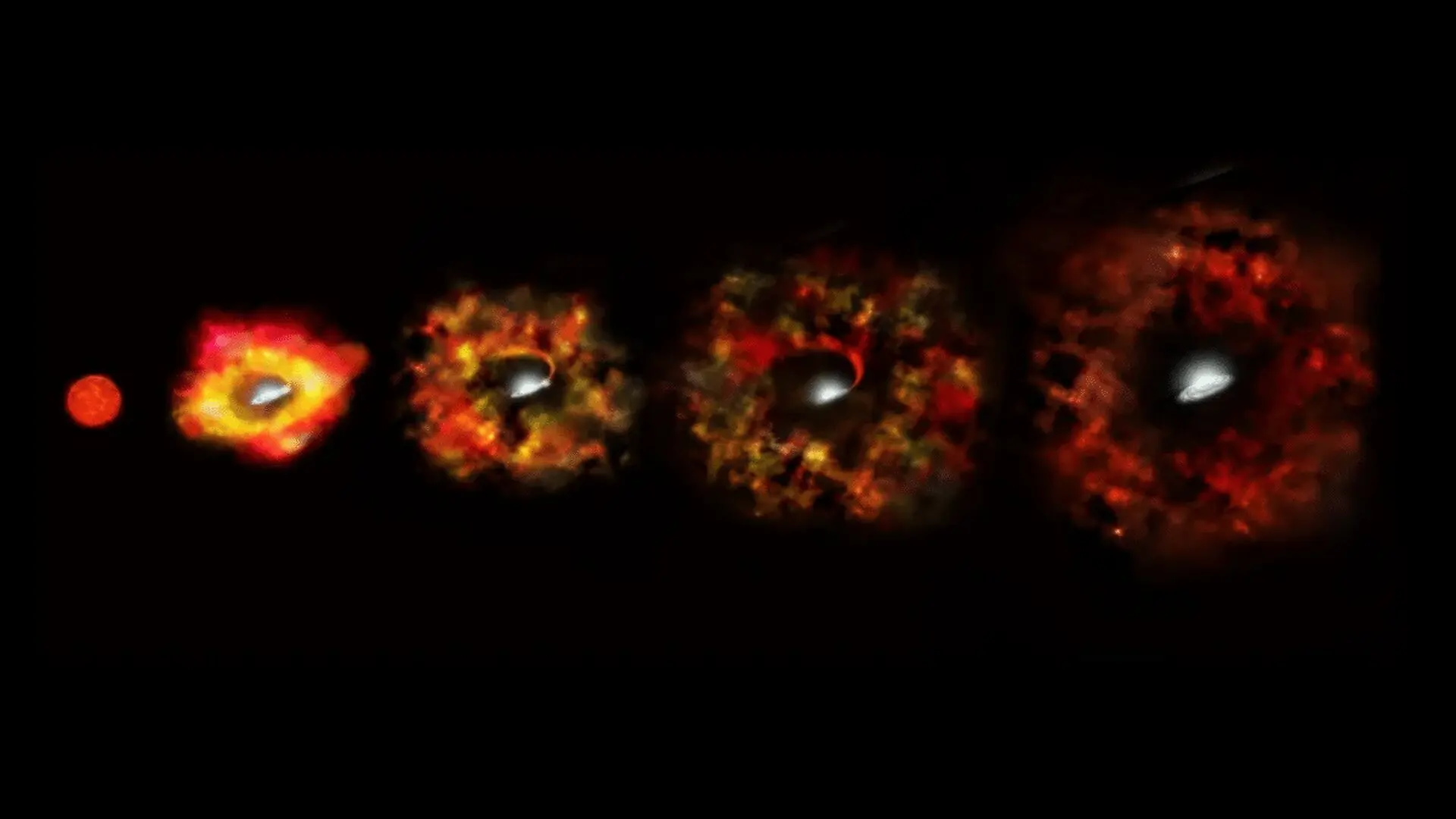
The transition from a dying star to either a spectacular supernova or a silent collapse into a black hole may hinge on the elusive behavior of subatomic particles known as neutrinos. Research published in the journal Physical Review D suggests that the way these particles shift their characteristics during a star’s final collapse is a decisive factor in determining its ultimate fate.
Stellar Destinies and the Role of Ghost Particles
When a massive star reaches its end, its core undergoes a violent collapse. While simulations have long been used to model this event, the specific influence of neutrinos—often dubbed ghost particles because of their weak interaction with matter—has remained a significant variable. Despite their near-massless nature, neutrinos are the primary vehicles for energy release during these cataclysmic events, carrying away roughly 99 percent of the total energy generated by the core collapse.
As these particles move through the dense environment of a collapsing star, they undergo a process called flavor conversion, shifting between different types. According to Mariam Gogilashvili, a particle astrophysicist at the University of Copenhagen’s Niels Bohr Institute, these subtle transitions are far from incidental. Because neutrinos manage the bulk of the energy transfer, even minor fluctuations in their behavior can fundamentally alter the star’s trajectory toward either a supernova explosion or the formation of a black hole.
Sensitivity in Mid-Range Massive Stars
The research team focused on how these neutrino transformations affect the energy balance required to trigger a successful supernova. By integrating these particle interactions into their models, they found that the outcome for many stars is more precarious than previously assumed. Specifically, stars with masses ranging between 16 and 30 times that of the Sun, which were once thought to reliably result in supernova explosions, often failed to do so when neutrino flavor conversions were accurately factored into the physics.
“What surprised us most was that the stars between 16 and 30 times the mass of the sun, many of which explode comfortably in our standard simulations, turned out to be particularly sensitive to neutrino physics,” noted co-author Irene Tamborra of the Niels Bohr Institute, speaking to Space.com. This sensitivity implies that our current understanding of stellar evolution may need to be recalibrated to account for the complex dance of particles inside the core.
Redefining the Life Cycle of Massive Stars
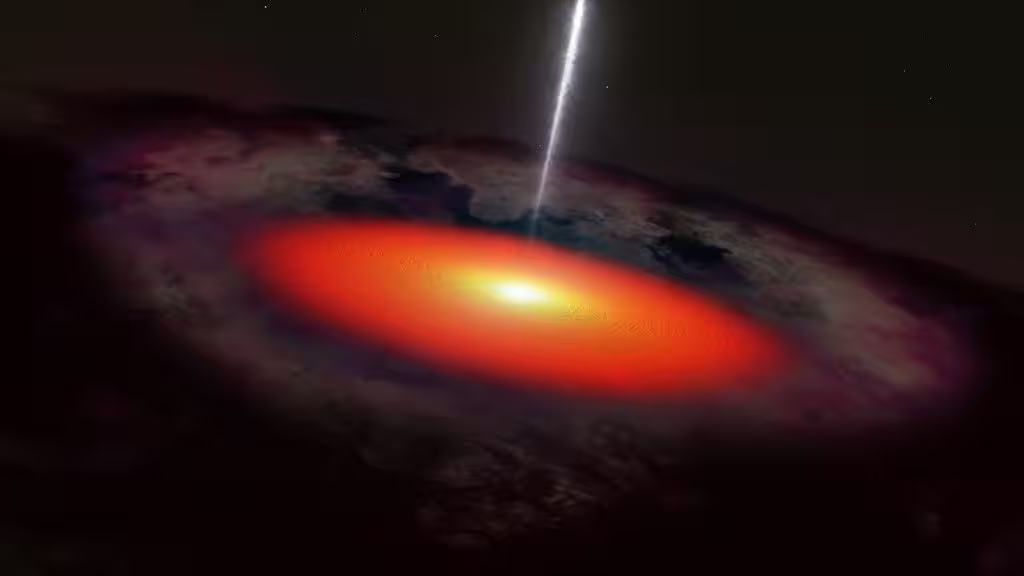
For decades, astronomers have attempted to reconcile the observed number of supernovas with the number of massive stars that appear to simply vanish into black holes. This latest study suggests that the missing piece of the puzzle lies in the intersection of particle physics and stellar dynamics. By demonstrating that neutrinos can reshape the environment around a collapsing core and influence the strength of the resulting shock wave, the researchers have underscored that these tiny particles are essential to understanding the evolution of the cosmos.
Moving forward, the scientific community looks toward the next generation of simulations and the potential for direct detection of neutrinos from a nearby supernova. Such an observation would provide a definitive empirical test for these models, finally bridging the gap between theoretical particle behavior and the observable deaths of the universe’s most massive stars.
This article has been fact checked for accuracy, with information verified against reputable sources. Learn more about us and our editorial process.
Last reviewed on .
Article history
- Latest version
Reference(s)
- Anonymous, “Neutrino flavor conversion shapes the rate of failed core-collapse supernovae.” Physical Review D, August 5, 2026 American Physical Society (APS), doi: 10.1103/pz3y-3lv5. <https://journals.aps.org/prd/accepted/10.1103/pz3y-3lv5>.
- Choi, Charles. “Flavor-changing 'ghost particles' may reveal which stars go supernova — and which turn into black holes.”, September 20, 2026 Space <https://www.space.com/astronomy/stars/flavor-changing-ghost-particles-may-reveal-which-stars-go-supernova-and-which-turn-into-black-holes>.
Cite this page:
- Posted by Farah Siddiqui