Juno Uncovers Jupiter’s Complex Layered Shield Against Solar Wind
NASA’s Juno mission has discovered that Jupiter utilizes a complex system of plasma waves to shield itself from the intense pressure of solar wind.
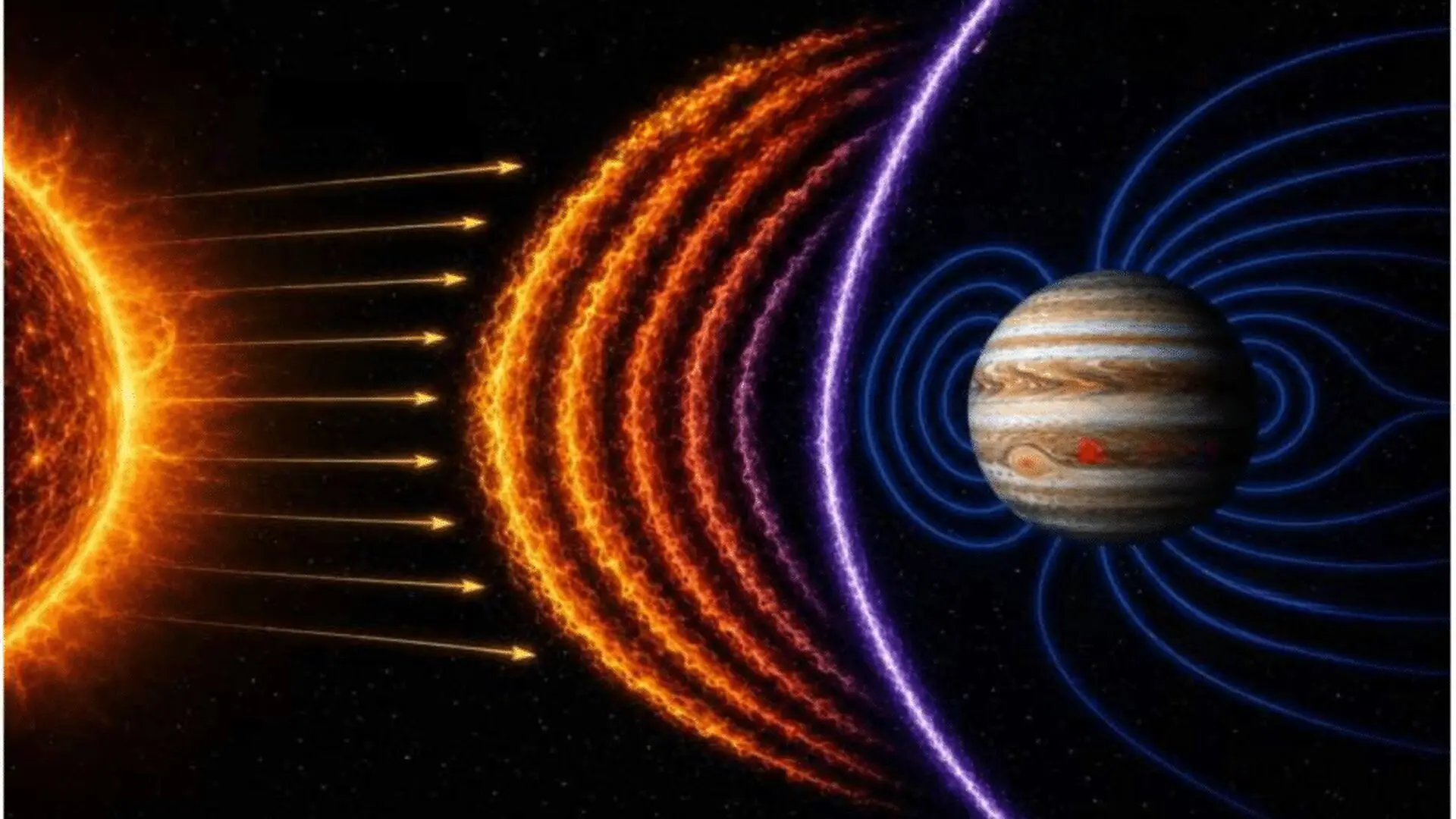
Data transmitted by NASA’s Juno spacecraft has revealed that Jupiter employs a sophisticated, multi-layered defensive strategy to deflect the solar wind. Unlike the simpler magnetic barriers observed at Earth, the gas giant utilizes a complex array of plasma waves and secondary shock structures to manage the constant bombardment of charged solar particles.
Decoding the Mechanics of a Planetary Shield
At the heart of the discovery is the planet’s bow shock, a massive, invisible interface where the solar wind—a high-velocity stream of particles flowing from the Sun—collides with the planet’s magnetic environment. While Earth’s magnetosphere serves as a relatively straightforward buffer, research published in Nature Communications suggests that Jupiter’s scale and unique environment demand a far more intricate response.
Scientists from the University of Iowa utilized the Juno Waves instrument to conduct the most granular analysis of these shock structures to date. Their findings demonstrate that Jupiter does not rely on a single wave pattern. Instead, it generates a diverse spectrum of plasma wave harmonics. By distributing the energy of incoming solar particles across multiple frequencies, the planet can more effectively heat and decelerate the solar wind before it penetrates deeper into the Jovian system.
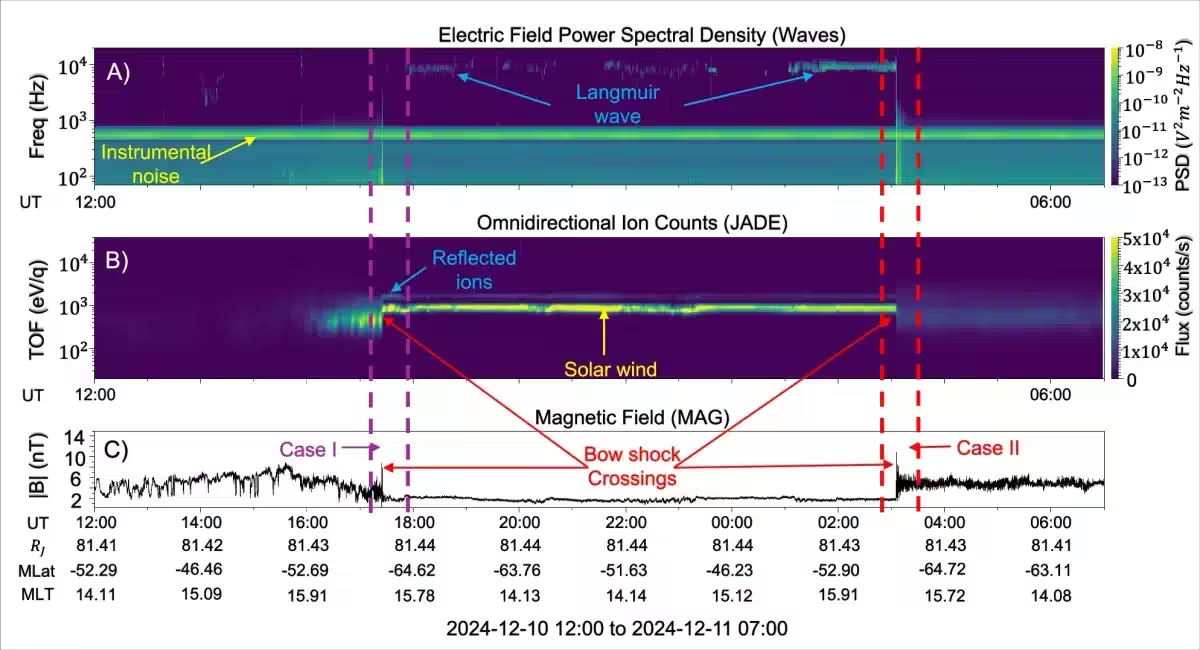
Layered Defenses and Secondary Shocklets
The study highlights a clear departure from Earth-like magnetospheric behavior. Jupiter’s boundary is bolstered by the presence of smaller, intermediary structures known as shocklets. These features interact with the solar wind well before it reaches the primary shock front, establishing a tiered defense mechanism. This structural complexity appears to be an evolutionary adaptation to the intense, high-energy environment characteristic of the outer solar system.
Jayasri Joseph, a postdoctoral researcher in the Department of Physics and Astronomy at the University of Iowa and the paper’s lead author, noted that this multi-frequency approach is key to the planet’s resilience. By utilizing a wider range of frequencies, Jupiter can process a larger volume of solar material, effectively breaking down the energy that would otherwise disrupt its atmosphere.
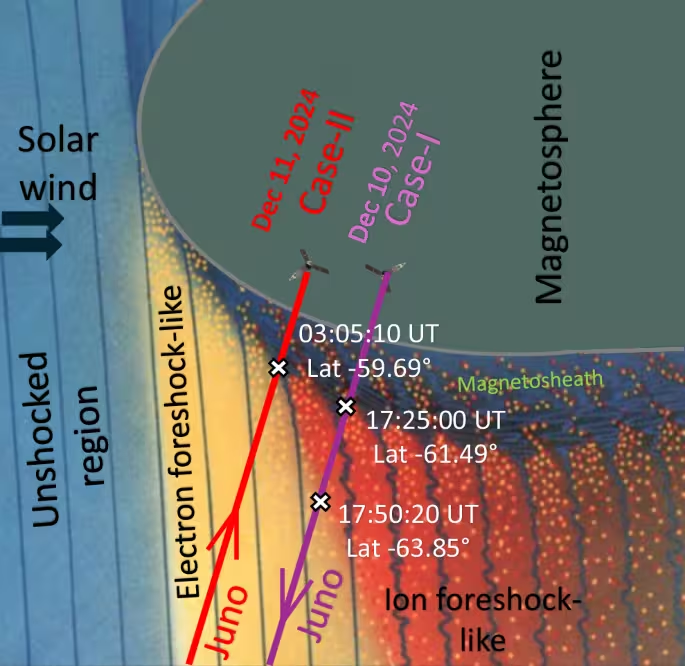
A Laboratory for Cosmic Physics
Beyond clarifying the mechanics of Jupiter’s immediate environment, these observations provide a unique window into high-energy physics elsewhere in the galaxy. The shock processes observed at Jupiter share similarities with the powerful, turbulent regions found near supernova remnants. Because these distant phenomena are difficult to study in situ, the researchers argue that Jupiter serves as an accessible laboratory for understanding how cosmic bodies convert kinetic energy into heat and particle acceleration.
By studying how Jupiter modulates the solar wind, scientists are better equipped to model the violent energy transfers that define the broader universe, bridging the gap between planetary science and the study of extreme astrophysical events.
The research, which utilized data from the solar wind environment, underscores the necessity of high-fidelity measurements in characterizing the diverse ways that planetary bodies shield themselves from the Sun’s influence.
This article has been fact checked for accuracy, with information verified against reputable sources. Learn more about us and our editorial process.
Last reviewed on .
Article history
- Latest version
Reference(s)
- Joseph, J.. “Plasma wave observations from Juno spacecraft at the Jovian bow shock - Nature Communications.”, vol. 17, no. 1, July 31, 2026, pp. 9263 Nature, doi: 10.1038/s41467-026-76223-x. <https://www.nature.com/articles/s41467-026-76223-x>.
Cite this page:
- Posted by Farah Siddiqui