New ALMA Images Reveal Mysterious Organizing Force Behind Betelgeuse Hot Spots
New ALMA images reveal persistent hot spots in Betelgeuse’s atmosphere, and a mysterious stellar companion may explain their unusual alignment.
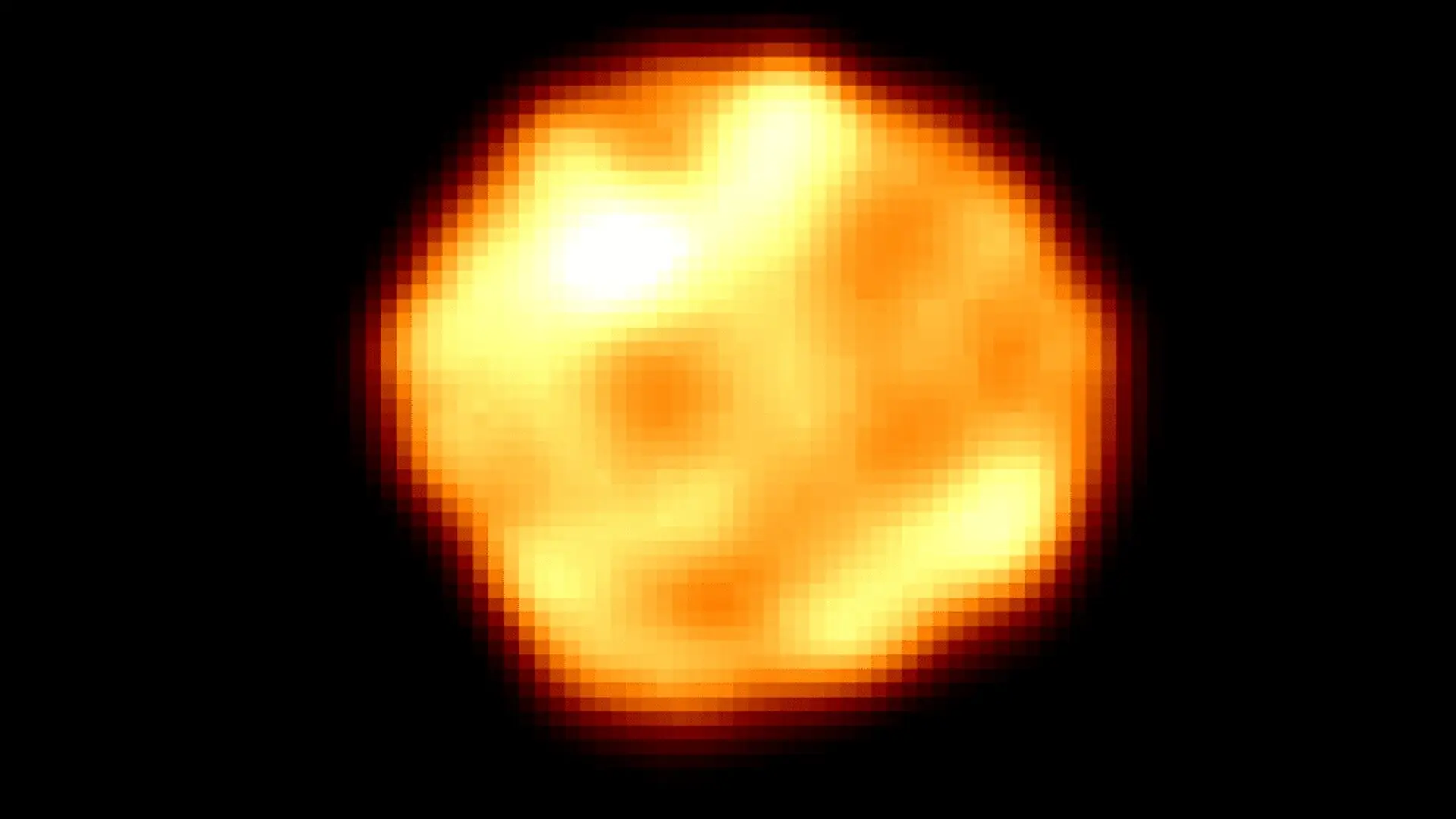
Fresh, high-resolution imagery of the red supergiant Betelgeuse has revealed a chaotic and increasingly asymmetric atmosphere, marked by persistent features that may be influenced by a hidden companion star. These findings, detailed in a study appearing in Astronomy & Astrophysics, provide an unprecedented look at the complex physical mechanics driving the final evolutionary stages of one of the sky’s most iconic massive stars.
The research offers a critical baseline for understanding the star’s behavior following its 2019 “Great Dimming” event, when the star’s luminosity plummeted by a factor of 2.5. Astronomers, led by Bill Dent of the University of Manchester, utilized the Atacama Large Millimeter/submillimeter Array (ALMA) in Chile to peer through the star’s outer layers, comparing the current atmospheric state with data collected by the same facility in 2015.
Peering into the Stellar Engine
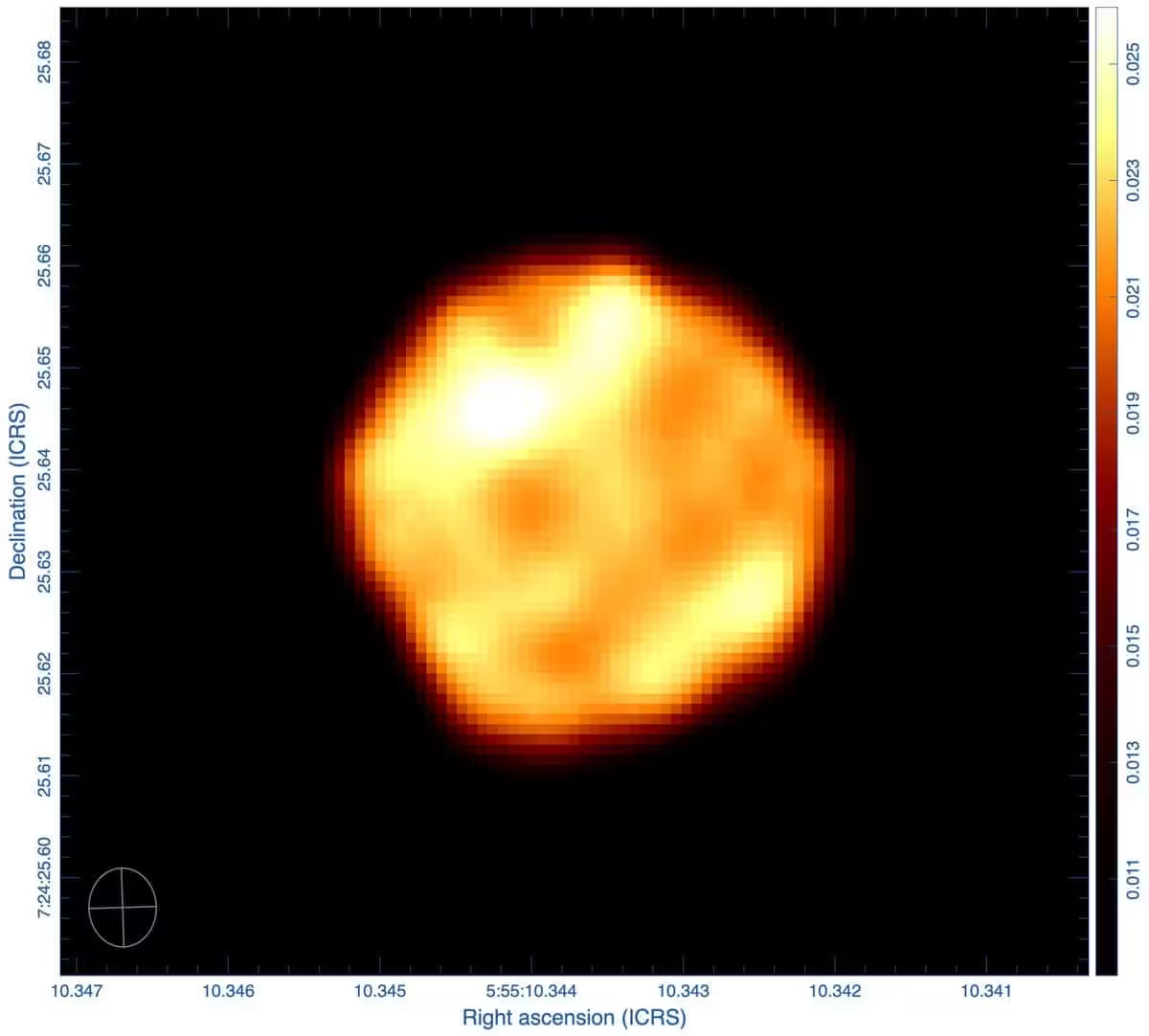
By leveraging the immense power of ALMA’s 66 radio antennas, the researchers achieved a spatial resolution of 7 milliarcseconds, a feat comparable to spotting a 13-meter object on the lunar surface. Because the array operates at millimeter and submillimeter wavelengths, it can effectively resolve the ionized and molecular gases located just above the star’s photosphere. The resulting maps show that the inner atmosphere is far from a uniform disk, displaying sharp, localized temperature gradients and structural imbalances.
The data indicates that Betelgeuse has become significantly more asymmetric over the last decade. The researchers identified intense hotspots, some registering temperatures roughly 800 degrees higher than the surrounding material. These features appear to be the signature of massive convective cells. While the Sun hosts a vast population of small-scale convective features, Betelgeuse is dominated by a fewer number of gargantuan cells that churn material through its outer layers.
Evidence of an Orbital Influence
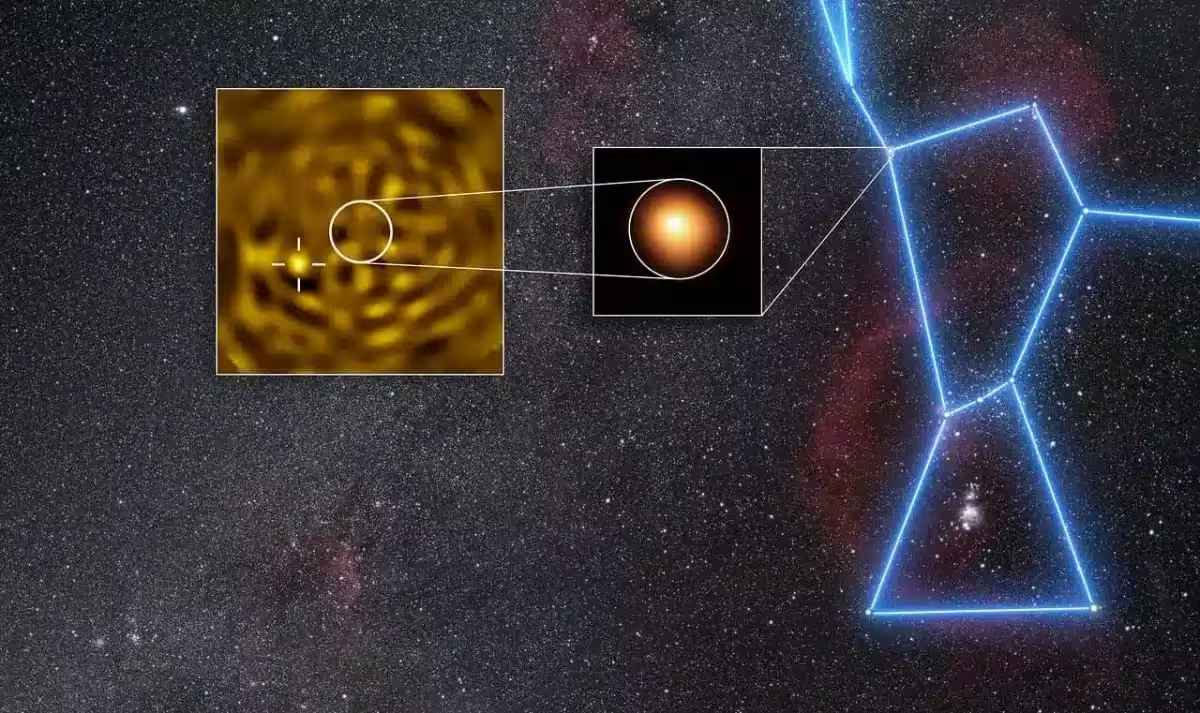
Most intriguing is the discovery that these bright hotspots are not randomly distributed. Observations indicate a preferred orientation that has persisted since 2015, suggesting a more stable, underlying geometry than previously assumed. This discovery coincides with growing evidence for a small companion star orbiting Betelgeuse, as reported in July 2026.
While the team stops short of confirming a causal link, the spatial alignment suggests that the companion’s orbit could be dictating the location of the most active convection zones. According to Dent, the most stable and persistent hotspots may reside near the poles of the star, potentially influenced by the gravitational interaction or orbital dynamics of the companion. Future studies will aim to track these structures over time to determine if they shift in correlation with the companion’s orbital path.
Understanding these dynamics is central to solving the mystery of how red supergiants shed their mass. As these stars approach the end of their lifespans, they cast off huge quantities of matter into space through stellar winds, eventually culminating in a supernova. By monitoring how energy and material move through these asymmetric layers, astronomers are gaining a clearer picture of the processes that feed the interstellar medium and ultimately lead to the violent death of massive stars.
This article has been fact checked for accuracy, with information verified against reputable sources. Learn more about us and our editorial process.
Last reviewed on .
Article history
- Latest version
Cite this page:
- Posted by Farah Siddiqui