Astronomers Finally Uncover The Violent Collision That Ejected A Supermassive Black Hole
Astronomers have pinpointed the violent galactic merger that ejected a supermassive black hole into intergalactic space, shedding light on its wild journey.
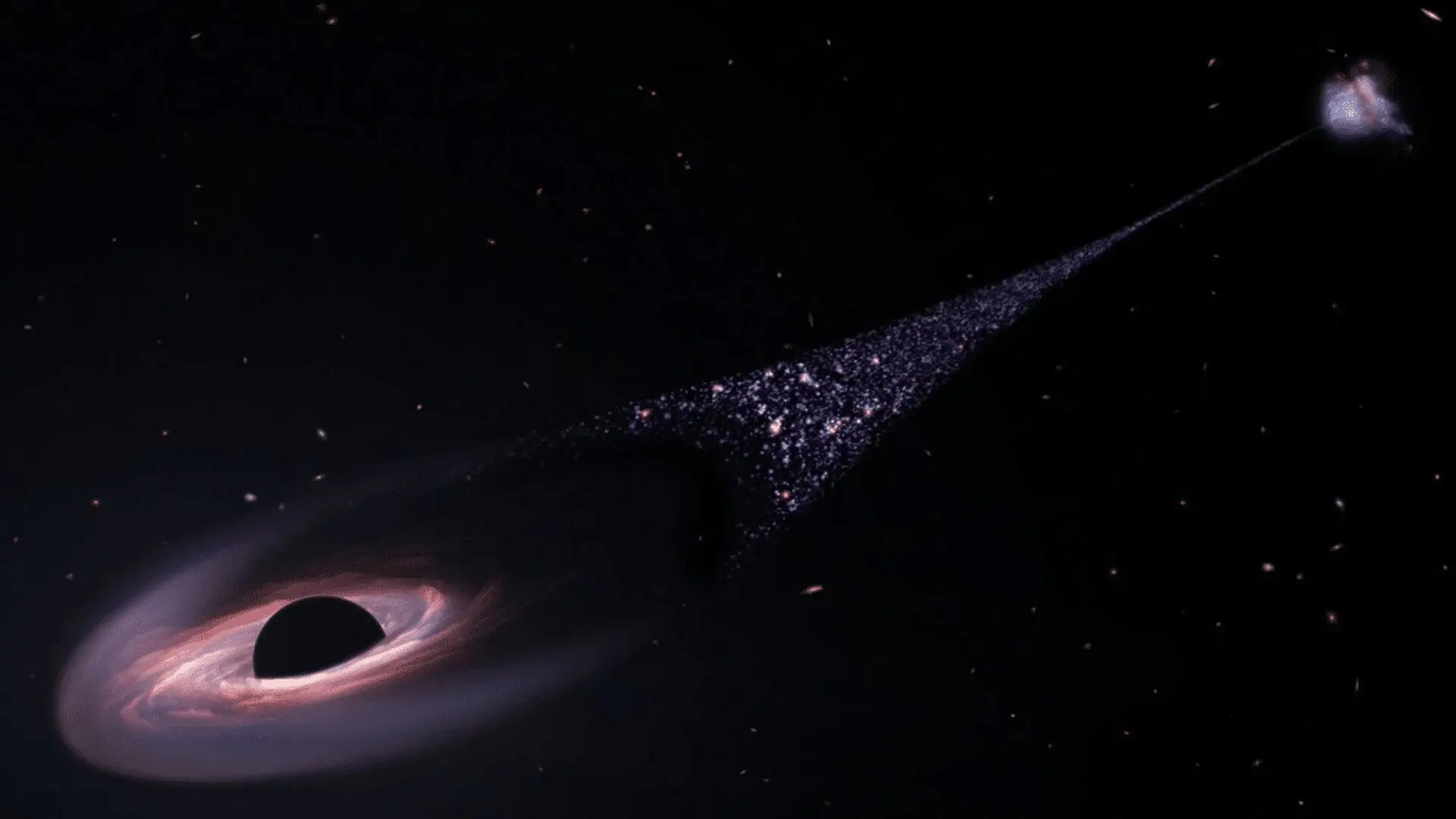
Astronomers have successfully reconstructed the origin of a rogue supermassive black hole, confirming that a violent celestial collision is responsible for launching the object on a high-speed trajectory through intergalactic space. The findings, published in Physical Review Letters, detail the history of RBH-1, a massive entity currently hurtling away from its parent galaxy at approximately 1,000 kilometers per second.
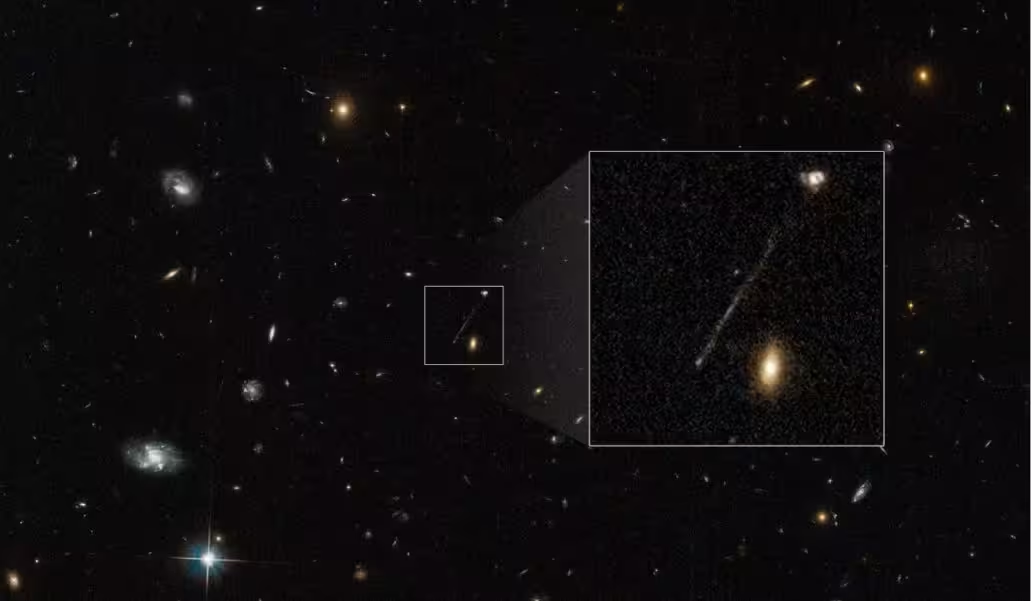
First identified in 2022, RBH-1 initially baffled researchers due to an unusual, elongated structure trailing behind it. Stretching over 202,000 light-years, this feature was eventually identified as a wake of newly formed stars ignited by the black hole’s passage through cold gas. The object is located roughly 7.5 billion light-years from Earth.
Mapping the Mechanics of a Galactic Kick
A research team from the University of California, Santa Barbara (UCSB) utilized deep-space data from the Hubble and James Webb space telescopes to trace the black hole’s path back to its source. To determine how such a massive object could be ejected, the team ran hundreds of thousands of simulations, testing various mass ratios, rotation speeds, and orbital alignments.
The data suggests that RBH-1 was forged from the merger of two smaller supermassive black holes. For this level of kinetic energy to be released, the two progenitors had to be spinning at extreme velocities. Specifically, the larger black hole was likely rotating at 70 to 75 percent of the maximum speed permitted by Einstein’s general relativity. Furthermore, the mismatch in the rotational axes of the two black holes provided the necessary gravitational recoil to slingshot the merged object out of its host galaxy.
“I was initially surprised by how extreme this sounds, but then I realized it probably had to be the case in order to have produced the dramatic feature visible in telescopes,” stated Tejaswi Venumadhav, an associate professor at UCSB and co-author of the study.
Rewriting the History of Galactic Evolution
The event appears to have been set in motion by a galactic collision roughly 70 million years before the ejection of RBH-1. This merger brought two central black holes into close proximity, where their intense gravitational interaction ultimately led to the supermassive black hole being cast out into the intergalactic void.
While theoretical models have long suggested that between 5 and 10 percent of galaxy mergers should result in the ejection of a central black hole, observing the phenomenon directly has proven difficult. RBH-1 serves as the first complete, observable case study of this process, offering researchers a rare window into the link between gravitational wave physics and the structural evolution of galaxies.
By studying the trajectory and the stellar trail left by this runaway object, astronomers can now better understand the chaotic history of mergers that shaped distant regions of the cosmos. The findings provide critical evidence that these “gravitational kicks” are not merely theoretical, but are a fundamental, albeit rare, aspect of how galaxies interact and evolve over billions of years.
This article has been fact checked for accuracy, with information verified against reputable sources. Learn more about us and our editorial process.
Last reviewed on .
Article history
- Latest version
Reference(s)
- “Physicists reconstruct the collision that launched a runaway black hole.”, August 24, 2026 The Current <https://news.ucsb.edu/2026/022754/physicists-reconstruct-collision-launched-runaway-black-hole>.
Cite this page:
- Posted by Farah Siddiqui