Scientists Have Finally Created A Lab-Grown Hexagonal Diamond That Is Harder Than Natural Gems
Scientists have achieved a breakthrough in studying a rare form of carbon, potentially explaining why it behaves so differently from ordinary diamonds.
Researchers in China have successfully synthesized pure, macroscopic samples of hexagonal diamond, a rare carbon allotrope also known as lonsdaleite. By creating high-quality specimens large enough for rigorous physical testing, the team has confirmed long-standing theories that this material possesses superior hardness and durability compared to the traditional cubic diamonds used in industry and jewelry.
The findings, detailed in the journal Nature, address a decades-old scientific bottleneck. While hexagonal diamond was first theorized in 1962 and later identified in microscopic fragments within meteorites in 1967, researchers had previously struggled to isolate enough of the mineral to definitively map its unique properties.
Engineering a Rare Crystal
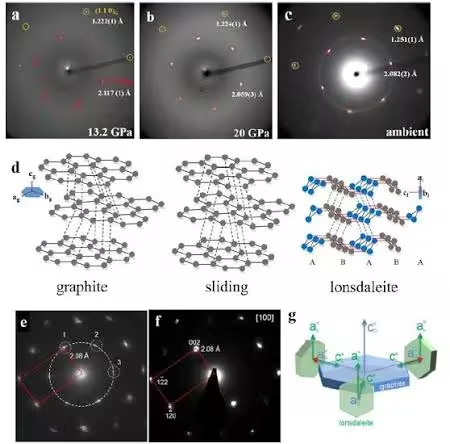
To produce the samples, the research team utilized a specialized high-pressure process. By compressing highly ordered graphite at approximately 20 gigapascals—a force equivalent to 200,000 times the atmospheric pressure at sea level—for a duration of 10 hours, they created a stable environment. Following this compression, the material was subjected to temperatures ranging between 1,300 and 1,900 degrees Celsius.
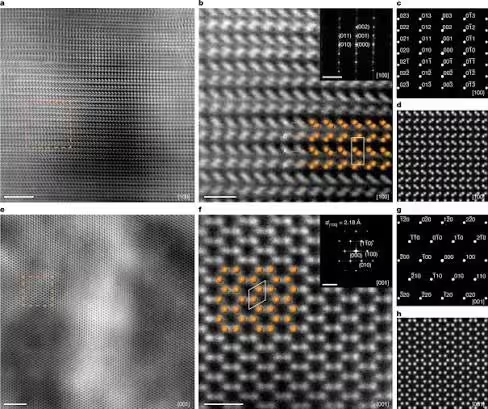
The resulting crystals measured roughly 1.5 millimeters in diameter. Using a combination of large-scale molecular simulations, spectroscopy, and structural analysis, the investigators were able to confirm the identity of the hexagonal lattice, which organizes carbon atoms in a honeycomb-like pattern rather than the standard cubic structure.
Advanced Mechanical Capabilities
Experimental data indicates that lonsdaleite is not only stiffer and harder than its cubic counterpart but also exhibits significantly higher resistance to oxidation. This chemical stability suggests that the material could maintain its integrity in high-temperature industrial environments where standard diamonds would typically begin to degrade.
As noted by Live Science, the ability to synthesize this mineral without the contaminants typically found in meteoritic samples opens new avenues for material science. The research highlights the delicate balance required for synthesis, as exceeding specific pressure and temperature thresholds causes the hexagonal structure to collapse into conventional diamond.
Future Industrial and Scientific Applications
Beyond its value as a laboratory specimen, lonsdaleite holds promise for practical applications. Physicist Chong-Xin Shan of Zhengzhou University, a co-lead author of the study, highlighted the material’s potential in thermal management systems, advanced cutting tools, and the evolving field of quantum sensing.
The discovery also aids researchers in deciphering the conditions of extraterrestrial impacts. By understanding exactly how lonsdaleite forms, scientists can better interpret the history of meteorites that carry these carbon structures, effectively using the minerals as geological sensors that record the violent events of the early solar system.
This article has been fact checked for accuracy, with information verified against reputable sources. Learn more about us and our editorial process.
Last reviewed on .
Article history
- Latest version
Reference(s)
- Lai, Shoulong., et al. “Bulk hexagonal diamond.” Nature, vol. 651, no. 8106, March 4, 2026, pp. 621-625. Springer Science and Business Media LLC, doi: 10.1038/s41586-026-10212-4. <https://doi.org/10.1038/s41586-026-10212-4>.
- Pine, Damien. “In physics first, Chinese scientists create rare 'hexagonal diamond' that's harder than natural diamond.”, March 15, 2026 Live Science <https://www.livescience.com/physics-mathematics/in-physics-first-chinese-scientists-create-rare-hexagonal-diamond-thats-harder-than-natural-diamond>.
Cite this page:
- Posted by Farah Siddiqui