After Five Years on Mars, NASA’s Perseverance Rover Is About to Complete a Marathon
NASA’s Perseverance rover has spent years exploring the Martian landscape, yet its newest target could be the most fascinating location it has encountered.
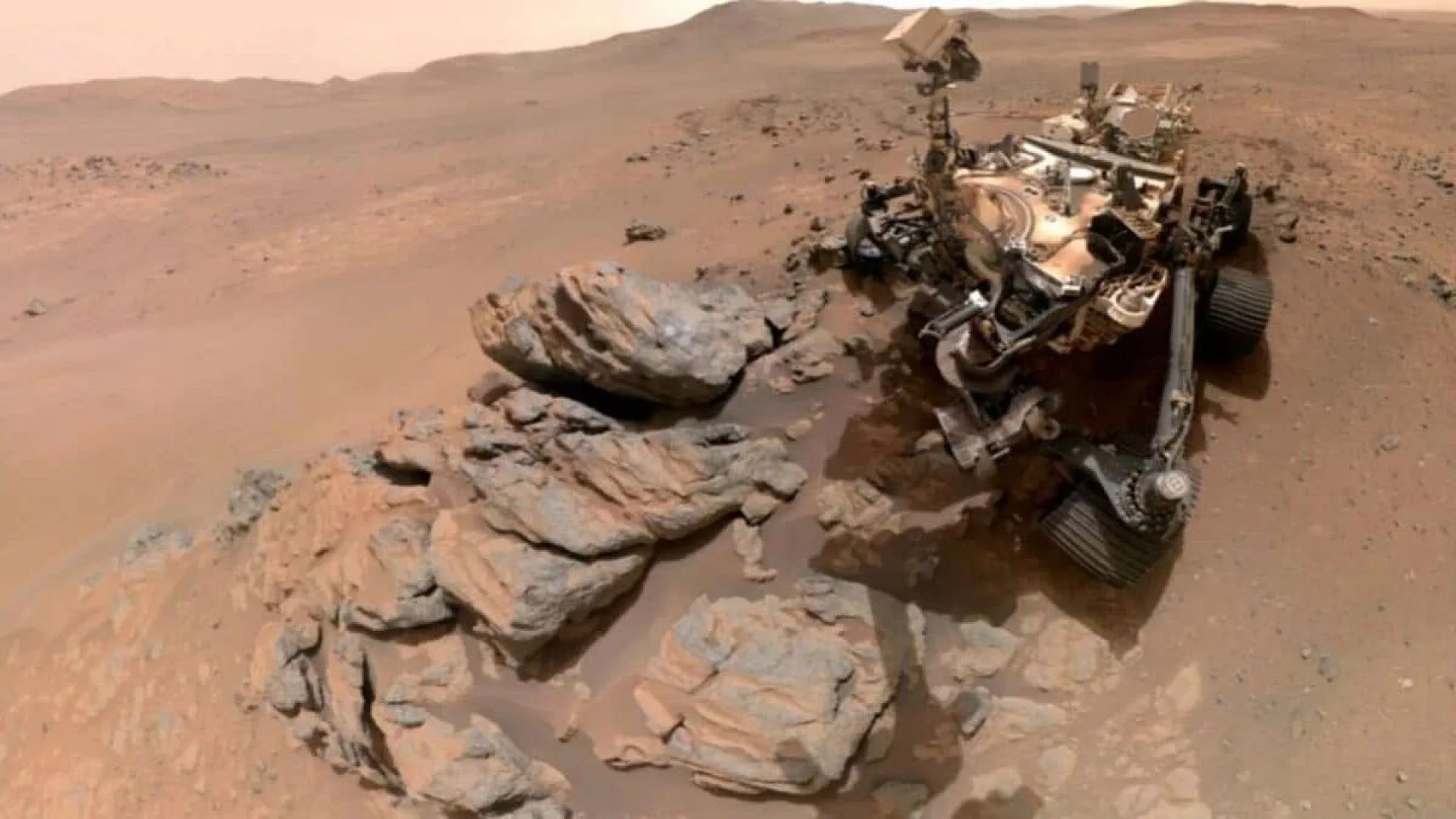
NASA’s Perseverance rover is closing in on a historic milestone on Mars after covering nearly 42 kilometers of the planet’s surface since its landing in February 2021. As it explores the Martian terrain, the rover is also investigating ancient rock formations that scientists believe could be among the oldest ever studied during the mission.
New images released by NASA show Perseverance situated just beyond the western rim of Jezero Crater, an area filled with ancient fractured rocks and geological structures that may reveal new insights into Mars’ early history. Researchers say the region has become one of the mission’s most scientifically valuable locations.
The rover is currently operating in an area known as Lac de Charmes, located west of Jezero Crater. The naming convention follows the rover team’s informal tradition of using lake- and water-themed names, as the mission is focused on exploring the remnants of an ancient Martian lake environment.
Recently, Perseverance completed its analysis of a rocky outcrop called Arathusa. Before studying the rock, the rover used its abrasion tool to grind away the altered outer surface and expose fresher material underneath. Geologists often employ the same method on Earth to study rock composition more accurately.
Perseverance Captures a Stunning Mars Selfie
NASA published a new self-portrait assembled from 61 individual images taken on March 11. The mosaic shows Perseverance beside the Arathusa outcrop after finishing scientific analysis at the site.
“We took this image when the rover was in the ‘Wild West’ beyond the Jezero Crater rim — the farthest west we have been since we landed at Jezero a little over five years ago,” Stack Morgan said.

Mission scientists believe the rocks in this region may predate the formation of Jezero Crater itself. NASA reported that analysis of the Arathusa outcrop revealed igneous minerals, suggesting volcanic origins tied to Mars’ distant past.
The surrounding landscape may appear barren at first glance, though researchers say it contains a surprising diversity of geological features. One enhanced-color panorama released by NASA shows Perseverance tracks stretching through the rocky Arbotregion, where rounded boulders sit below sharp-edged ridges.
Ancient Mars Rocks Hold Secrets of the Past
One of the most closely studied features in the area is the presence of megabreccia, large fragmented rocks believed to have formed during a massive impact event on Isidis Planitia roughly 3.9 billion years ago.
Scientists think these rocks were blasted into the air during the impact before falling across the surrounding terrain. Some fragments may have originated deep beneath the Martian surface. In comments released by NASA, Ken Farley, deputy project scientist at Caltech, stated:
“What I see in this image is excellent exposure of likely the oldest rocks we are going to investigate during this mission,” he also added, “There is a sharp ridgeline visible in the mosaic whose jagged, angular texture contrasts starkly with the rounded boulders in the foreground.”
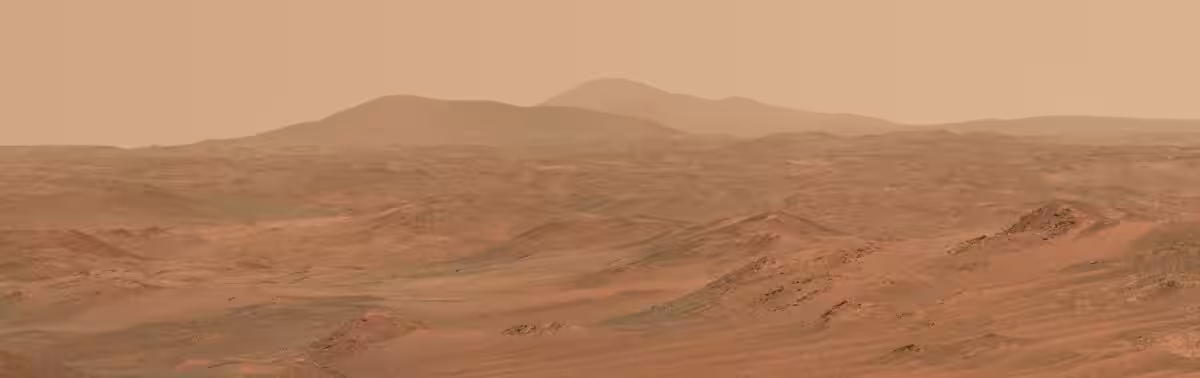
Researchers also identified what may be a volcanic dike, a vertical intrusion of magma that hardened underground before erosion gradually exposed it over billions of years.
These ancient formations are attracting attention because they may preserve evidence of Mars’ earliest geological conditions. Stack Morgan noted that rocks originating deep within the crust could help scientists better understand whether the Red planet once had a magma ocean and how the planet evolved into a potentially habitable environment.
Perseverance Prepares for Its Next Move
Perseverance has now traveled nearly the full length of a marathon, officially measured at 42.195 kilometers. The rover’s next symbolic milestone would be the equivalent of an ultramarathon, which begins at 50 kilometers. Steve Lee, acting project manager for the mission at JPL, said long-distance exploration has always been part of the rover’s design and scientific strategy.
“Having the benefit of four previous rover missions, the Perseverance team has always known our mission was a marathon and not a sprint.”
NASA says the rover will continue studying rocks in the Arbot region before potentially heading toward an area named Gardevarri, where exposed deposits of olivine have already been identified. The mineral forms deep inside planets at very high temperatures and can also contain carbonates associated with past water activity.
“We’ve almost reached marathon distance. Our selfie may show that the rover is a bit dusty, but its beauty is more than skin deep. Perseverance is in great shape as we continue our explorations and extend into ultramarathon drive distances,” he added.
Mission planners are also considering a future route toward Singing Canyon, another location containing ancient rock formations targeted for further analysis.
This article has been fact checked for accuracy, with information verified against reputable sources. Learn more about us and our editorial process.
Last reviewed on .
Article history
- Latest version
Reference(s)
- Laboratory, Jet. “NASA’s Perseverance Rover Snaps Selfie in Mars’ Western Frontier.” NASA Jet Propulsion Laboratory (JPL) <https://www.jpl.nasa.gov/news/nasas-perseverance-rover-snaps-selfie-in-mars-western-frontier/>.
- “Megabreccia - an overview | ScienceDirect Topics.”, doi: 10.1016/B978-0-444-53831-4.00002-1. <https://www.sciencedirect.com/topics/earth-and-planetary-sciences/megabreccia>.
- Laboratory, Jet. “Isidis Planitia.” NASA Jet Propulsion Laboratory (JPL) <https://www.jpl.nasa.gov/images/pia03087-isidis-planitia/>.
- “Kenneth A. Farley - Division of Geological and Planetary Sciences.” <https://www.gps.caltech.edu/people/kenneth-a-farley>.
- Team, NASA. “Steven Lee.”, June 29, 2018 NASA Science <https://science.nasa.gov/people/steven-lee/>.
Cite this page:
- Posted by Divya Iyer