New Zealand cave uncovers 1‑million‑year‑old bird and frog fossils, revealing lost forest
New Zealand’s hidden caves uncover fossils that reveal an ancient, alien-like environment, offering a glimpse into a world vastly different from today.
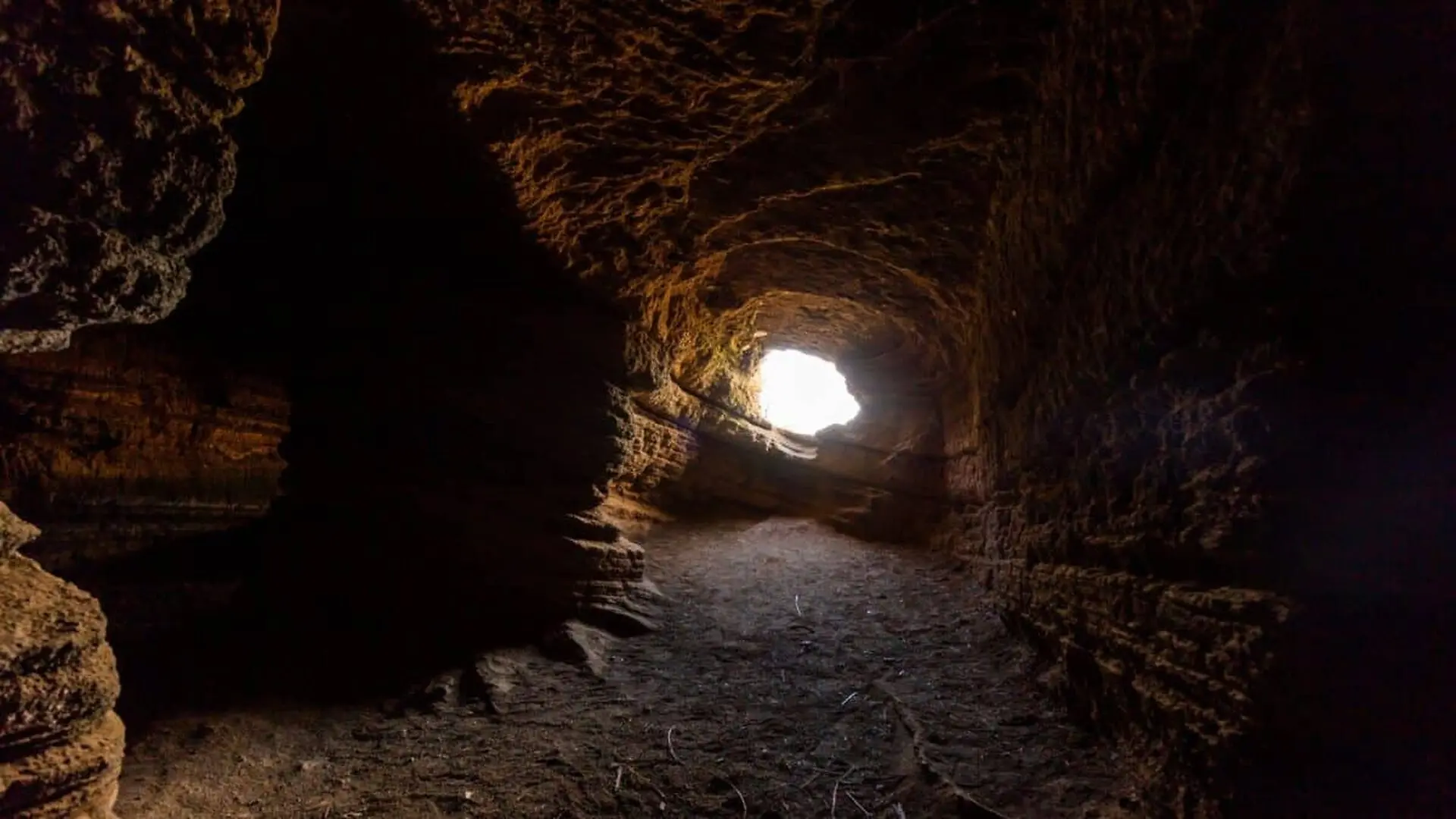
Researchers exploring a cave on New Zealand’s North Island have uncovered a fossil cache that dates back over one million years, offering a rare glimpse of an ancient forest community. The assemblage includes birds and frogs that no longer inhabit the region, together with several taxa that have never been recorded by science.
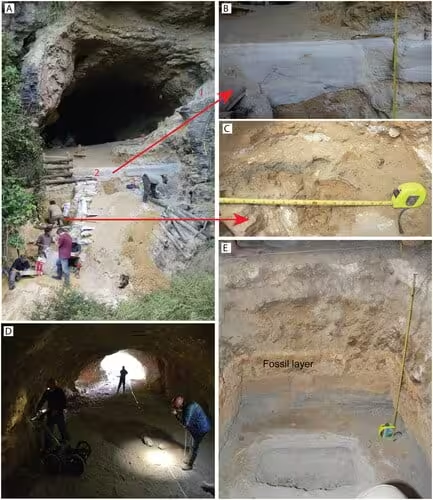
The remains were recovered from sediment layers inside a cave system that functioned as a natural time‑keeper over extensive periods. What sets the site apart is the precise geological context: volcanic ash layers trapped organic material, enabling scientists to piece together fragments of ecosystems that once flourished on the island but have since vanished.
For many years, knowledge of New Zealand’s pre‑human ecological past was limited to isolated fragments, leaving large gaps between older fossil records and more recent biological data. The research, published in Alcheringa: An Australasian Journal of Palaeontology, helps close part of that gap by extending the island’s biodiversity timeline into a period that was previously poorly documented.
Volcanic Ash Layers Preserve a Million‑Year Snapshot
The fossils were positioned between two distinct ash deposits, one dated to roughly 1.55 million years ago and the other to about 1 million years ago. These layers created a natural time capsule that kept the bones of birds and frogs that lived in forest and shrubland habitats intact.
Analysis of the cave sediments revealed 12 bird species and four frog species, including several avian forms not previously documented. The diversity points to a complex ecosystem that existed during a time of environmental instability on the island. Lead author Trevor Worthy, associate professor at Flinders University, said:
“This is a newly recognized avifauna for New Zealand, one that was replaced by the one humans encountered a million years later.”
Mass Extinctions Preceded Human Settlement
The study indicates that a substantial portion of New Zealand’s species loss occurred long before humans arrived, which began about 750 years ago. Researchers estimate that between 33 and 50 percent of species on the island vanished during the million years preceding human colonisation.
“The shifting forest and shrubland habitats forced a reset of the bird populations,” Scofield said. “We believe this was a major driver for the evolutionary diversification of birds and other fauna in the North Island,” co‑author Paul Scofield of Canterbury Museum explained.
These insights reshape the narrative of extinction on the islands, portraying it as a prolonged process rather than an event solely linked to human impact. The fossil record reveals repeated interruptions in ecological continuity, with major shifts in species composition over time.
The findings also illustrate how New Zealand’s uniquely isolated wildlife evolved under repeated environmental upheavals rather than through a steady, long‑term trajectory.
Newly Identified Birds Reveal Evolutionary Shifts
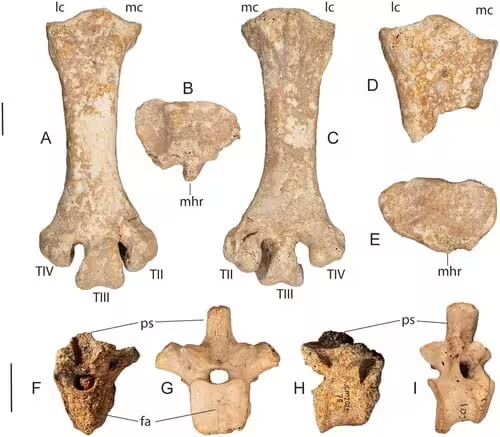
Among the most striking discoveries is an ancient parrot, Strigops insulaborealis, an early relative of the modern kākāpō. The fossil shows limb characteristics that suggest weaker legs than the present‑day species, raising the possibility that the bird retained some flight capability, a hypothesis that remains under investigation.
The site also yielded remains of a precursor to the modern takahē, adding depth to the evolutionary story of this large, flightless bird. In addition, researchers identified an extinct pigeon closely allied with Australian bronzewing pigeons, extending the historic range of that lineage.
Trevor Worthy noted that the assemblage demonstrates a far richer avian community in New Zealand’s ancient forests than previously recognised. Scofield added:
“This wasn’t a missing chapter in New Zealand’s ancient history, it was a missing volume.”
This article has been fact checked for accuracy, with information verified against reputable sources. Learn more about us and our editorial process.
Last reviewed on .
Article history
- Latest version
Reference(s)
- “Associate Professor Trevor Worthy - Flinders University.” Flinders University <https://www.flinders.edu.au/people/trevor.worthy>.
- Worthy, Trevor H.., et al. “The first Early Pleistocene ( ca 1 Ma) fossil terrestrial vertebrate fauna from a cave in New Zealand reveals substantial avifaunal turnover in the last million years.” Alcheringa: An Australasian Journal of Palaeontology, vol. 50, no. 1, January 26, 2026, pp. 480-519. Informa UK Limited, doi: 10.1080/03115518.2025.2605684. <https://www.tandfonline.com/doi/full/10.1080/03115518.2025.2605684>.
- “Paul Scofield Senior Curator Human History.” Canterbury Museum <https://www.canterburymuseum.com/research-education/our-researchers/paul-scofield>.
Cite this page:
- Posted by Linda Wilson