Hidden Forces Deep Inside Earth Are Secretly Changing the Length of Our Days
Earth’s rotation is slowing in unexpected ways, revealing mysterious, hidden processes occurring deep within the planet’s core.

The length of an Earth day is not a fixed constant. While we rely on the 24-hour cycle to structure our lives, the planet’s rotation speed fluctuates, occasionally shaving off or adding a few milliseconds. While these variations are imperceptible to the average person, they provide geophysicists with a rare window into the turbulent, inaccessible machinery operating thousands of miles beneath our feet.
Recent research indicates that a portion of these rotational shifts stems from a complex, hidden struggle for angular momentum occurring between the planet’s inner core, outer core, and the surrounding mantle. While phenomena such as massive earthquakes, shifting ice sheets, atmospheric winds, and ocean tides are known to influence Earth’s spin, they do not account for the entirety of the decadal changes observed by scientists.
Unveiling the Dynamics of the Deep Interior
A new study, published in Nature, offers a fresh perspective on this interplay. Researchers Huifeng Zhang and Mathieu Dumberry from the University of Alberta reconstructed the interaction between the core and mantle spanning the years 1964 to 2019. By integrating seismic data regarding inner-core rotation with advanced models of outer-core fluid dynamics, the team sought to clarify how forces are transmitted across the core-mantle boundary.
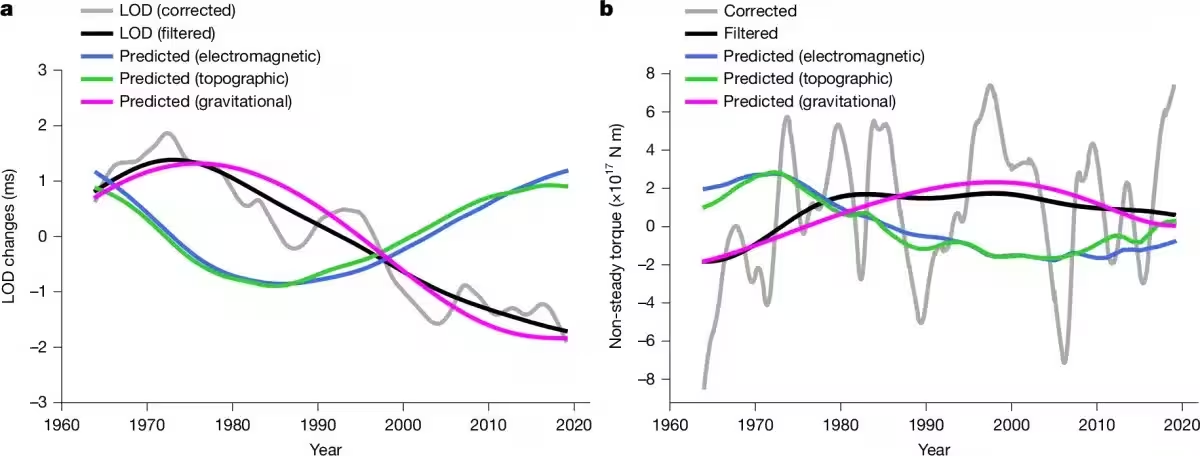
While scientists have recognized for over three decades that core-mantle interactions drive these variations, the exact mechanism of force transfer has remained elusive. The researchers suggest that viscous drag—the friction created by flowing liquid metal—is insufficient to explain the observed shifts. Instead, they point toward electromagnetic stress, hypothesizing that the lowermost mantle acts as an electrical conductor, allowing the churning metal of the outer core to exert significant influence on the layers above it.
A Subterranean Tug-of-War
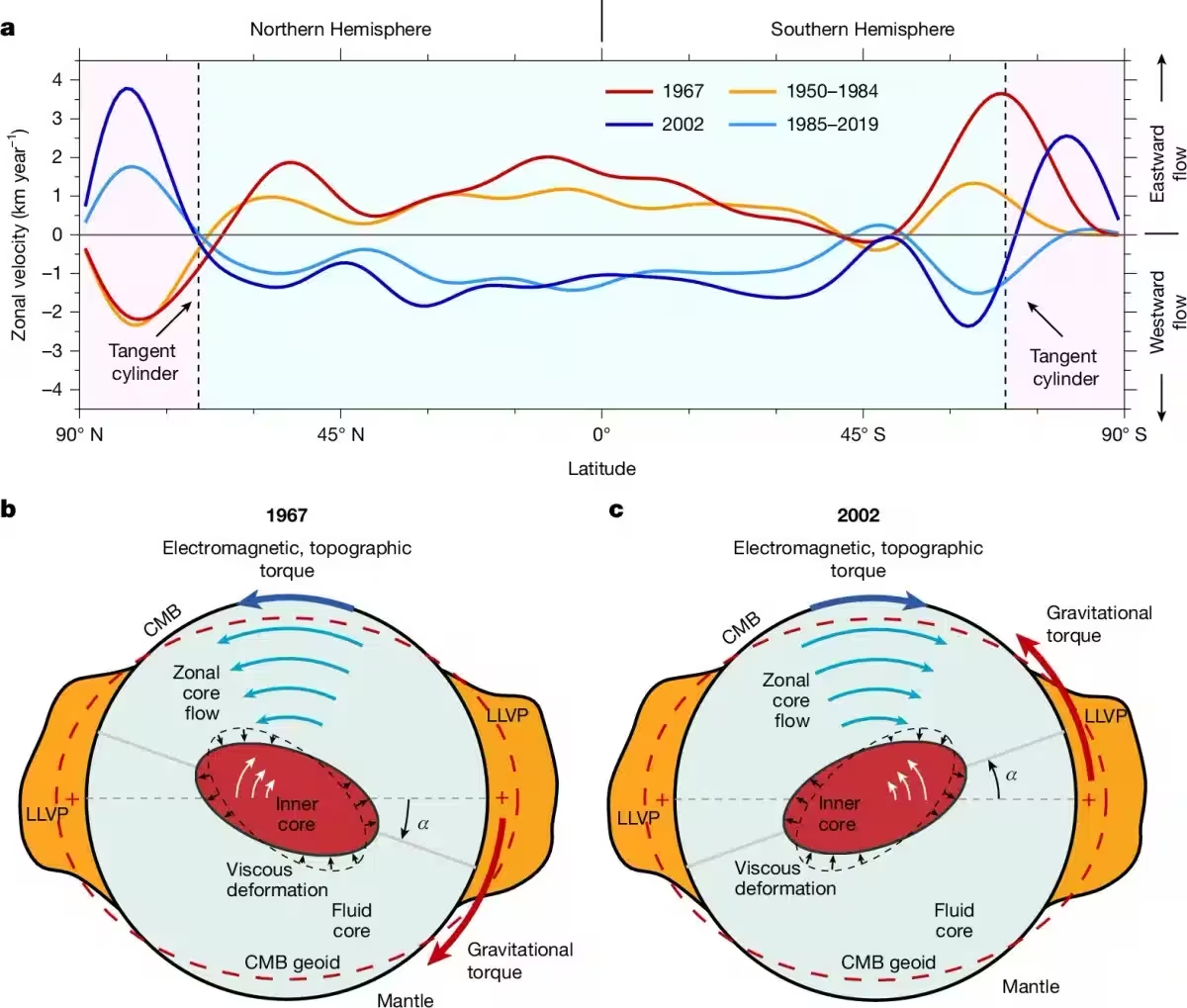
The study reveals a persistent mechanical tension deep within the planet. When material at the core-mantle boundary moves westward, it exerts a corresponding westward torque on the mantle. Simultaneously, the inner core, which rotates at a slightly different rate and maintains an eastward offset, experiences a gravitational pull that attempts to realign it with the mantle. This creates a competing eastward torque.
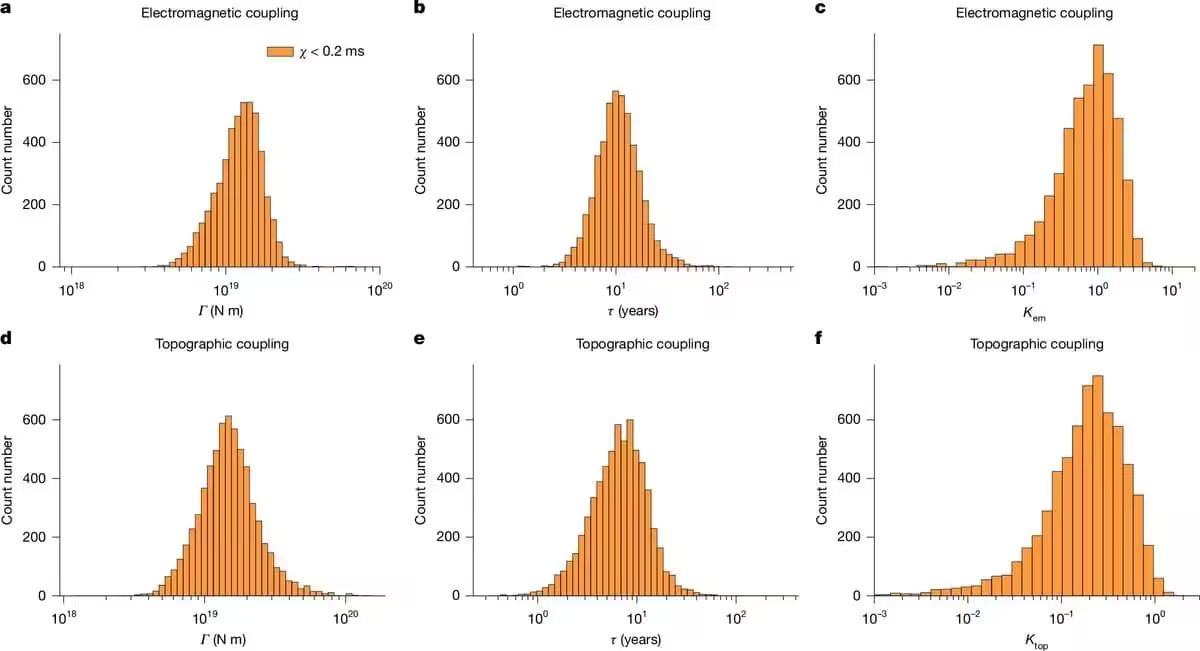
These two opposing forces exist in a delicate balance. When this equilibrium shifts, the rotation of the entire planet adjusts, manifesting as the subtle changes in the length of a day that scientists measure. Furthermore, the researchers suggest that the inner core may undergo minor structural deformations over just a few years, adding another layer of complexity to this internal system.
The Limits of Current Models
While the study provides a robust framework, it is not without limitations. Current seismic measurement precision limits the researchers’ ability to resolve fluctuations occurring on timescales shorter than two or three decades. Consequently, while they have successfully modeled longer-term trends, the nuances of shorter-term variations remain difficult to capture.
Moreover, the models currently lack full resolution of all electromagnetic and topographic torques. As Zhang and Dumberry noted, refining our understanding of these core-mantle forces is vital, as it directly contributes to our comprehension of the physical properties and dynamic evolution of the Earth’s deep interior.
For the average inhabitant of Earth, these millisecond variations are entirely irrelevant to daily life. However, to the scientific community, they serve as essential data points, echoing the persistent, quiet mechanical struggle occurring deep below our feet.
This article has been fact checked for accuracy, with information verified against reputable sources. Learn more about us and our editorial process.
Last reviewed on .
Article history
- Latest version
Reference(s)
- Zhang, Huifeng. “Gravitational torque drives multidecadal variations in length of day - Nature.”, vol. 658, no. 8134, pp. 119-124. Nature, doi: 10.1038/s41586-026-10999-2. <https://go.redirectingat.com/?id=74968X1525083&url=https%3A%2F%2Fwww.nature.com%2Farticles%2Fs41586-026-10999-2&sref=https%3A%2F%2Fwww.popularmechanics.com%2Fscience%2Fa73961847%2Fdeep-earth-length-days%2F&xs=1&xcust=%5Butm_source%7C%5Butm_campaign%7C%5Butm_medium%7C%5Bgclid%7C%5Bmsclkid%7C%5Bfbclid%7C%5Brefdomain%7C%5Bcontent_id%7C65ba902e-04c6-4d9a-948e-7115779c8ee5%5Bcontent_product_id%7Caa1f3068-d9c5-4b65-8ead-70cbe5f402fb%5Bproduct_retailer_id%7C5cec9d00-00d8-463c-a92d-6a6fb174fb1c%5Blt%7C%5Baxid%7Cca9f17f9-5a8e-49ca-8f9c-e8270e45e2ab%5D&xcreo=500008>.
Cite this page:
- Posted by Vikram Desai