Lab Tests Reveal How Fracture Angles and Stress Cycles Break Deep Coal
Researchers discover that specific cut angles and dynamic loading amplitudes trigger complex fracture networks in deep coal seams.
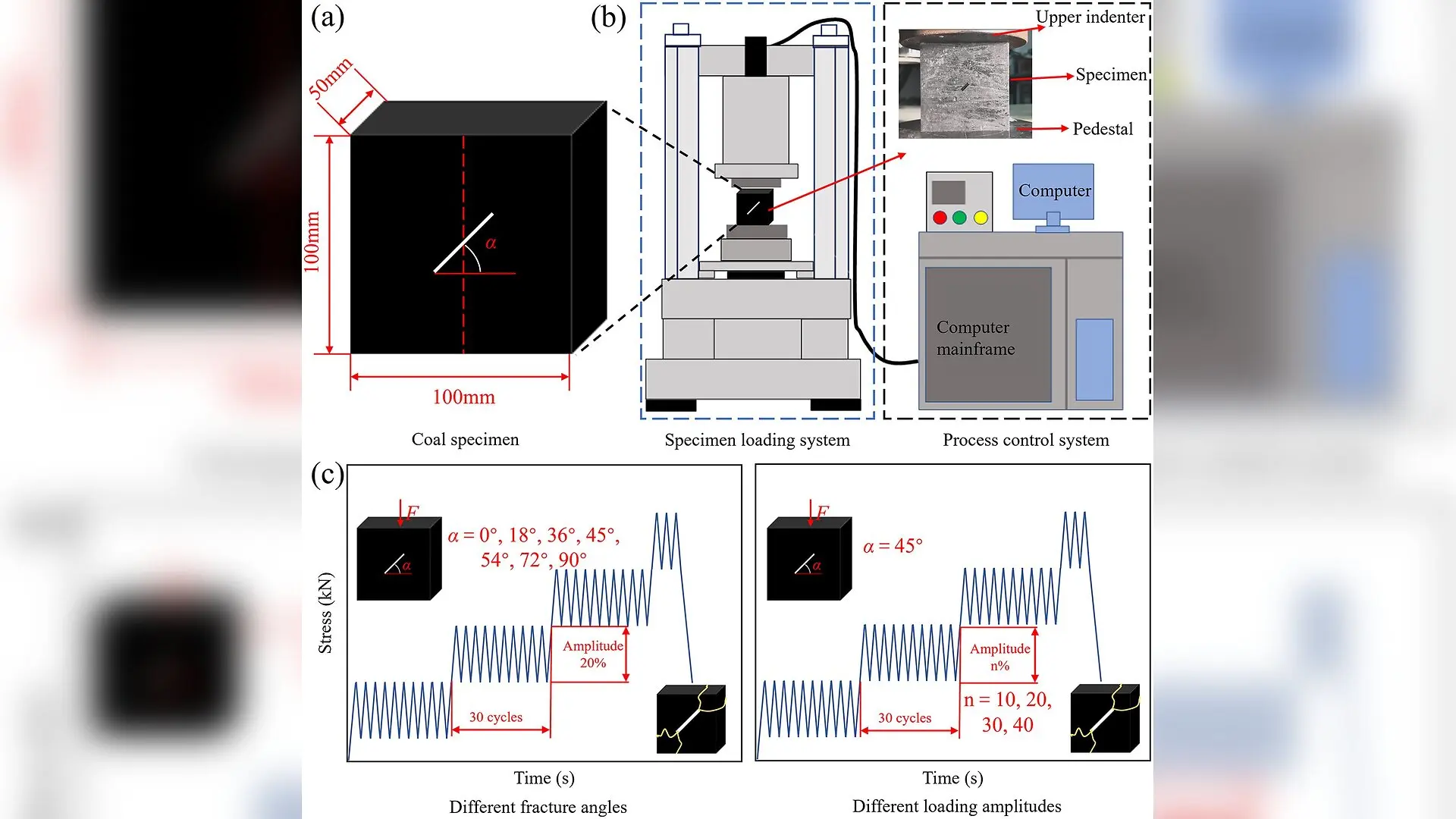
Deep underground coal formations experience intense pressure and repeat disturbances that complicate efforts to extract trapped methane gas, but laboratory tests now reveal how specific fracture angles and cyclic loading patterns alter coal deformation. As mining operations reach deeper into low-permeability rock, enhancing gas flow paths through techniques like hydraulic cutting becomes essential for both safety and resource recovery.
How Cutting Angles and Stress Cycles Shape Coal Failure
To understand how external disturbances influence slotted coal bodies, researchers performed laboratory experiments on rectangular coal specimens measuring 100 mm by 100 mm by 50 mm. Each sample contained a pre-fabricated central fracture set at various angles ranging from 0 degrees to 90 degrees. These samples were tested on a universal testing machine using multi-level cyclic loading and unloading stress paths designed to simulate repeated mining disturbances. The findings were published in PLOS One by Xiaoyan Sun and colleagues, detailing the complex interplay between stress amplitudes and structural angles.
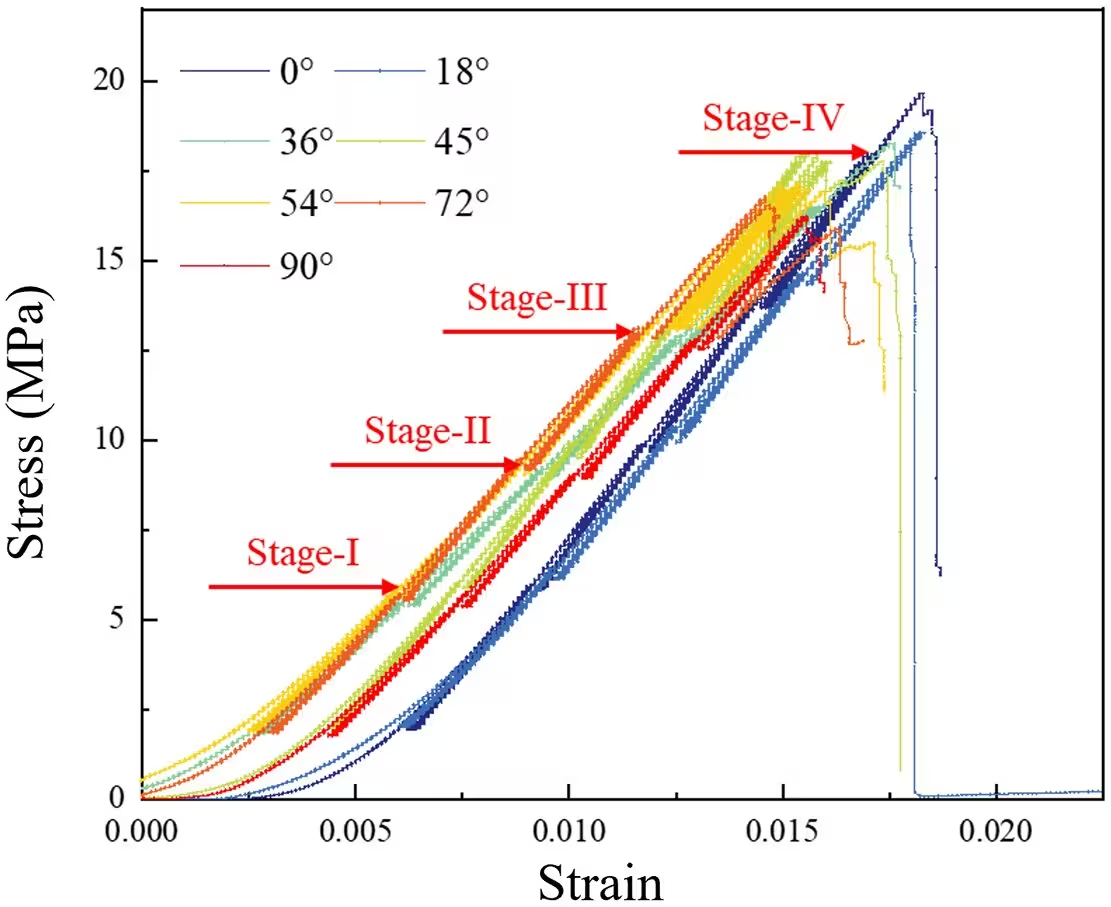
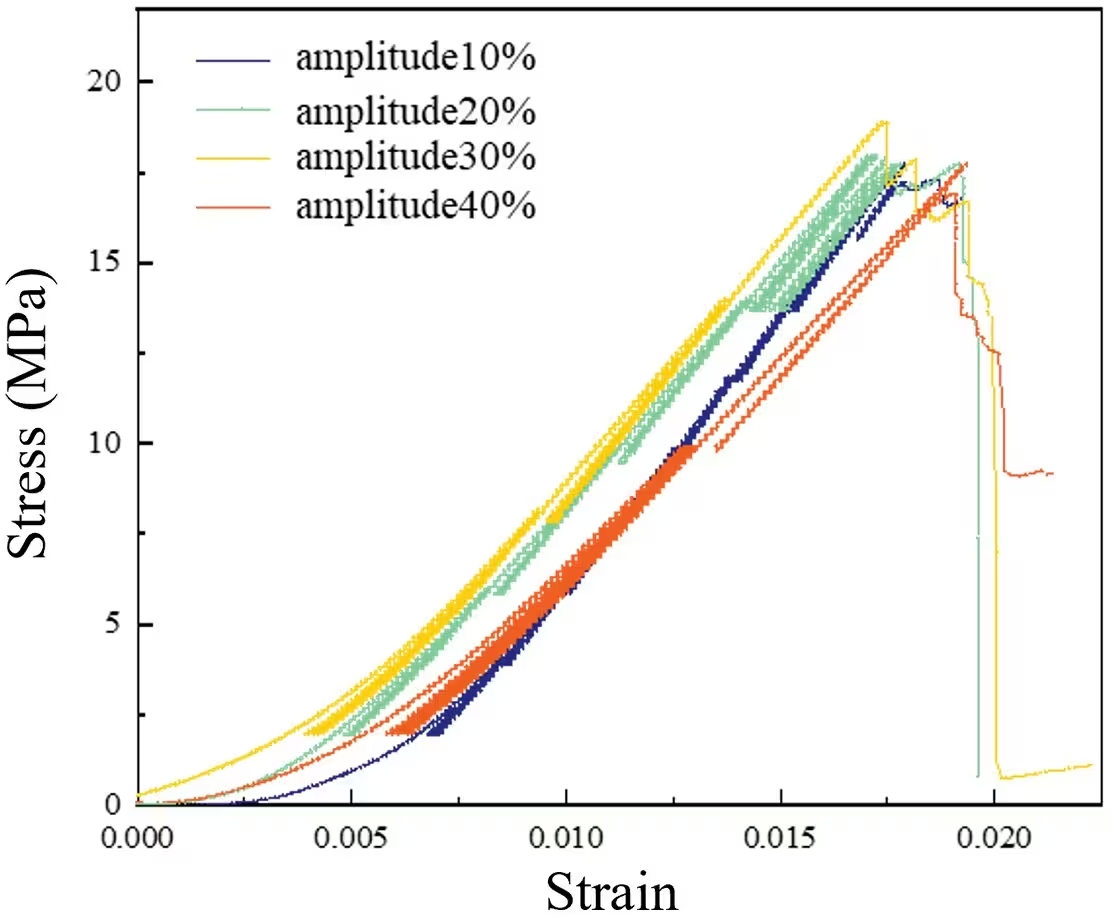
The stress-strain curves recorded during the tests displayed a characteristic sparse-dense-sparse pattern in their plastic hysteresis loops. During initial loading, loops were sparse due to the compaction of internal pores, followed by a denser quasi-elastic phase, and finally a sparse region as rapid plastic deformation accumulated near failure. Both peak strength and peak strain decreased as the pre-cut fracture angle increased from 0 to 90 degrees. Conversely, when keeping the fracture angle constant at 45 degrees and varying the cyclic stress amplitude, the peak strength remained largely stable while the peak strain increased alongside the loading amplitude.
Energy Dissipation and Modulus Shifts Under Dynamic Stress
The ability of coal to resist deformation was evaluated using loading and unloading secant moduli. At low stress levels, the modulus of the specimens increased rapidly before stabilizing, whereas near the point of failure, the modulus rose quickly and then dropped as damage took over. The average unloading and loading moduli consistently decreased as the fracture angle increased, indicating that steeper or wider angles weaken the structural integrity of the material. Furthermore, higher cyclic amplitudes resulted in lower average moduli during corresponding loading stages, pointing to accelerated fatigue damage.
Energy calculations showed that input energy splits into elastic strain energy and dissipated energy, with the dissipated portion fueling internal fracture growth. The proportion of dissipated energy varied significantly depending on the geometry of the pre-cut slot. Samples with fracture angles of 36 degrees and 45 degrees exhibited peak dissipated energy ratios, reaching up to 11.23 percent under higher cyclic amplitudes. This heightened energy consumption corresponded directly to more extensive microfracture propagation and the creation of intricate fracture networks.
Why Certain Fracture Angles Create Complex Network Patterns
Three-dimensional scanning of the fractured cross-sections revealed distinct morphological shifts across different angles and stress levels. At low angles of 0 and 18 degrees, fractures propagated smoothly along the pre-existing slot direction with minimal deviation. At 36 and 45 degrees, however, the paths became highly convoluted, producing a dense network of secondary transverse and wing fractures driven by mixed tensile-shear failure. At 90 degrees, fracture propagation was restricted, resulting in simpler, open-type failure surfaces.
Similarly, increasing the cyclic loading amplitude from 10 percent to 40 percent intensified structural complexity. Higher dynamic load disturbances promoted extensive branching, yielding rougher fracture surfaces and sharply reducing bedding plane separation phenomena. The authors concluded that hydraulic cutting angles fundamentally dictate whether a coal body fails via shear, tension, or a hybrid mode, providing critical data to optimize underground methane extraction protocols.
The research was published in PLOS One on November 19, 2026.
This article has been fact checked for accuracy, with information verified against reputable sources. Learn more about us and our editorial process.
Last reviewed on .
Article history
- Latest version
Reference(s)
- Sun, Xiaoyan., et al. “Deformation response and energy evolution of slotted coal subjected to cyclic loading.” PLOS One, vol. 21, no. 11, November 19, 2026, pp. e0362971 Public Library of Science (PLoS), doi: 10.1371/journal.pone.0362971. <https://doi.org/10.1371/journal.pone.0362971>.
Cite this page:
- Posted by Bilal Abbasi