Möbius Strip Geometry Forces Liquid Crystals Into Unusual Topological States
A study on curved, non-orientable surfaces reveals how molecular alignment splits based on the parity of half-twists.
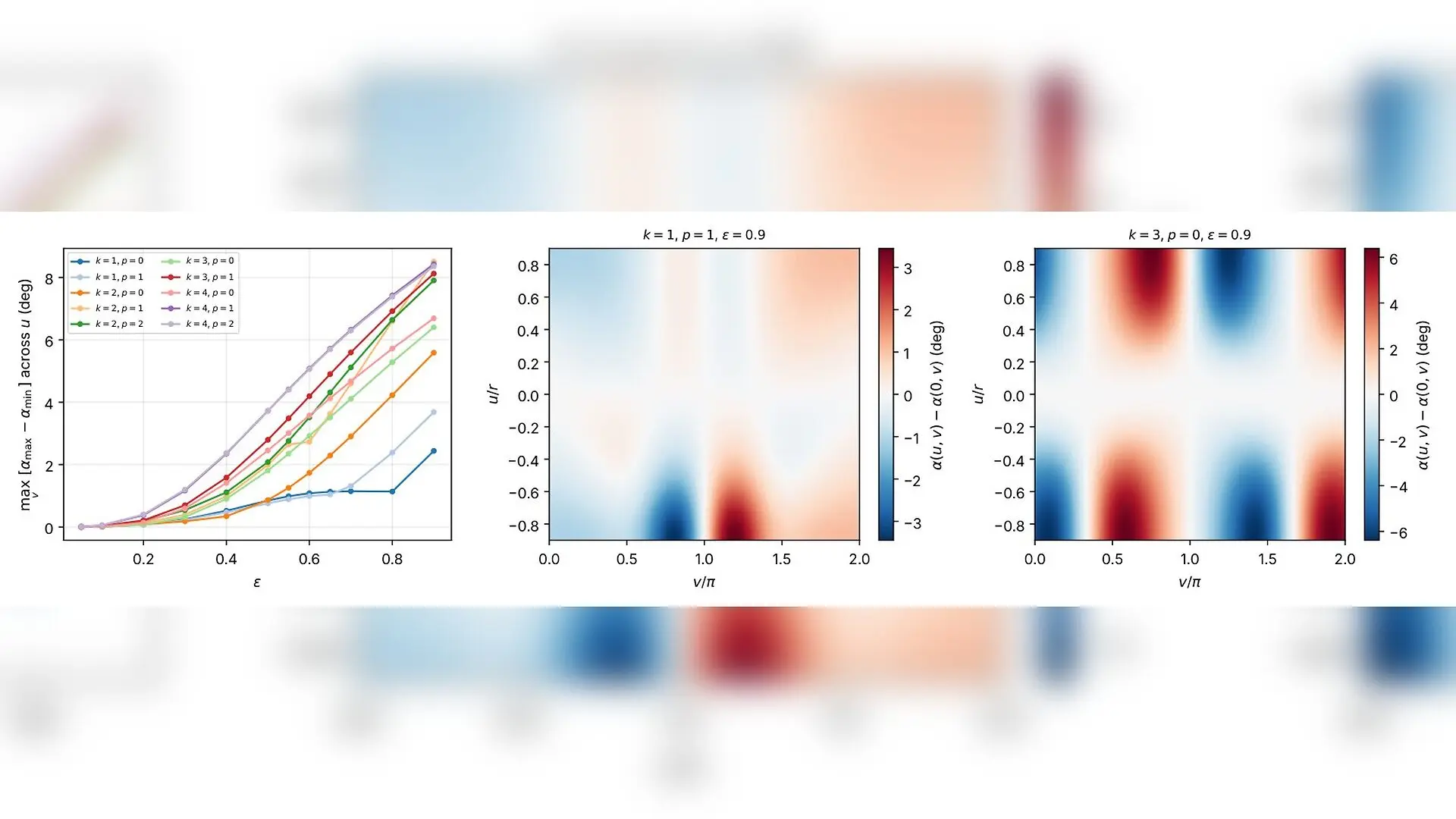
When rod-shaped molecules of a nematic liquid crystal are confined to the twisted geometry of a Möbius strip, their molecular alignment responds in surprising ways to the surface’s unique topological constraints. Researchers investigating how non-orientable surfaces shape ordered phases discovered that the physical behavior of these liquid crystals depends heavily on whether the strip contains an even or odd number of half-twists.
The study, available on the arXiv preprint server, was conducted by Massimo Frittelli, Sébastien Fumeron, and Gaetano Napoli. They analyzed how a thin layer of nematic liquid crystal, where molecules maintain a uniform average orientation known as a director, behaves when forced to conform to both the intrinsic geometry and the extrinsic curvature of a Möbius-like ring.
Unlike standard cylindrical surfaces where molecular orientations form predictable winding numbers, a Möbius strip lacks orientability, meaning a global reference frame cannot be defined without interruption. Because the molecules exhibit head-to-tail symmetry, the researchers found that the topological classification splits based on the parity of the twist count.
How Twist Parity Controls Molecular Order
For strips with an even number of half-twists, the topological index acts as a traditional winding number, where integer steps quantify complete rotations of the molecular director. However, when the strip possesses an odd number of half-twists, the head-to-tail symmetry of the liquid crystal means that only the parity of the sector becomes physically meaningful, preventing the net rotation of the director along the core line from being quantized.
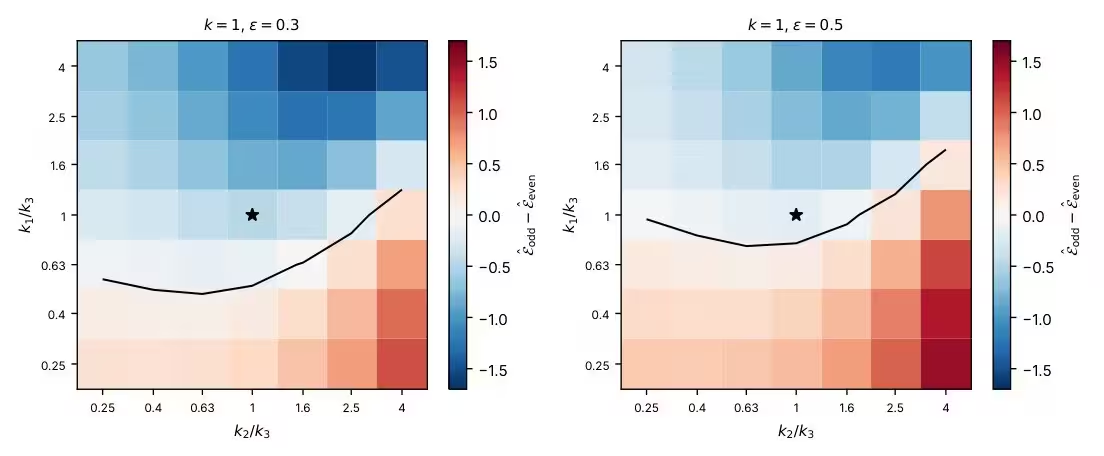
Using finite-element methods alongside reduced analytical models, the authors mapped out the energy landscapes of these configurations across different aspect ratios and elastic constants. They observed that for a single half-twist, the preferred energy state shifts from an odd topological sector to an even sector once the strip aspect ratio exceeds approximately 0.58.
Energy Competition and Structural Strains
The geometry of the curved substrate introduces mechanical frustration into the system. As the strip width relative to the central radius increases, the internal energy costs associated with splay, twist, and bend deformations force the liquid crystal to reorganize.
For strips featuring two half-twists, the team identified two distinct energy minima within the same topological sector that exchange their dominance near an aspect ratio of 0.60, occurring without any underlying change in topology. Furthermore, exploring elastic anisotropy revealed that stiff splay elasticity strongly favors odd sectors, while large twist constants favor even sectors.
While the current mathematical framework relies on smooth line fields under the assumption of a very thin film, the findings highlight how non-orientable surfaces and extrinsic curvature jointly dictate equilibrium states. The authors note that extending these insights to active matter systems or incorporating variable scalar order parameters will help clarify how topological defects emerge in more complex soft matter architectures.
The study was posted to the arXiv preprint server on November 19, 2026.
This article has been fact checked for accuracy, with information verified against reputable sources. Learn more about us and our editorial process.
Last reviewed on .
Article history
- Latest version
Reference(s)
- Frittelli, Massimo. “Nematic equilibria on a Möbius strip: topology and extrinsic curvature.” arXiv.org <http://arxiv.org/abs/2611.26552v1>.
Cite this page:
- Posted by Bilal Abbasi