Oldest Known Wooden Structure Found in Africa Rewrites History of Human Ingenuity
Archaeologists have discovered mysterious ancient structures buried deep beneath a Zambian riverbank, built by an unknown group of early humans.

Archaeologists have unearthed evidence of sophisticated engineering dating back nearly half a million years, long before the emergence of Homo sapiens. Along the banks of the Kalambo River in Zambia, researchers discovered two interlocking logs, shaped and joined by an ancient hand, which constitute the oldest known wooden structure ever recorded.
The discovery, detailed in the journal Nature, pushes back the timeline for human mastery over natural materials. By analyzing the sediment surrounding the logs, a team led by Larry Barham of the University of Liverpool determined the structure is at least 476,000 years old.
Precision Craftsmanship in the Deep Past
The logs were found in a waterlogged, oxygen-deprived environment upstream of Kalambo Falls. The upper log, a piece of bushwillow (Combretum zeyheri), features a carefully carved, U-shaped notch that fits securely over a larger supporting trunk. Microscopic analysis reveals that this notch was fashioned using stone tools, exhibiting distinct chopping and scraping marks consistent with deliberate woodworking techniques.
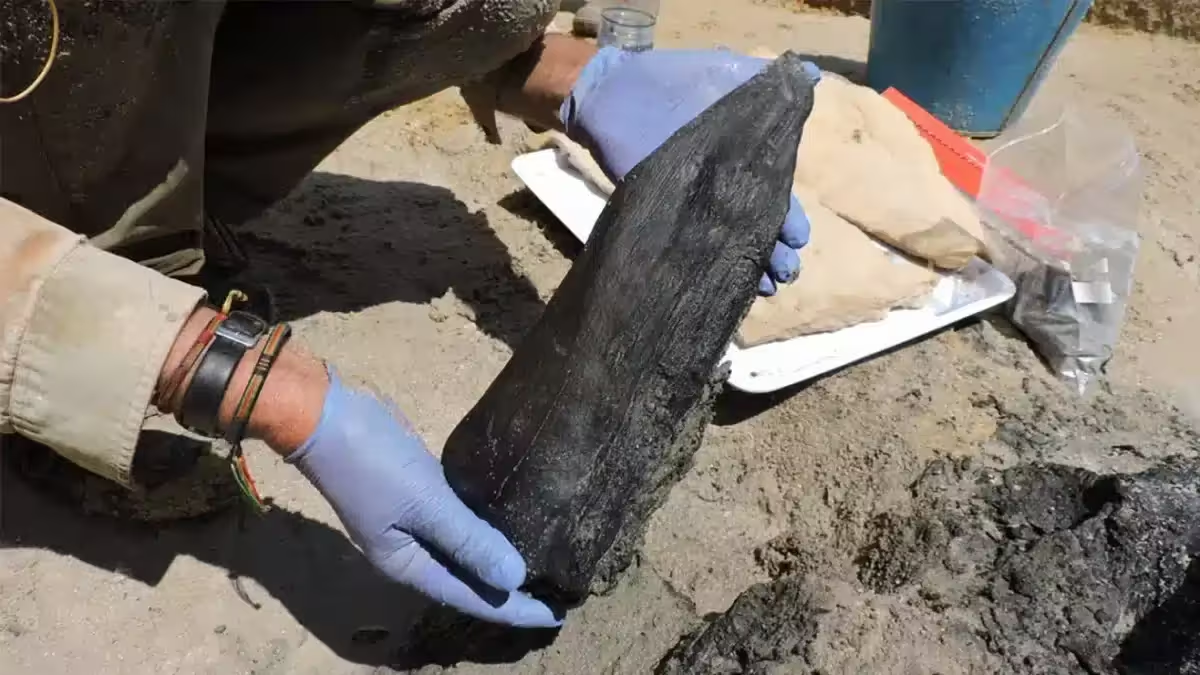
Barham noted that the notch was designed to prevent lateral movement, providing critical stability to the arrangement. For the research team, this represents a major cognitive leap, suggesting that early hominins were capable of complex planning and intentional environmental modification.
Dating Ancient Timber
Because the wooden remains far exceed the range of traditional radiocarbon dating, the team employed luminescence dating on the surrounding sand. This technique measures the last time mineral grains were exposed to sunlight, providing a chronological anchor for the archaeological layer. Analysis of 16 samples confirmed a mean age of 476,000 years, with some estimates suggesting the site could be as old as 554,000 years.

The discovery far surpasses previous records for wooden structures, which were previously thought to be no more than 9,000 years old. While older individual wooden artifacts exist, such as a 780,000-year-old plank fragment from Israel, the Kalambo site is unique in demonstrating the assembly of multiple components.
Evidence of a Constructed Environment
Beyond the primary structure, the riverbank yielded additional modified wooden implements, including a wedge and a digging stick. The presence of these tools supports the theory that the logs were part of a larger, functional assembly, perhaps serving as a raised platform or foundation to protect against the river’s seasonal flooding.

Archaeologist Annemieke Milks of the University of Reading, who was not involved in the study, described the find as a significant window into the capabilities of early hominins. The act of joining two pieces of wood is also seen as a technical precursor to hafting, the critical innovation of attaching stone tools to handles.
Identifying the Architects
Because no skeletal remains were recovered at the site, the identity of the builders remains a subject of speculation. Barham suggests that the individuals responsible were likely Homo heidelbergensis, a hominin species known to have occupied the region during that timeframe. Other possibilities include Homo erectus.

The logs are currently undergoing conservation efforts at the York Archaeological Trust in the United Kingdom. Upon completion, they will be repatriated to Zambia for permanent display at the Livingstone Museum.
This article has been fact checked for accuracy, with information verified against reputable sources. Learn more about us and our editorial process.
Last reviewed on .
Article history
- Latest version
Reference(s)
- Barham, L.. “Evidence for the earliest structural use of wood at least 476,000 years ago - Nature.”, vol. 622, no. 7981, pp. 107-111. Nature, doi: 10.1038/s41586-023-06557-9. <https://www.nature.com/articles/s41586-023-06557-9>.
- Metcalfe, Tom. “Earliest Evidence of Wooden Construction Uncovered.”, September 20, 2023 Scientific American <https://www.scientificamerican.com/article/earliest-evidence-of-wooden-construction-uncovered/>.
Cite this page:
- Posted by Vikram Desai