Century Old Fossil Found in London Museum Drawer Identified as New Species of Dinosaur
A 120-million-year-old feathered predator with massive claws has been discovered sitting unnoticed in a London museum drawer for nearly a century.

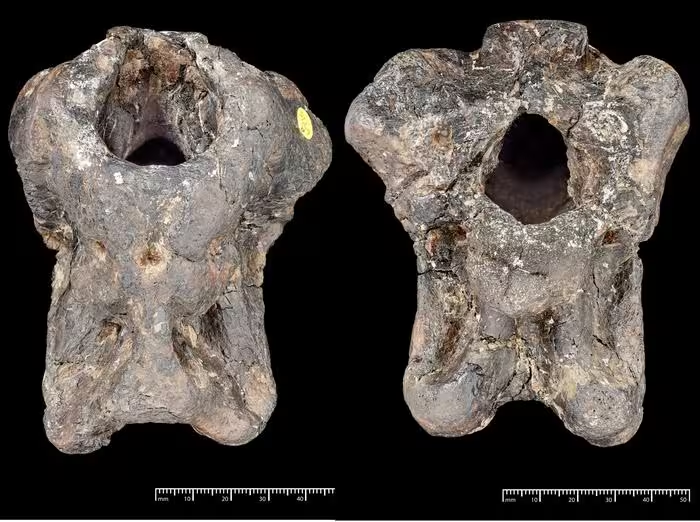
A fossilized fragment, relegated to a museum drawer for nearly a century, has been identified as a groundbreaking discovery: Invictibellatrix amberina, the inaugural megaraptoran species confirmed to have roamed Europe. Dating back approximately 120 million years, this unassuming piece of a skull provides critical evidence for a long-debated theory regarding the migration of these formidable predators toward the southern continents.
For over 100 years, the specimen was regarded as little more than an anonymous scrap of braincase. Initially recovered from the base of a cliff on the Isle of Wight by amateur paleontologist Reginald Walter Hooley, the bone was acquired by the Natural History Museum in London in 1924 as part of a massive collection of more than 1,000 items. Its true significance remained hidden until a recent analysis, published in Royal Society Open Science, revealed its identity.
Clues Hidden in Plain Sight
To determine the origin of the fossil, researchers performed a comparative analysis against the remains of various carnivorous dinosaurs, including tyrannosaurs and spinosaurs. The fragment exhibited distinct anatomical markers, such as an hourglass-shaped crest and a specific oval opening for the spinal cord, which collectively identified it as a megaraptoran. Lead author Cassius Morrison expressed surprise that the specimen had gone unnoticed for so long, noting that the Isle of Wight remains a potential treasure trove for future discoveries.
While the skull fragment lacks the dramatic, curved claws that define the megaraptoran lineage, researchers have reconstructed the creature based on its evolutionary relatives. Invictibellatrix—a name translating to “unconquered female warrior”—likely reached lengths of three to four meters (10 to 13 feet) and stood roughly five feet tall. According to Morrison, the predator likely sported feathers and occupied an ecological niche similar to that of a modern hyena, preying on small mammals, lizards, and other dinosaurs.
Bridging the Continental Gap
The discovery is instrumental in solving a geographic puzzle. Paleontologists have long hypothesized that megaraptorans originated in Asia and traveled through Europe to reach the southern supercontinent, Gondwana. Until this identification, the European leg of this migration lacked fossil evidence. Co-author Charlie Scherer stated that this finding provides the missing link, confirming that the group traversed this northern route rather than relying on island-hopping strategies.
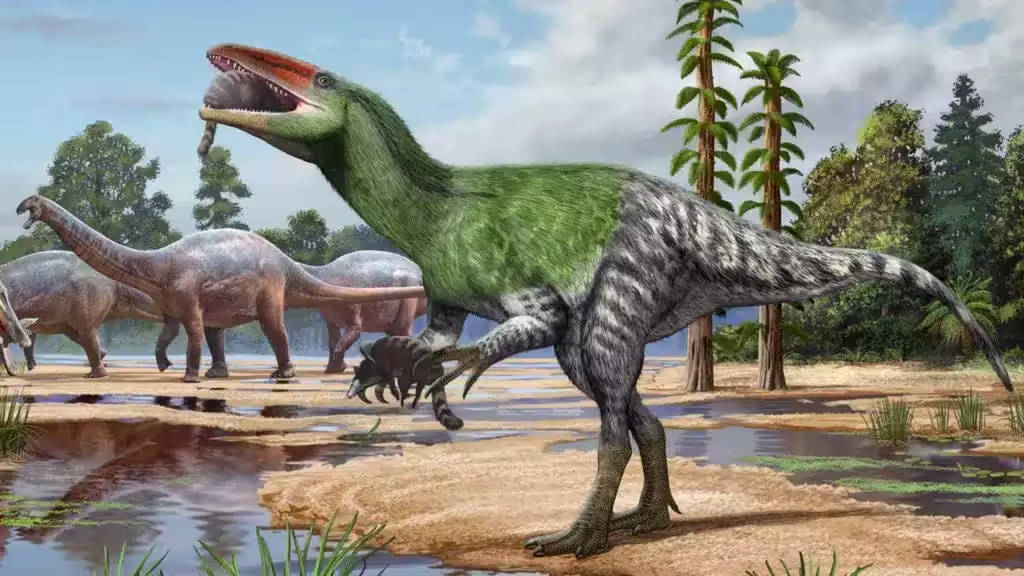
During the Early Cretaceous, these predators were widespread across Laurasia, the northern landmass. While they eventually vanished from the north, they rose to become apex predators in the south, where some species evolved terrifying, 14-inch-long claws. By confirming the presence of Invictibellatrix in Europe, scientists have gained a clearer understanding of the evolutionary path that allowed these unique, arm-focused hunters to eventually dominate the southern hemisphere.
This article has been fact checked for accuracy, with information verified against reputable sources. Learn more about us and our editorial process.
Last reviewed on .
Article history
- Latest version
Reference(s)
- projects, Contributors. “British paleontologist.”, February 15, 2007 Wikimedia Foundation, Inc. <https://en.wikipedia.org/wiki/Reginald_Hooley>.
- <https://royalsocietypublishing.org/rsos/article/13/10/260937/483607/A-new-megaraptoran-dinosaur-from-the-Lower>.
- <https://www.researchgate.net/profile/Cassius-Morrison>.
- <https://www.ucl.ac.uk/mathematical-physical-sciences/earth-sciences/people/research-students/charlie-scherer>.
Cite this page:
- Posted by Hassan Raza