Astronomers Spot Strange Chemical Glow Inside A Cosmic Hamburger That May Be Birthing A Planet
ALMA observatory data reveals new details of Gomez’s Hamburger, a cosmic disk that may be actively forming a giant planet within its gas and dust layers.
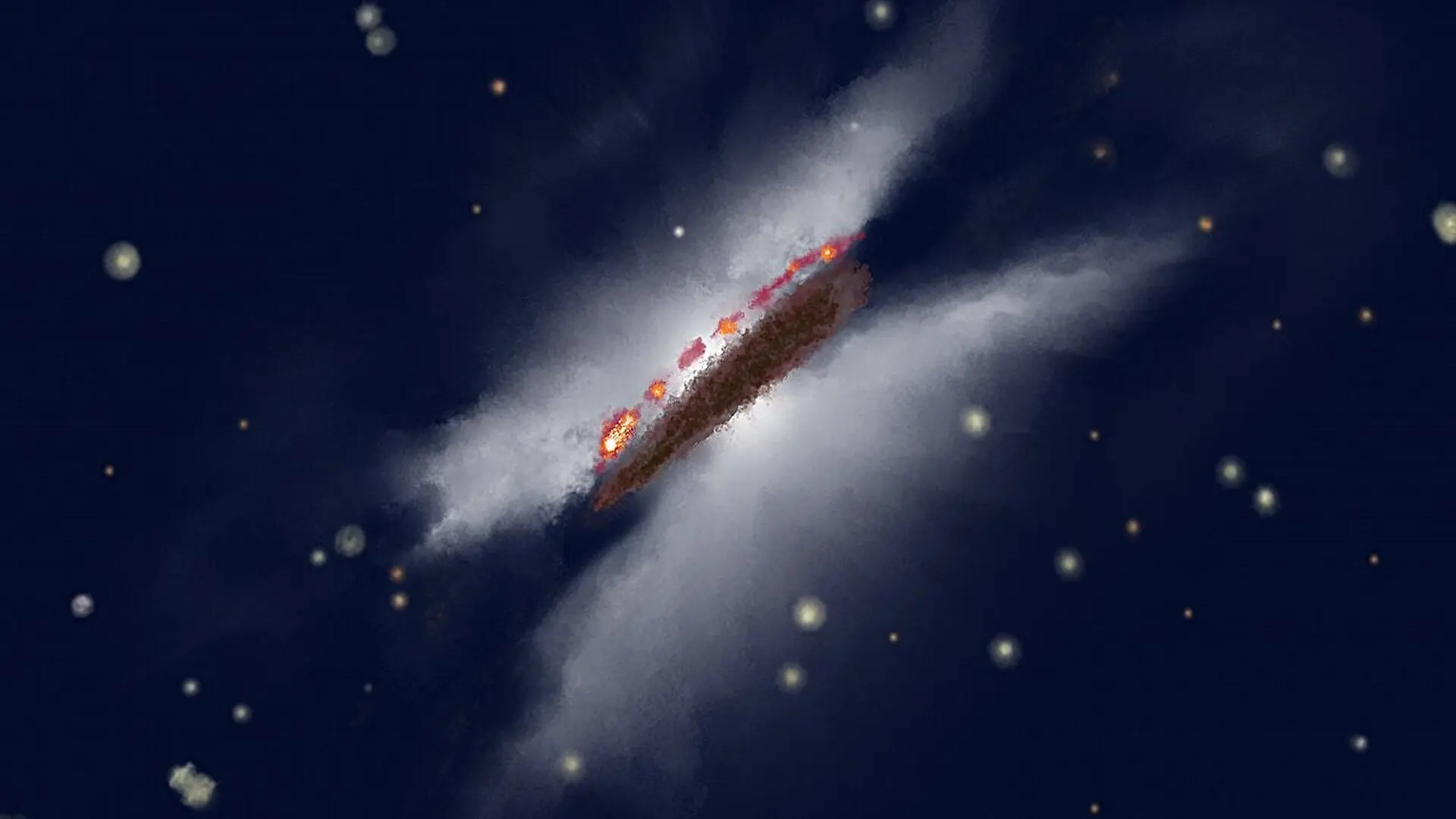
Astronomers using the Atacama Large Millimeter/submillimeter Array (ALMA) have uncovered chemical clues that may point to the birth of a giant planet within the vast, dusty expanse of the protoplanetary disk known as Gomez’s Hamburger (GoHam). By mapping sulfur monoxide emissions, researchers identified a distinct arc of gas that peaks near a mysterious, dense clump of material dubbed GoHam b, suggesting that the formation of a massive object could be actively altering the surrounding environment.
The findings, led by University of Minnesota assistant professor Charles Law, were recently accepted for publication in The Astrophysical Journal and are currently available on arXiv. The study provides a detailed look at the internal architecture of one of the largest known disks capable of forming planets.
A Unique Vantage Point for Planet Formation
Gomez’s Hamburger is a young star system characterized by an expansive, gas-rich disk viewed nearly edge-on. This rare orientation allows scientists to observe the disk’s vertical structure, separating the upper layers from the midplane. “GoHam gives us a rare and clear view of the vertical and radial structure of a very large, nearly edge-on disk,” Law noted, emphasizing the system’s role as a vital benchmark for testing theories of how planetary systems evolve.
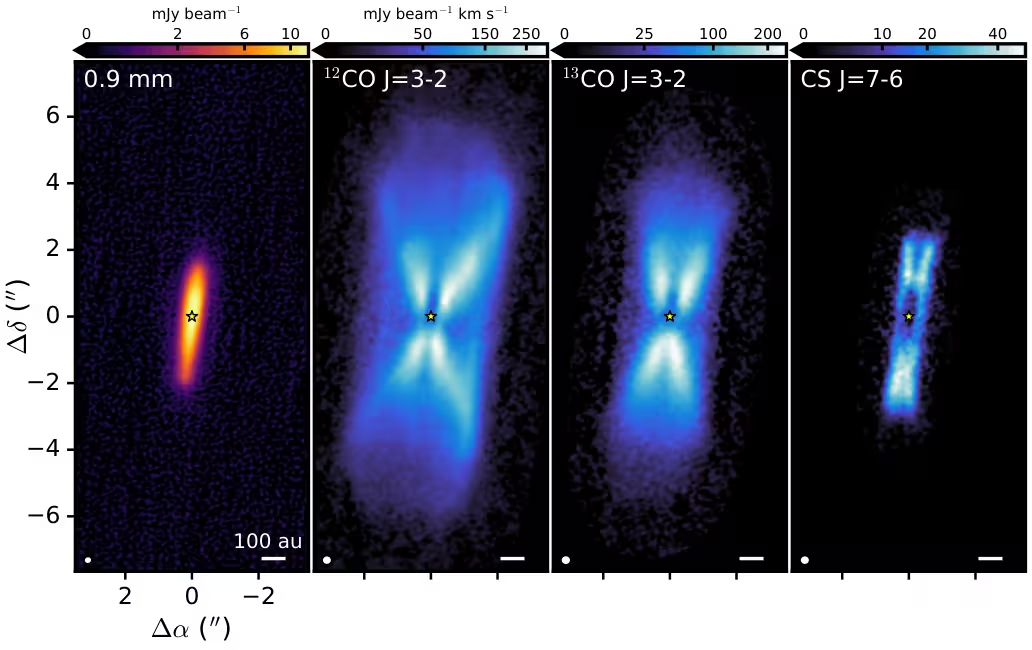
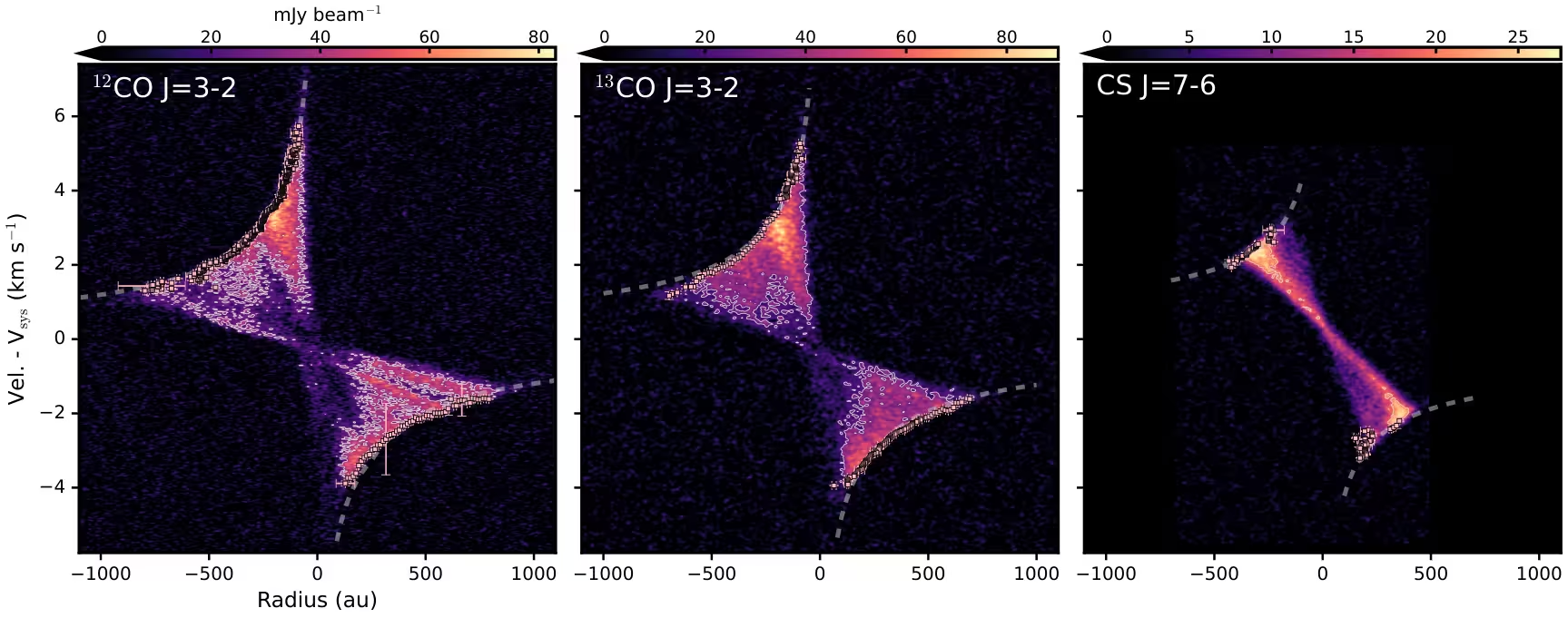
By utilizing ALMA to observe dust at 0.9-millimeter wavelengths alongside molecular markers like carbon monoxide and sulfur-bearing compounds, the team was able to map different layers of the disk. These emissions reveal a stratified environment where molecular signals trace gas at varying heights above the central plane, providing a comprehensive map of the disk’s physical and chemical state.
Sulfur Emissions Hint at Hidden Activity
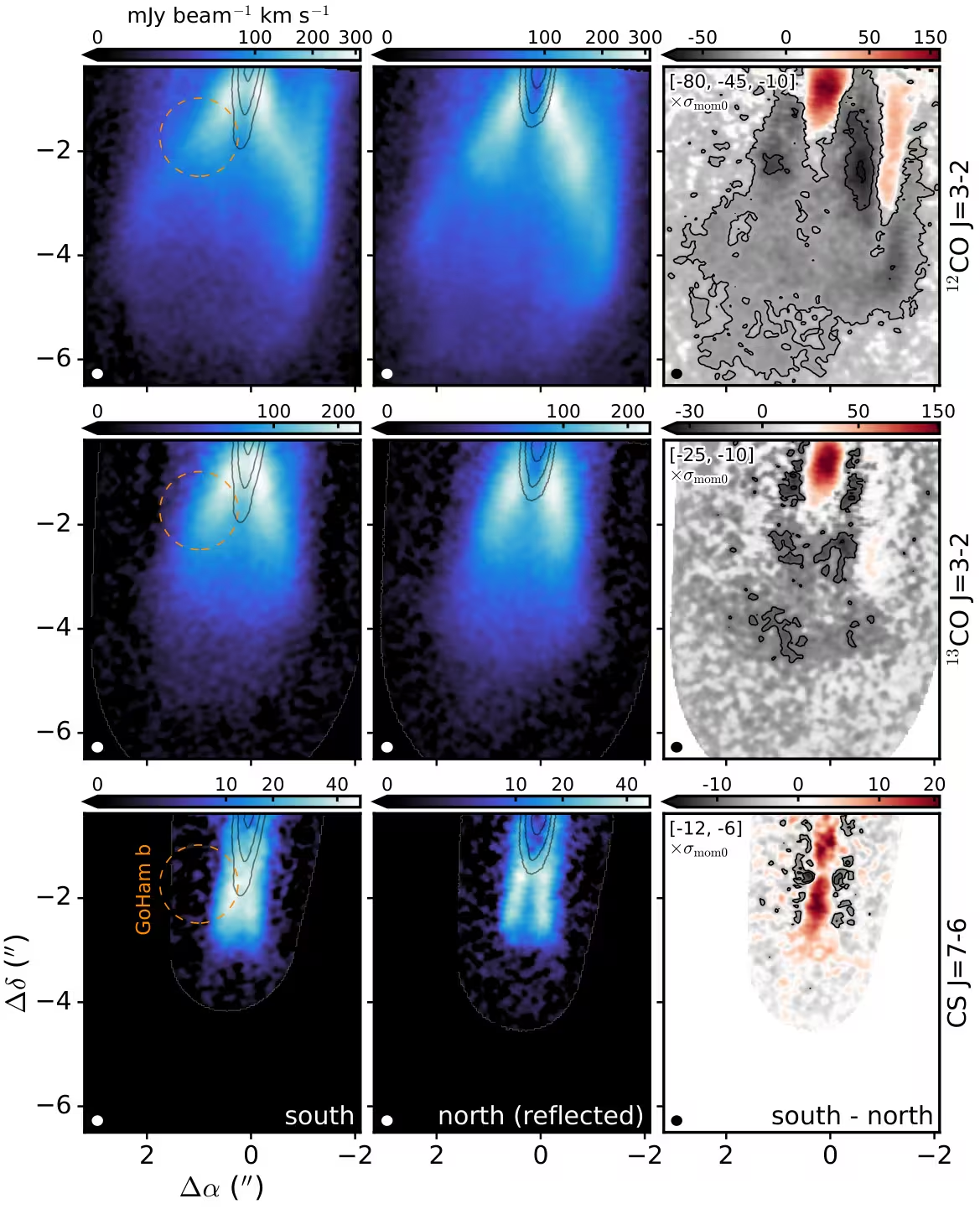
The discovery of a sulfur monoxide (SO) arc along the eastern side of the disk is particularly significant. The brightness of this gas is notably asymmetrical, with a clear peak aligned with the southern density feature known as GoHam b. This clump, estimated to sit approximately 280 astronomical units from the host star, has long been a candidate for a young protoplanet.
The researchers hypothesize that the localized SO enhancement is driven by thermal energy. In the frigid conditions of a protoplanetary disk, sulfur is often locked within icy grain coatings. The presence of a forming object could trigger heating or compression, releasing this sulfur into the gas phase. While this provides a compelling chemical signature of a protoplanet, the team cautions that other factors, such as uneven stellar illumination or the impact of infalling material, could also produce similar effects.
Complex Dynamics at the Disk’s Edge
The study also highlights the disk’s massive scale and structural irregularities. Estimates suggest the system contains roughly 180 Earth masses of dust, an amount significantly higher than seen in many similar systems. This density raises the possibility that the disk is subject to gravitational instability, a process that can trigger the collapse of material into massive fragments or spiral arms.
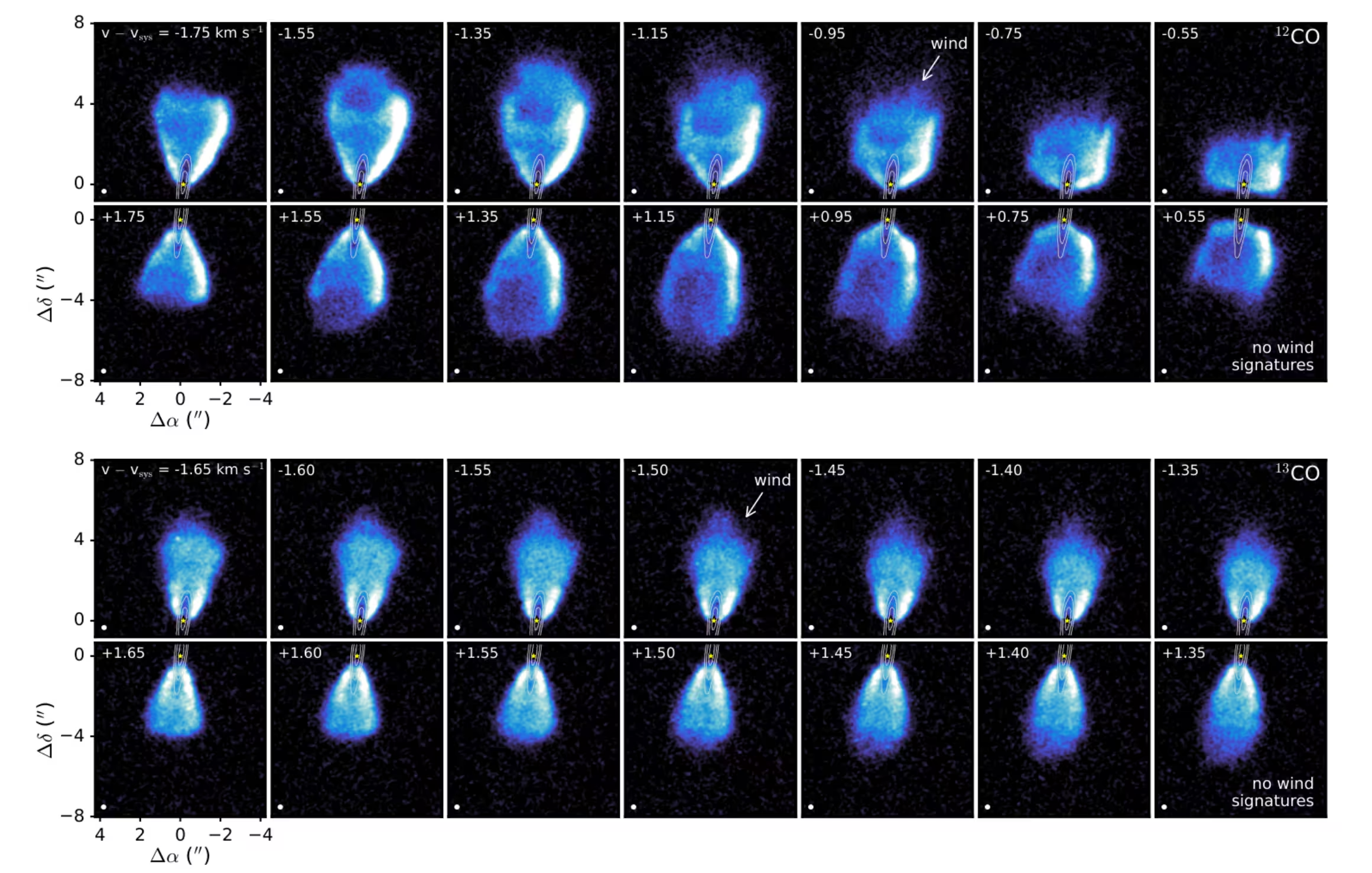
Beyond the potential planet, the team observed wispy bands of gas extending from the northern side of the disk. These features show motion that deviates from standard orbital patterns, hinting at the presence of a “disk wind.” Such outflows are often driven by intense radiation heating—a process known as photoevaporation—or by complex magnetic forces, though the specific mechanism remains under investigation.
Refining the Scale of a Cosmic Nursery
By revising the distance to Gomez’s Hamburger to roughly 450 light-years, the team has recalculated the physical dimensions of this massive nursery. The disk extends approximately 900 astronomical units in radius, with a central star about 2.2 times the mass of the Sun. These precise parameters are essential for modeling the gravitational and chemical interactions occurring within.
Future research will aim to determine if other warm-gas indicators correlate with the sulfur-rich arc near GoHam b. Distinguishing whether this localized chemistry is truly the fingerprint of a growing giant planet or a byproduct of the disk’s broader, turbulent evolution will be the next major step in understanding how large-scale structures emerge from the dust.
Additional Resources
- An SMA Molecular Inventory of the Edge-on Protoplanetary Disk Gomez’s Hamburger, The Astrophysical Journal (2026).
- Spirals and Clumps in V960 Mon: Signs of Planet Formation via Gravitational Instability around an FU Ori Star?, The Astrophysical Journal Letters (2023).
- A three-dimensional view of Gomez’s hamburger, Monthly Notices of the Royal Astronomical Society (2020).
- Gravitational Instabilities in Circumstellar Disks, Annual Review of Astronomy and Astrophysics (2016).
- Very Large Telescope observations of Gomez’s Hamburger: Insights into a young protoplanet candidate, Astronomy & Astrophysics (2015).
This article has been fact checked for accuracy, with information verified against reputable sources. Learn more about us and our editorial process.
Last reviewed on .
Article history
- Latest version
Reference(s)
- “The ALMA View of the Edge-on Gomez’s Hamburger System: A Highly-Dynamic, Asymmetric Protoplanetary Disk Reveals the Earliest Phases of Giant Planet Formation.” <https://arxiv.org/html/2609.09290v2>.
- Cusson, Erin M.., et al. “An SMA Molecular Inventory of the Edge-on Protoplanetary Disk Gomez’s Hamburger.” The Astrophysical Journal, vol. 1005, no. 2, July 3, 2026, pp. 179 American Astronomical Society, doi: 10.3847/1538-4357/ae731e. <https://doi.org/10.3847/1538-4357/ae731e>.
- Weber, Philipp., et al. “Spirals and Clumps in V960 Mon: Signs of Planet Formation via Gravitational Instability around an FU Ori Star?.” The Astrophysical Journal Letters, vol. 952, no. 1, July 25, 2023, pp. L17 American Astronomical Society, doi: 10.3847/2041-8213/ace186. <https://doi.org/10.3847/2041-8213/ace186>.
- Teague, Richard., et al. “A three-dimensional view of Gomez’s hamburger.” Monthly Notices of the Royal Astronomical Society, vol. 495, no. 1, April 30, 2020, pp. 451-459. Oxford University Press (OUP), doi: 10.1093/mnras/staa1167. <https://doi.org/10.1093/mnras/staa1167>.
- Kratter, Kaitlin., et al. “Gravitational Instabilities in Circumstellar Disks.” Annual Review of Astronomy and Astrophysics, vol. 54, no. 1, September 19, 2016, pp. 271-311. Annual Reviews, doi: 10.1146/annurev-astro-081915-023307. <https://doi.org/10.1146/annurev-astro-081915-023307>.
- Berné, O.., et al. “Very Large Telescope observations of Gomez’s Hamburger: Insights into a young protoplanet candidate.” Astronomy & Astrophysics, vol. 578, June 11, 2015, pp. L8 EDP Sciences, doi: 10.1051/0004-6361/201526041. <https://doi.org/10.1051/0004-6361/201526041>.
Cite this page:
- Posted by Aisha Ahmed