Inside The NASA Command Center Planning Every Move Of The Curiosity Mars Rover
More than a decade into its mission, NASA’s Curiosity rover continues to uncover evidence of ancient, life-supporting environments within Mars’ Gale Crater.

At NASA’s Jet Propulsion Laboratory in Pasadena, California, a dedicated team of engineers and scientists orchestrates the daily movements of the Curiosity rover across the Martian landscape. Operating from millions of miles away, these specialists spend their shifts analyzing fresh data sent back from the Red Planet to determine the mission’s next tactical and scientific objectives.
The Complex Coordination Behind Martian Exploration
The operational cycle begins the moment Curiosity completes its daily tasks and transmits a new trove of data back to Earth via a network of orbiting spacecraft. This information is processed at NASA facilities, where the team works under strict time constraints to assess the rover’s mechanical health and evaluate the findings from its onboard instruments.
According to Ashwin Vasavada, the project scientist for the mission, the planning process requires a delicate balance between ambitious scientific exploration and the physical realities of the rover. Teams must carefully weigh the remaining power and thermal limits against the desire to collect data from specific, high-priority targets. This effort was recently highlighted by the rover’s encounter with unique, polygon-shaped geological fractures. To understand whether these patterns resulted from thermal stress or ancient evaporation, international research teams collaborated to program the rover’s robotic arm, laser, and imaging systems, converting their findings into a complex sequence of commands relayed through the Deep Space Network.
Unlocking the Geologic History of Gale Crater
Curiosity’s mission is centered on the exploration of Gale Crater, where it continues to ascend the slopes of Aeolis Mons, or Mount Sharp. This massive sedimentary mountain serves as a stratigraphic archive of Martian history, documenting a time when the planet was significantly warmer and wetter. The rover’s findings have already confirmed that lakes and streams once persisted within the crater for millions of years before shifting climatic conditions transformed the environment into the arid world observed today.
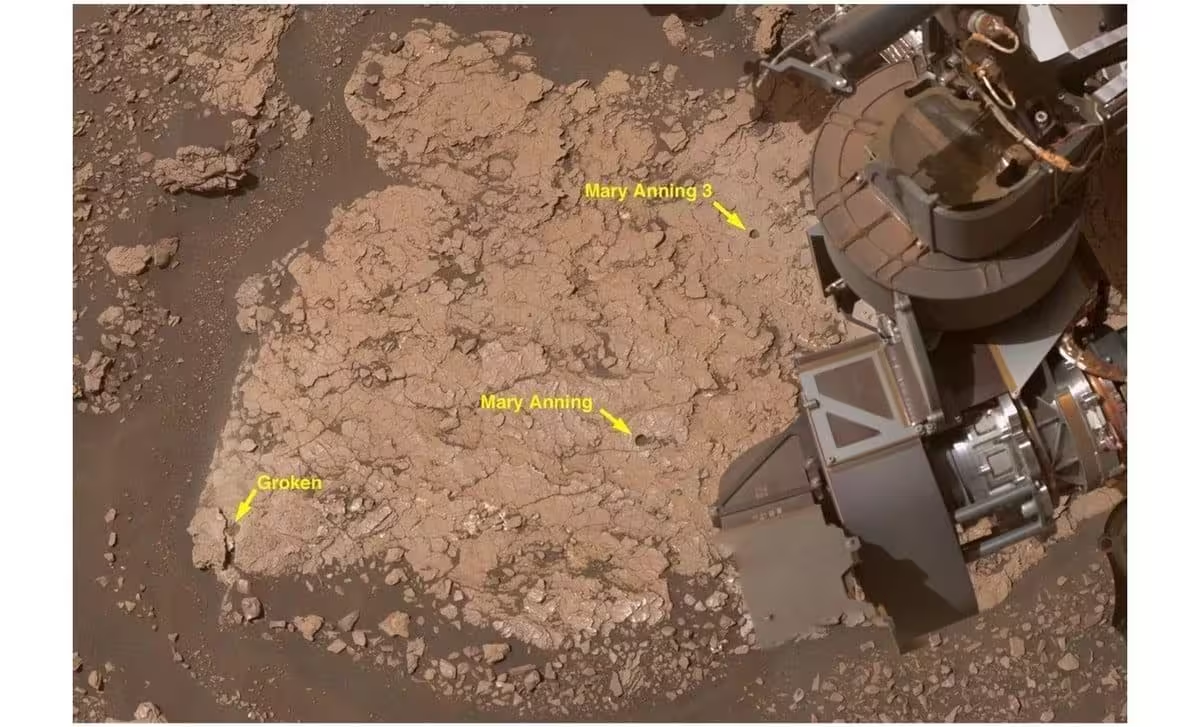
Deep within these rock layers, the rover has identified complex organic molecules, which serve as the building blocks for life as we know it. While the presence of these carbon-based compounds in areas like the “Mary Anning 3” drill site is significant, scientists caution that these materials could stem from either biological or non-biological geological processes. A recent NASA report confirmed the detection of 21 distinct carbon-containing molecules, including seven that had never been documented on the Martian surface before.
Beyond organic chemistry, the mission is currently investigating “boxwork” formations—intricate, ridge-like networks that hint at a more complex history of groundwater circulation than previously assumed. By analyzing these minerals, the mission team hopes to further refine their understanding of exactly how and when Mars shifted from a planet capable of supporting life-essential liquids to the desolate, cold desert it is today.
This article has been fact checked for accuracy, with information verified against reputable sources. Learn more about us and our editorial process.
Last reviewed on .
Article history
- Latest version
Reference(s)
- “JPL Science: Ashwin Vasavada.” <https://science.jpl.nasa.gov/people/vasavada/>.
- Hartono, Naomi. “NASA’s Curiosity Finds Organic Molecules Never Seen Before on Mars - NASA.”, April 21, 2026 NASA <https://www.nasa.gov/missions/mars-science-laboratory/curiosity-rover/nasas-curiosity-finds-organic-molecules-never-seen-before-on-mars/>.
Cite this page:
- Posted by Bilal Abbasi