Detection Dogs Sniff Out Elusive Dunnarts Ten Times Faster Than Traps
Trained canines track threatened Julia Creek dunnarts across vast Australian grasslands, outperforming traditional traps in speed and cost efficiency over large areas.
Conservation detection dogs can sniff out the critically elusive Julia Creek dunnart across vast Australian grasslands far quicker than traditional cage traps, according to a new study. The findings offer a fresh approach for tracking tiny, low-density marsupials that usually slip past standard ecological surveys.
Accurate population monitoring is required to assess the conservation status of species and make informed management decisions to prevent species extinctions. However, it is often difficult and prohibitively expensive to detect species that occur at low densities using traditional live-trapping survey methods, especially if they are small or cryptic in nature. Thus, development of rapid, accurate, and cost-efficient methods to detect and monitor such species is paramount for effective conservation.
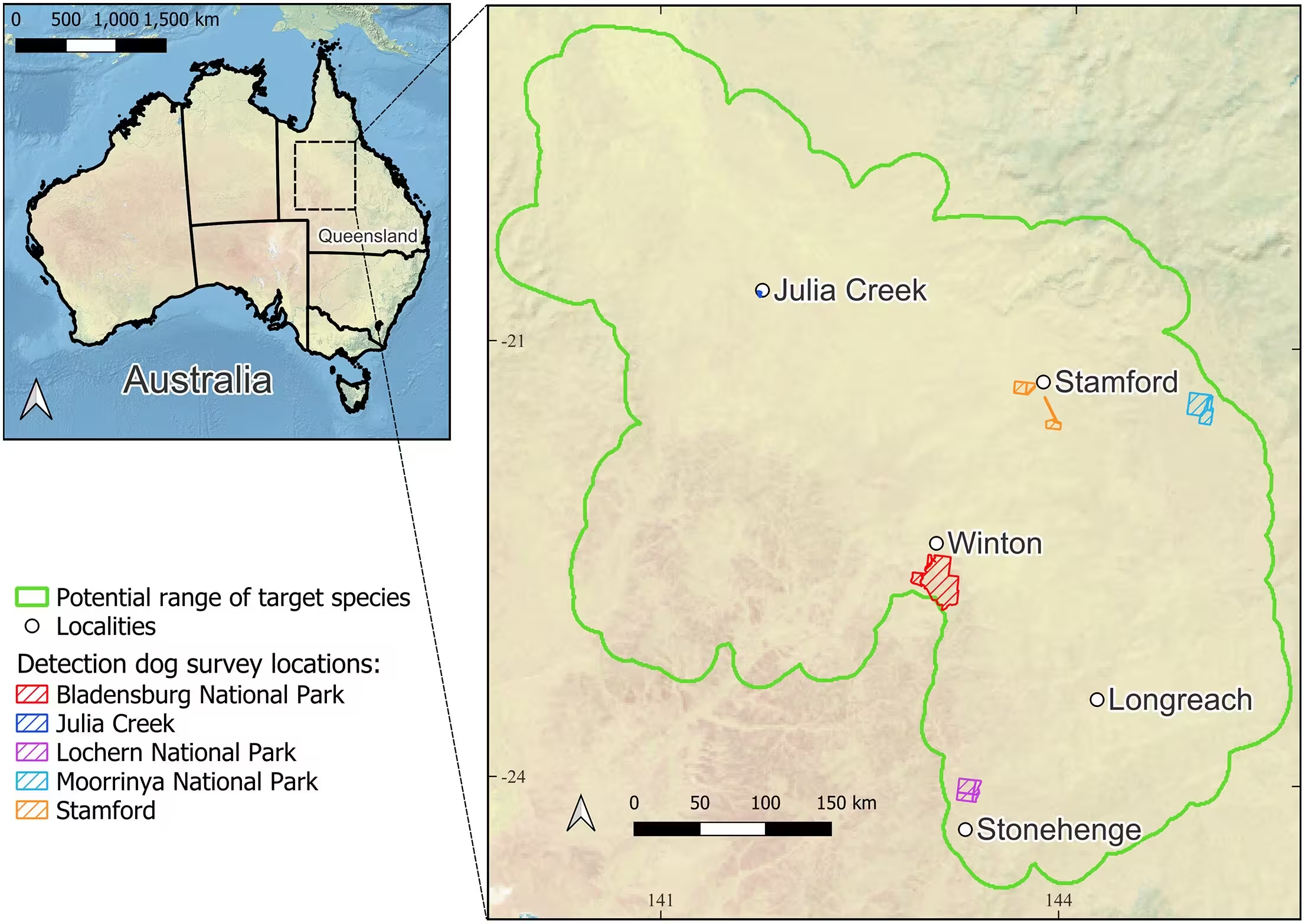
The Julia Creek dunnart, scientifically known as Sminthopsis douglasi, is a small dasyurid marsupial apparently restricted to tussock grasslands on cracking clay soils in central and north-west Queensland, Australia. The region experiences a semi-arid climate with distinct annual wet and dry seasons, highly variable interannual rainfall, and irregular extreme weather events, including prolonged droughts and flooding rains influenced by the El Nino Southern Oscillation. The distribution of S. douglasi is poorly understood because their tussock grassland habitat is vast and open, extending for hundreds of kilometres in remote Australia and requiring considerable investment of time, labour, and money to survey.
The species can be detected using live capture Elliott-style metal box traps, baited camera traps, and thermal image cameras. However, these methods return variable spatiotemporal detection probabilities for S. douglasi, likely due to regional climatic variability and consequent population fluctuations, as well as inherent limitations of the detection techniques employed. Live capture and camera detection methods suffer from sampling bias related to the need to attract S. douglasi to the capture site.
Currently, S. douglasi is listed as Near Threatened on the IUCN Red List and Vulnerable under the Australian federal Environment Protection and Biodiversity Conservation Act 1999 and the Queensland Nature Conservation Act 1992. However, threats impacting the species, including severe weather, invasive species, and habitat modification, have ostensibly worsened in recent years. Three widespread flooding events affected parts of central and north-west Queensland in 2019, 2025, and 2026, and the intensity of such extreme weather events is predicted to increase under future climate change scenarios.
The density of feral domestic cats, Felis catus, has also markedly increased across the species’ range in recent years due to an irruption of native long-haired rats, Rattus villosissimus, that occurred from 2023 to 2024. Habitat modification due to land clearing for energy production and mining projects, and the spread of invasive weeds such as prickly acacia, Vachellia nilotica, are also new and ongoing threats to S. douglasi. In light of these issues, rapid and accurate presence and absence detection techniques that can cover large tracts of the Australian landscape are urgently required to better understand the current distribution of S. douglasi.
How Detection Dogs Were Trained to Find Tiny Marsupials
The research team assessed the utility and cost efficiency of detection dogs as a rapid detection strategy by modelling the threatened Australian dasyurid marsupial, Sminthopsis douglasi. The detection dogs were systematically trained to discriminate the odour of S. douglasi from co-occurring small mammals and were able to detect the target species under controlled and natural field conditions. The study is published in PLOS One, detailing how specialized canines can transform wildlife management practices in harsh environments.
Dogs trained to detect target odour for the benefit of the environment are generally referred to as conservation detection dogs or wildlife detection dogs. The use of detection dogs for conservation is not novel, with some of the earliest documented applications including searches for kiwi in New Zealand in the late 1890s. However, their use has increased markedly over the last few decades, proving particularly effective at surveying for species that occur at low densities.
Several studies have also used detection dogs to survey for small, cryptic mammals. This application is more challenging, as the live animal or its scat often cannot be found for visual or DNA corroboration. The presence of sympatric congeners to the target species also necessitates a more rigorous training and testing program prior to deployment to ensure confidence that the detection dogs will not make false positive errors.
Evaluating Precision and Field Performance Under Pressure
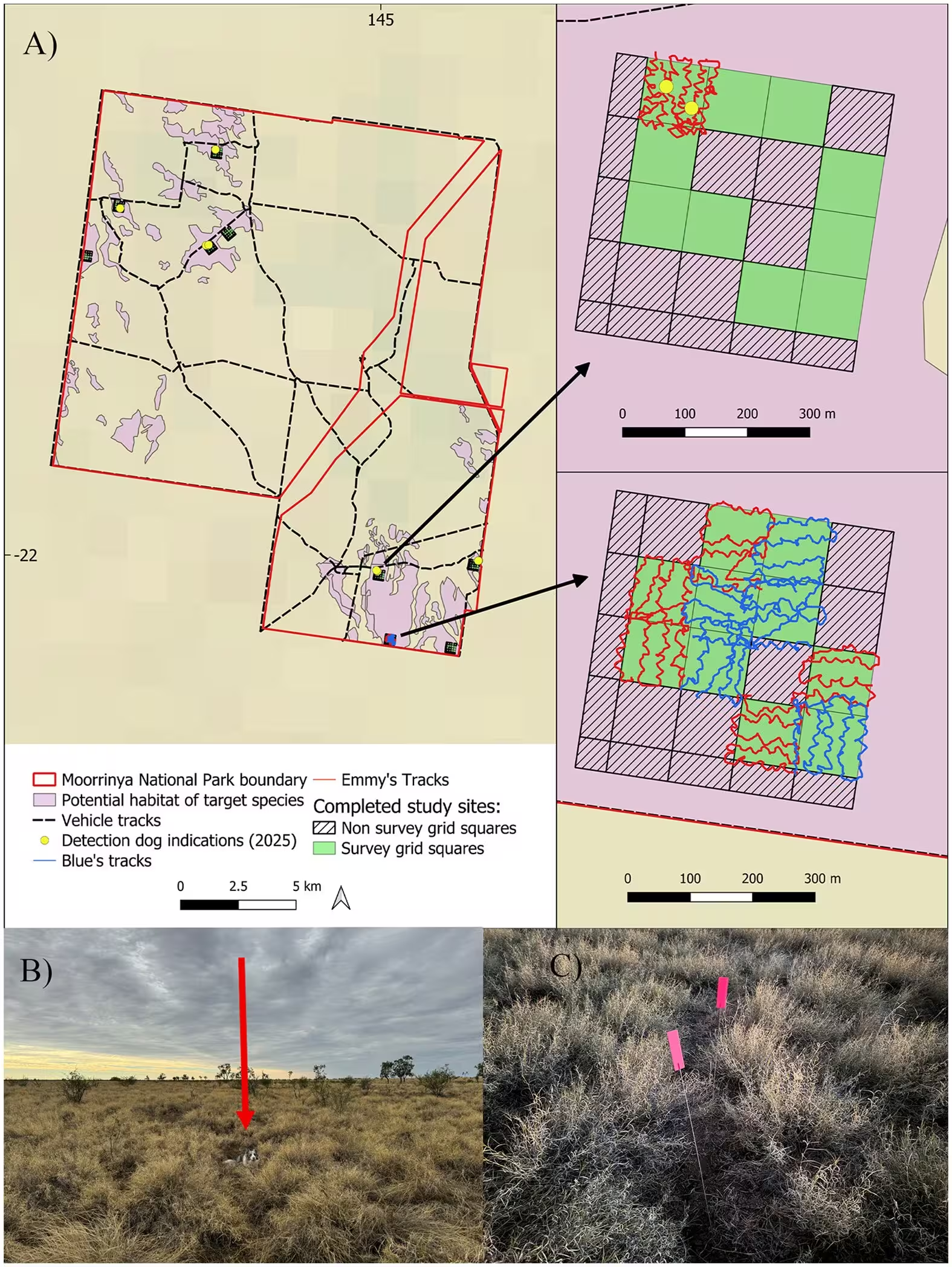
The study focused on detecting S. douglasi within its potential range across central and north-west Queensland, Australia. The primary detection dog handler undertook initial training and testing of the detection dogs at Wompoo Farm, located in Cooran, in the Shire of Noosa, Queensland, Australia. Cooran is well outside the potential range of S. douglasi, with the closest known population more than 1,000 kilometres distant. Environmental acclimatisation and field efficacy testing of the detection dogs took place at Stamford in fenced paddocks containing Mitchell grass tussock grassland on cracking clay soil.
The primary handler owned the two detection dogs used in the study, named Blue, a blue merle long-haired border collie, and Emmy, a black and white short-haired border collie. Both dogs were three to four years old during the project and were chosen specifically based on their strong drive for ball play reward, responsiveness to scent detection games, and natural herding behaviour in large landscape areas. Odour samples were collected from 33 individuals of S. douglasi, seven stripe-faced dunnarts, Sminthopsis macroura, three fat-tailed dunnarts, Sminthopsis crassicaudata, and eight long-haired rats, Rattus villosissimus.
The dogs demonstrated 100% sensitivity, specificity, and precision during controlled line-up trials and systematic grid searches. During field trials, the detection dogs indicated on all 46 targets while ignoring pervasive non-target odours from co-occurring rodents. Furthermore, the animals successfully tracked live, free-moving dunnarts to their underground retreats and grass tussock shelters across complex terrain.
Cost Efficiency and the Challenge of Physical Verification
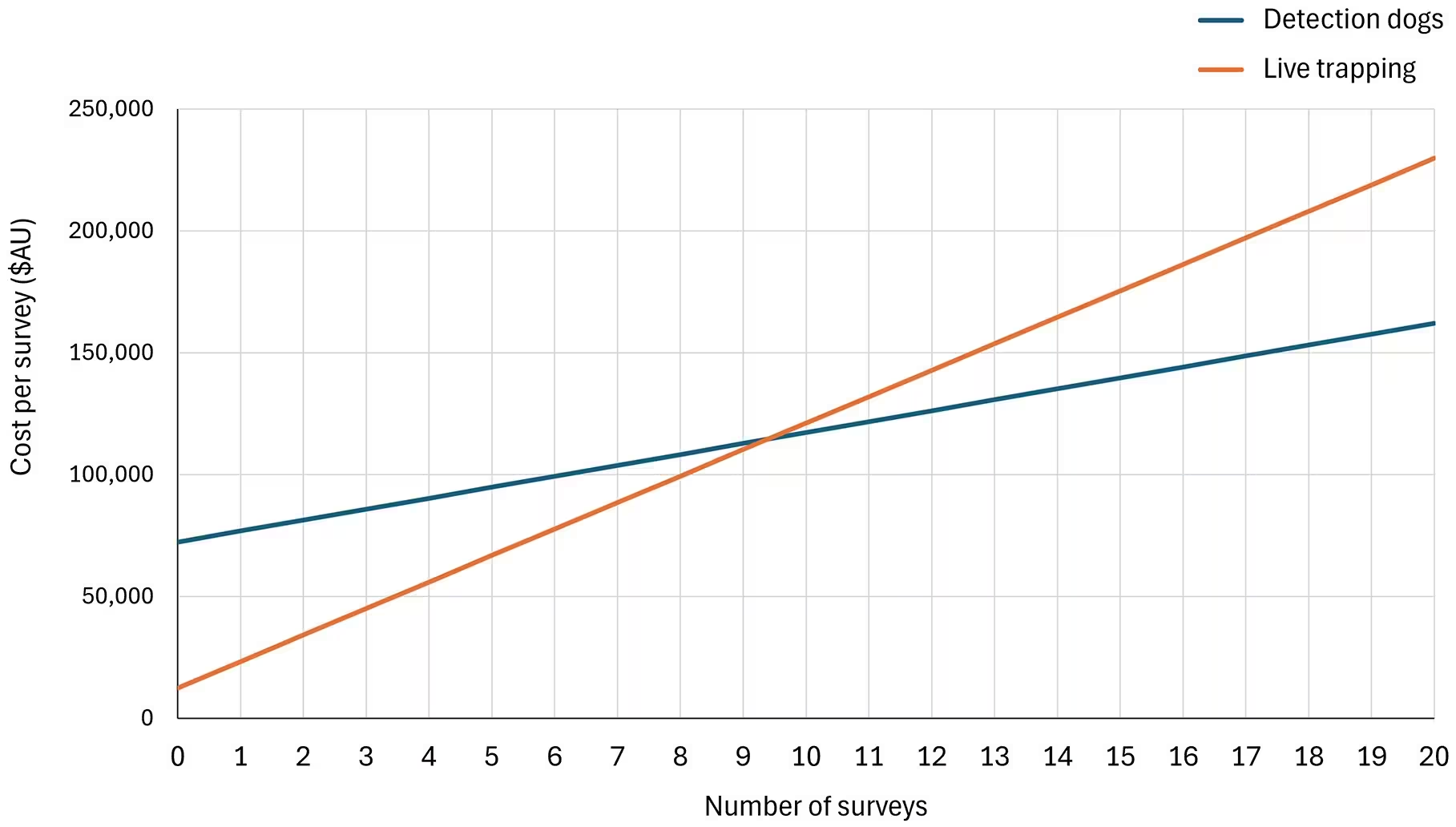
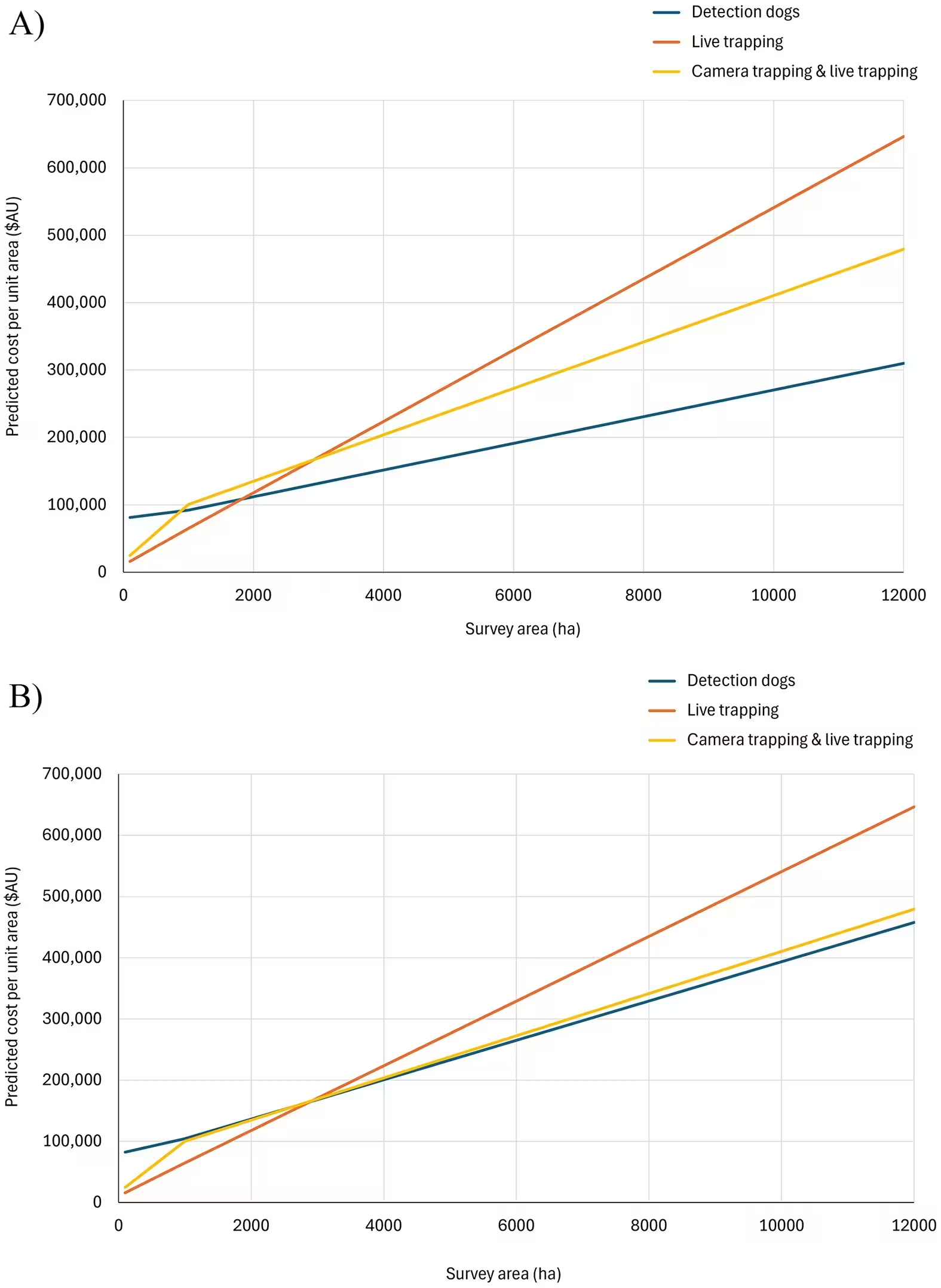
While detection dog surveys carried a higher upfront training cost than traditional live-trapping methods, they rapidly achieved financial parity after roughly nine site surveys. Due to their exceptional speed and reduced manpower requirements, detection dogs proved significantly more affordable when surveying moderate to large impact assessment areas exceeding 2,000 hectares.
The average time required to complete a site survey using detection dogs was roughly two hours, compared to twenty hours for standard live-trapping grids. Despite these operational efficiencies, researchers noted a significant hurdle in obtaining independent physical verification of dog indications. Heavy rodent activity and predator pressure frequently complicated follow-up confirmation using camera traps and endoscopes, highlighting the need for structured confidence-grading frameworks when uncorroborated canine detections are used for environmental decision-making.
The research was published in PLOS One on November 17, 2026.
This article has been fact checked for accuracy, with information verified against reputable sources. Learn more about us and our editorial process.
Last reviewed on .
Article history
- Latest version
Reference(s)
- Gray, Emma L.., et al. “The utility and relative cost of using detection dogs compared to traditional methods for surveying small, cryptic mammals: A case study on the threatened Julia Creek dunnart, Sminthopsis douglasi.” PLOS One, vol. 21, no. 11, November 17, 2026, pp. e0362850 Public Library of Science (PLoS), doi: 10.1371/journal.pone.0362850. <https://doi.org/10.1371/journal.pone.0362850>.
Cite this page:
- Posted by Priya Sharma