Ancient Fossil Discovery Upends Everything We Thought We Knew About How Animals Moved to Land
New fossil evidence challenges the traditional timeline of evolution, revealing a far more complex transition from aquatic life to land-dwelling animals.
The evolutionary leap from aquatic habitats to terrestrial life remains one of the most significant chapters in vertebrate history. For generations, evolutionary biologists operated under the assumption that the ancestors of all modern four-limbed animals—including mammals, birds, and reptiles—mirrored the life cycles of contemporary amphibians. This traditional model suggested these ancient creatures hatched as aquatic larvae, later undergoing a dramatic metamorphosis to transition into adult forms.
A study published in Science is now upending that paradigm. By analyzing remarkably preserved fossils, researchers have discovered that early tetrapods likely bypassed the larval stage entirely, growing instead through direct development where hatchlings emerged as miniature, fully formed versions of their adult counterparts.
New Fossil Evidence Challenges Traditional Evolutionary Models
The investigation centered on specimens recovered from the Mazon Creek site in Illinois, a location world-renowned for its ability to preserve soft tissues that are typically lost to the fossil record. The research team focused on a collection of dozens of juvenile fossils representing the critical evolutionary bridge between fish and the first four-legged vertebrates.
Among the most significant finds were specimens of embolomeres, ancient crocodile-like predators that prowled the swamps and river systems of the Carboniferous and Permian periods. While fully grown adults could reach lengths exceeding three meters, the juvenile fossils examined were mere centimeters in size.
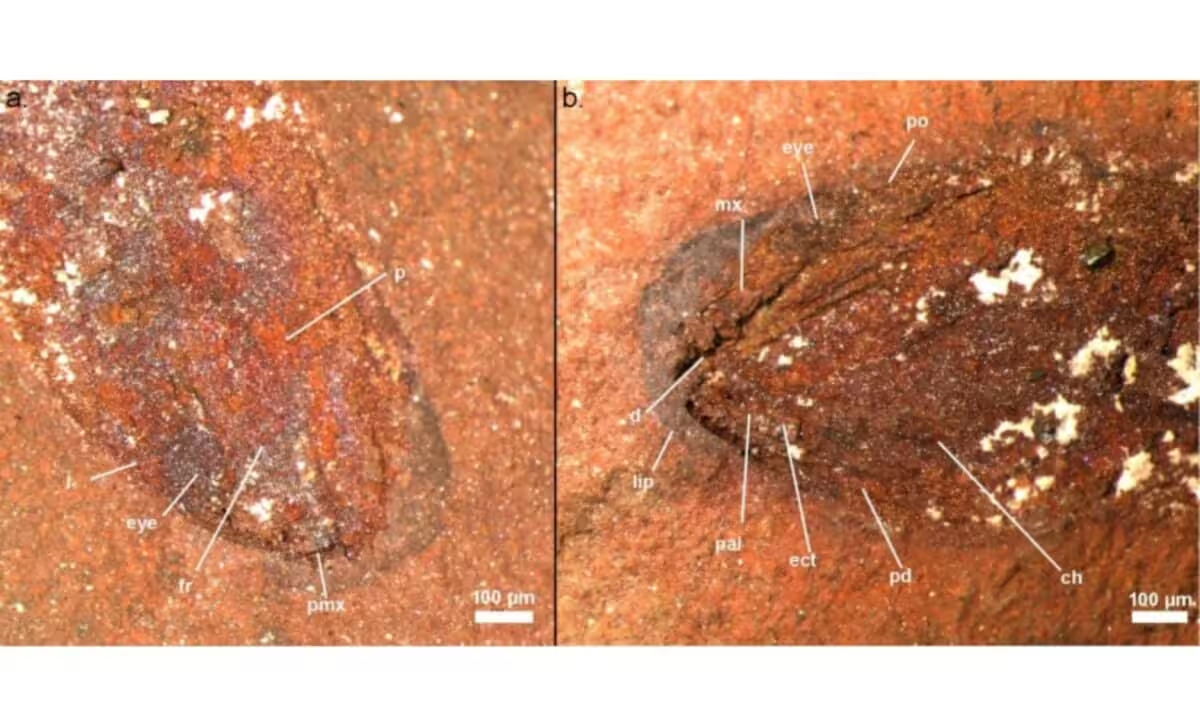
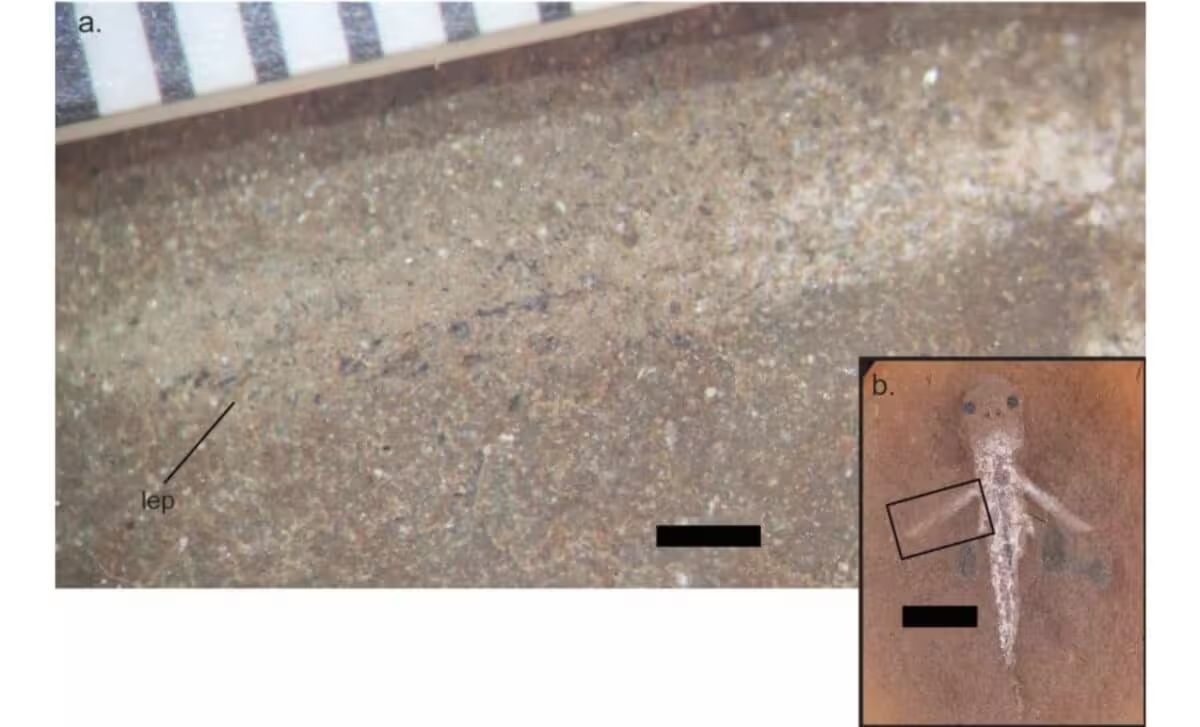
One specimen, catalogued as FMNH PR 1082, dates back roughly 308 million years. Researchers noted the presence of residual yolk within the fossil, confirming the animal was a hatchling that had not yet begun independent feeding. Despite its diminutive size, the specimen already possessed anatomical hallmarks of adulthood, including developed limbs with digits, while conspicuously lacking the external gills and metamorphic traits characteristic of tadpole-like larvae.
“Our study shows that this basic underlying premise, that the first four-legged vertebrates grew up like amphibians, is wrong,” explains Jason Pardo, a research associate at the Field Museum and co-lead author of the paper.
Direct Development as an Evolutionary Strategy
The findings suggest that metamorphosis was not a fundamental prerequisite for the conquest of land. Instead, early tetrapods appear to have utilized a direct development model, with the complex transformation seen in modern amphibians likely emerging much later in the evolutionary timeline.
While these ancient animals were clearly tethered to water, the lack of external gills does not necessarily imply they were entirely land-dwelling from birth. It is possible these creatures utilized internal gills similar to those found in modern fish. The study also opens the door to the possibility that some early tetrapods reproduced in moist terrestrial environments, though the fossil record has yet to confirm such reproductive behaviors definitively.
Arjan Mann, the Field Museum’s Assistant Curator of Early Tetrapods and co-lead author, emphasized that this discovery underscores the immense value of legacy fossil collections. By revisiting these specimens through modern analytical lenses, researchers are uncovering a far more nuanced narrative of evolution than previously realized. Rather than a linear progression from water to metamorphosis to land, the transition appears to be a multi-faceted process that challenges our definitions of developmental history.
This article has been fact checked for accuracy, with information verified against reputable sources. Learn more about us and our editorial process.
Last reviewed on .
Article history
- Latest version
Reference(s)
- Pardo, Jason D.., et al. “Direct development of stem tetrapods across the fin-to-limb transition.” Science, vol. 392, no. 6804, June 18, 2026, pp. 1292-1296. American Association for the Advancement of Science (AAAS), doi: 10.1126/science.aeb7635. <https://www.science.org/doi/abs/10.1126/science.aeb7635?af=R>.
- <https://www.researchgate.net/profile/Jason-Pardo>.
- “Arjan Mann - Field Museum.” <https://www.fieldmuseum.org/about/staff/profile/arjan-mann>.
Cite this page:
- Posted by Hassan Raza