Archaeologists Discover 140,000 Year Old Human Fossils Hidden Beneath The Indonesian Seabed
Submerged off the coast of Java, a newly discovered ancient river system reveals surprising insights into the life and migration of Homo erectus.

Submerged beneath the waters of the Madura Strait, a long-lost prehistoric landscape is offering scientists a new window into the lives of early humans. Roughly 140,000 years ago, this area was not a seabed, but a thriving river valley where Homo erectus hunted large mammals and navigated a sprawling, grassy terrain that once connected Java to the broader Southeast Asian mainland.
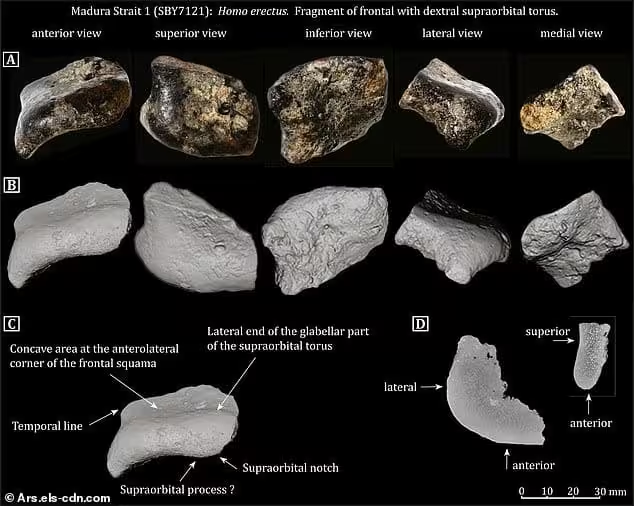
The discovery of human skull fragments alongside thousands of vertebrate fossils has shifted the known geographical range of late Javanese Homo erectus. While traditional fossil sites on the island have long been studied, these new findings, detailed in the journal Quaternary Environments and Humans, suggest that early hominins were far more distributed across the region’s ancient lowlands than previously realized.
A Submerged Ecosystem Revealed
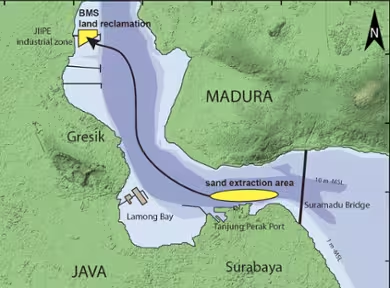
The evidence surfaced unexpectedly during marine sand dredging operations near Gresik in 2014 and 2015. Rather than a controlled archaeological dig, researchers were presented with a massive assemblage of over 6,000 fossils recovered from the seafloor. Analyzing this collection, experts identified at least 36 distinct species, including elephants, rhinoceroses, hippos, and Komodo dragons. The presence of river sharks and terrestrial mammals paints a picture of a permanent river system bordered by forests and open grasslands.
This environment existed during a period of significantly lower sea levels, when the Sunda Shelf emerged to create a land bridge between Java and the Asian mainland. According to Leiden University researchers, who led the geological and fossil analysis, the sea was roughly 100 meters lower than it is today, allowing the Solo River to flow across plains that have since vanished beneath the waves.
Dating the Lost Horizon
Because the dredging process disturbed the original geological layers, archaeologists could not rely on traditional stratigraphic positioning. Instead, they utilized optically stimulated luminescence (OSL), a method that determines when sediment grains were last exposed to sunlight. This dating placed the fossil-bearing deposits to a window roughly 140,000 years ago.
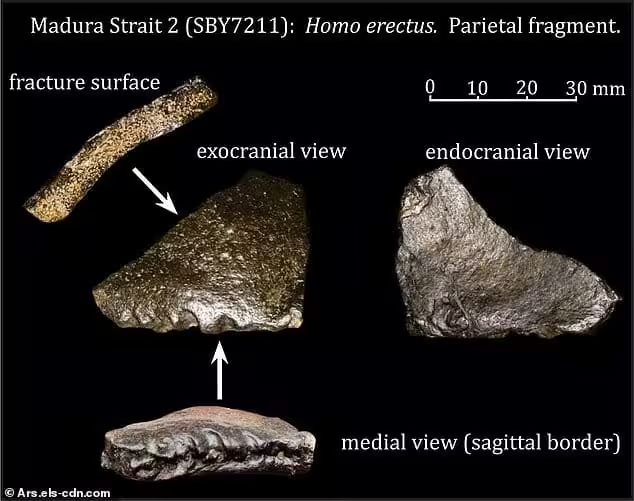
While the human remains themselves were not directly dated, the geological context confirms they belong to a period when the site was dry land. Analysis indicates these individuals were likely part of the late Javanese Homo erectus population, sharing morphological characteristics with fossils previously found at sites like Sangiran and Trinil.
Evidence of Sophisticated Hunting
The site has provided rare, potential insights into the behavioral patterns of these early hominins. Cut marks identified on the bones of freshwater turtles and large mammal limbs suggest the systematic processing of carcasses and the extraction of marrow. Furthermore, the age distribution of the hunted bovids—which favored adults over juveniles—points toward selective hunting strategies rather than opportunistic scavenging.
While archaeologist Harold Berghuis notes that such behaviors might reflect cultural or biological interactions with hominin populations further north in Asia, the current evidence remains suggestive rather than conclusive. Nevertheless, the findings highlight a level of resource management not clearly documented at other, earlier Javanese sites.

The discovery serves as a stark reminder that the history of human migration and settlement in Indonesia is largely written in territories now hidden beneath the ocean. As researchers continue to study the remains currently held at the Geological Museum in Bandung, the submerged valleys of the Sunda Shelf are increasingly viewed as a primary, if inaccessible, frontier in our understanding of Pleistocene human evolution.
This article has been fact checked for accuracy, with information verified against reputable sources. Learn more about us and our editorial process.
Last reviewed on .
Article history
- Latest version
Reference(s)
- <https://www.sciencedirect.com/journal/quaternary-environments-and-humans>.
- “Homo erectus from the seabed, new archaeological discoveries in Indonesia.”, May 16, 2025 Leiden University <https://www.universiteitleiden.nl/en/news/2025/05/homo-erectus-from-the-seabed-new-archaeological-discoveries-in-indonesia>.
- “Homo Erectus In Java 1.” <https://archaeologymag.com/wp-content/uploads/homo-erectus-in-java-1.jpg>.
Cite this page:
- Posted by Hassan Raza