World’s Largest 150‑Metre Dinosaur Footprint Trail Unearthed in Active Oxfordshire Quarry
Ancient trackway uncovered during routine industrial work reveals a prehistoric path hidden beneath the modern surface.
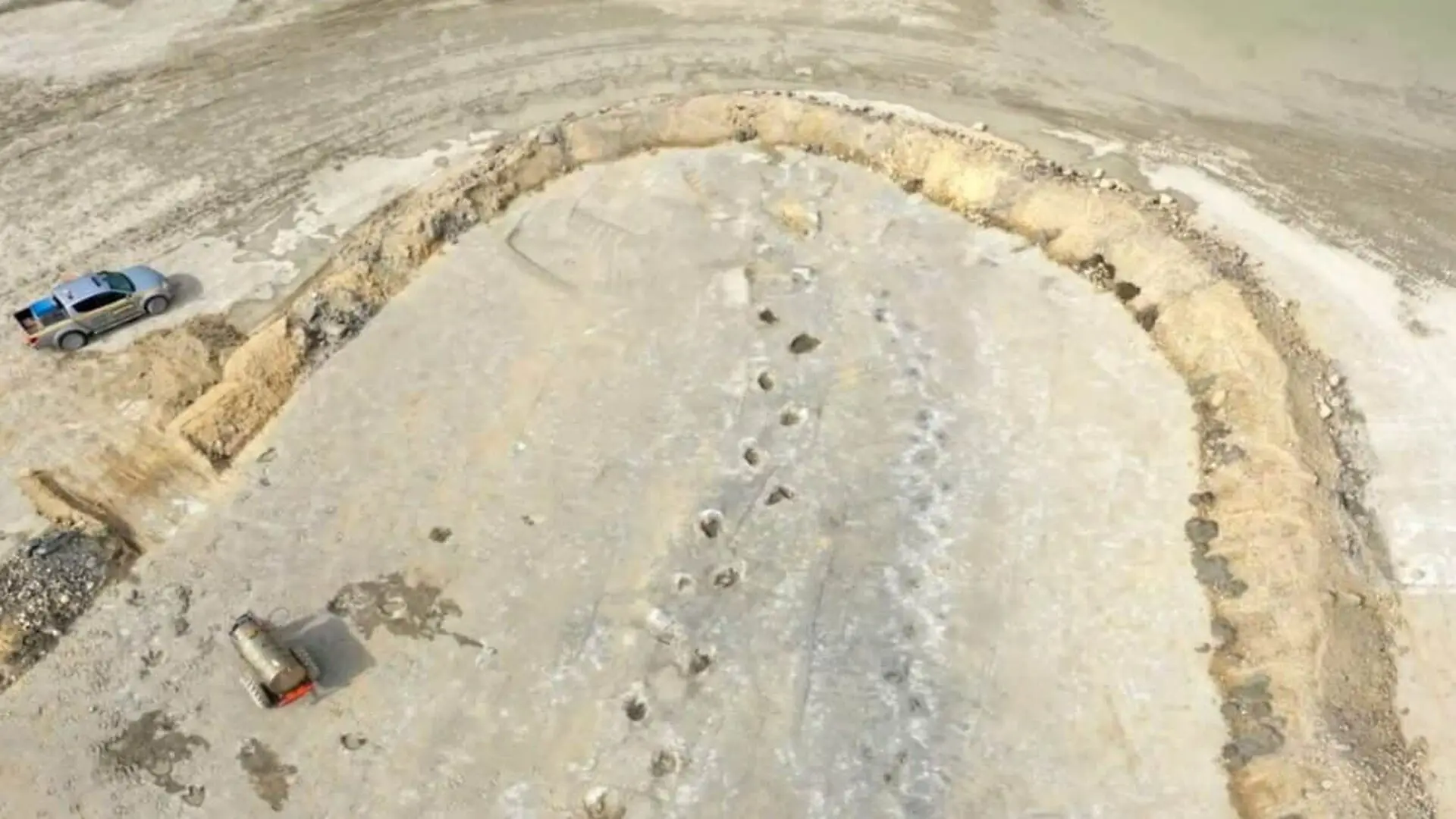
A team of archaeologists from the University of Oxford and the University of Birmingham has revealed a sprawling network of dinosaur footprints in a quarry near Oxfordshire, offering an unprecedented glimpse into Jurassic ecosystems.
The find emerged from Dewars Farm Quarry, where a week‑long excavation in June 2024 uncovered roughly 200 individual prints preserved in a thin clay layer. Researchers employed drones and high‑resolution cameras, capturing more than 20,000 images to document the site in three‑dimensional detail.
Extensive Trackways Stretch Over 150 Metres
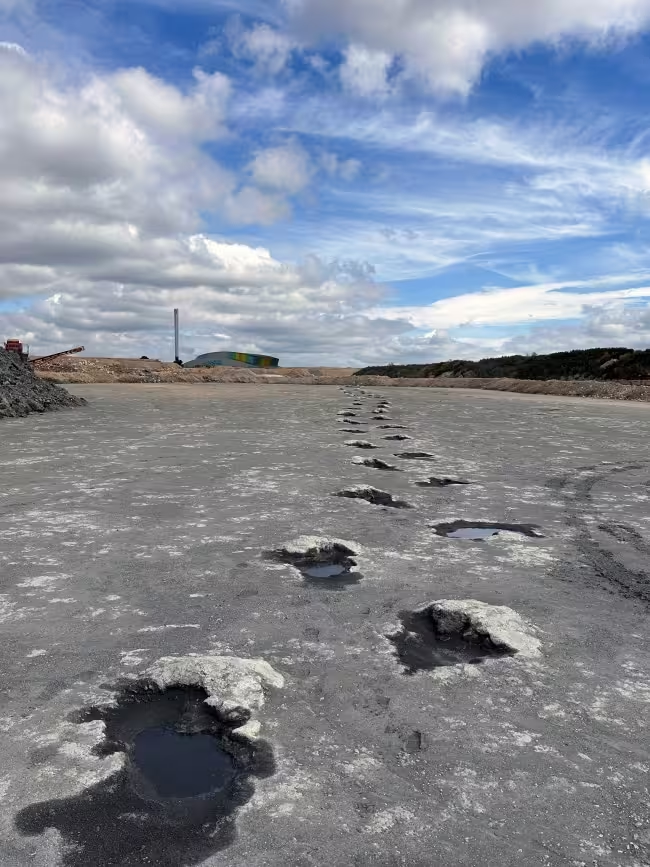
Five distinct pathways were mapped, with evidence suggesting additional prints extend beyond the excavated area. The longest uninterrupted stretch runs for over 150 metres, providing scientists a rare opportunity to analyse the locomotion of giant dinosaurs on a single ancient surface.
Four of the routes are attributed to colossal sauropods, likely members of the Cetiosaurus group, animals that could reach lengths of about 18 metres and share close ancestry with Diplodocus. The fifth trackway belongs to the carnivorous theropod Megalosaurus, a roughly 9‑metre predator whose three‑toed prints display clear claw marks.
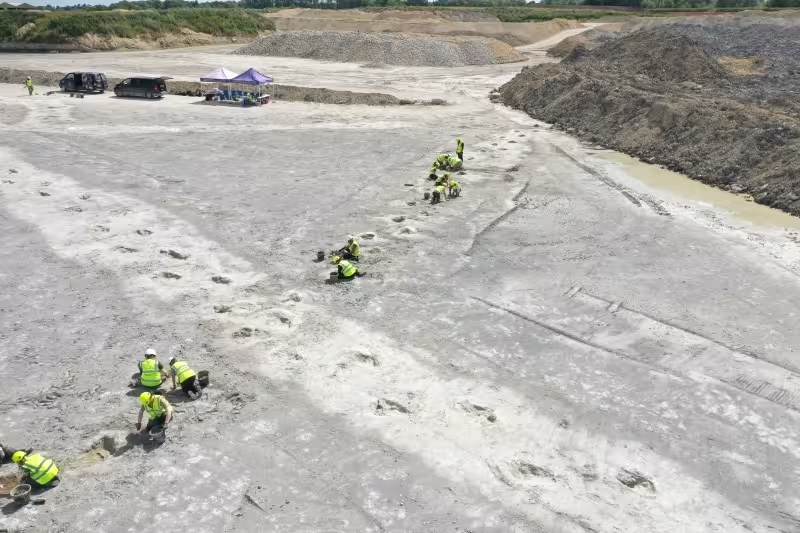
According to the Oxford University Museum of Natural History, a particular section of the quarry shows an intersection where Megalosaurus footprints cross those of the sauropods, hinting at possible contemporaneous activity, though the data do not confirm simultaneous passage.
“This site in Oxfordshire is the largest dinosaur track site in the UK, and arguably now the largest mapped dinosaur track site in the world when we consider finds dating back to the 1990s on the same surface nearby,” said University of Birmingham Professor Kirsty Edgar.
Digital Archive Secures Every Impression
Aerial drone footage and close‑range photogrammetry were combined to produce a comprehensive 3‑D model of the footprint field. The resulting digital archive will enable future researchers to analyse stride length, speed estimates and body proportions without further disturbance of the fragile sediments.
Richard Butler, Professor of Palaeobiology at Birmingham, emphasized the site’s value as part of Britain’s geological heritage and noted that the 3‑D data will keep the discovery accessible for generations.
“Our 3D models will allow researchers to continue to study and make accessible this fascinating piece of our past for generations to come.”
The preservation extends beyond the prints themselves; surrounding sediments contain burrows, shells and plant fossils that help reconstruct the muddy lagoon environment traversed by the dinosaurs.
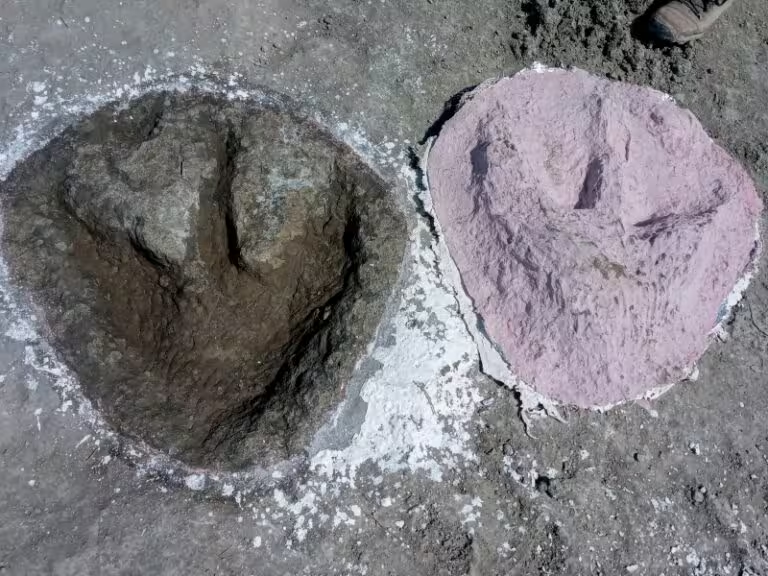
Dr Duncan Murdock, Earth Scientist at the Oxford University Museum of Natural History, explained that the fossilized mud records the pressure and drag of dinosaur feet, while the associated trace fossils provide clues about the surrounding flora and fauna.
How the Quarry Turned Into a Paleontological Treasure
The investigation began when quarry employee Gary Johnson noticed irregular bumps while removing the overlying clay. Collaboration between Oxford, Birmingham and the quarry’s management, led by Mark Stanway, enabled a rapid, week‑long operation that involved more than 100 volunteers and specialists.
Using excavators, rock saws and meticulous hand tools, the team exposed roughly 200 footprints, documenting each impression before covering the surface again to protect it from weathering.
This article has been fact checked for accuracy, with information verified against reputable sources. Learn more about us and our editorial process.
Last reviewed on .
Article history
- Latest version
Reference(s)
- “Professor Kirsty Edgar.” University of Birmingham <https://www.birmingham.ac.uk/staff/profiles/gees/edgar-kirsty>.
- “Professor Richard Butler.” University of Birmingham <https://www.birmingham.ac.uk/staff/profiles/gees/butler-richard>.
- “Duncan Murdock.” <https://oumnh.ox.ac.uk/people/duncan-murdock>.
Cite this page:
- Posted by Hassan Raza