Laughter’s 15-Million-Year Legacy Links Humans to Great Apes, Study Finds
New study reveals human laughter mirrors great ape rhythms, indicating a 15‑million‑year continuity in vocal control.

A recent analysis in Communications Biology reveals that the timing pattern of human laughter may trace back to a vocal signature that has stayed virtually unchanged for about 15 million years, offering a rare glimpse into the origins of speech and social signaling among great apes and early hominins.
A Millennial Rhythm Shared Across Apes
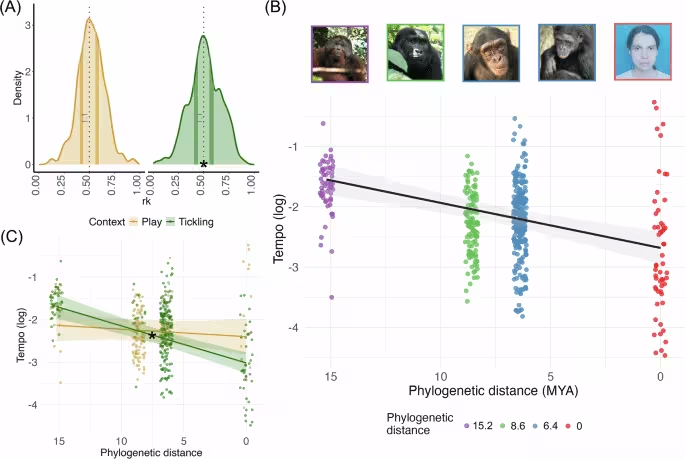
By recording spontaneous laughter from orangutans, gorillas, chimpanzees and bonobos, researchers identified a remarkably uniform rhythmic architecture—regularly spaced bursts of sound—that persists across these species. The consistency of this pattern suggests that laughter is not a recent human invention but a deep‑rooted vocal behavior inherited from a common ancestor that lived millions of years ago. This rhythmic regularity provides a biological imprint of ancient neural and vocal mechanisms that continue to surface in modern laughter.
Reassessing the Roots of Speech
The authors argue that this conserved laughter rhythm undermines the view of a sudden surge in human vocal complexity. Instead, it frames speech‑related abilities as an extension of a gradual enhancement of vocal control that began long before anatomically modern humans appeared. By linking rhythmic consistency to a deep‑time common ancestor, the study bridges behavioral neuroscience with evolutionary anthropology, compensating for the lack of fossil evidence for soft‑tissue traits such as vocalization.
“How did humans evolve the remarkable ability to speak? Speech leaves no fossils, and complex language exists only in our own species. But we’ve found a 15‑million‑year‑old clue in an unexpected place: our laughter,” says Chiara De Gregorio, an honorary research associate at the University of Warwick.
De Gregorio emphasizes that laughter is the only vocal expression shared by all living great apes, making it an ideal comparative tool. By mapping the rhythmic structure across species, the team demonstrates that a core timing mechanism has survived unchanged since the last common ancestor of humans and apes.
“Unlike speech, laughter is shared by all living great apes. By comparing how different species laugh, we can see that a basic rhythmic structure has remained unchanged since our last common ancestor. That’s extraordinary.”
Inferring the Voices of Extinct Hominins
Because direct observation of extinct hominins is impossible, the researchers used the shared laughter traits of extant apes to model likely vocal features of ancestral species. Their analysis suggests that early hominins may have produced laughter with timing characteristics intermediate between modern humans and chimpanzees, reflecting a stepwise increase in vocal flexibility over evolutionary time.
Comparative biology therefore offers a structured avenue for reconstructing behavioral attributes of long‑gone lineages, moving beyond speculation toward evidence‑based inference rooted in shared evolutionary history.
From Laughter to Language: A Continuum of Vocal Mastery
Human laughter displays a high degree of voluntary modulation—altering speed, pitch, and intensity according to social context—unlike the more constrained vocalizations of other primates. This expanded control likely mirrors a broader neural expansion that later supported articulate speech.
Adriano Lameira of the University of Warwick notes, “It is impossible to assess the precursor forms of language directly from our extinct ancestors. Laughter, being evolutionarily older and having remained shared between all living great apes, provides a rare evolutionary window into the vocal transformations that unfolded across hominid evolution until the first humans appeared on scene.” He adds that the data favor a model of gradual accumulation of vocal capabilities rather than a sudden leap, with laughter acting as a measurable remnant of earlier communicative systems.
Implications for Modern Human Communication
Collectively, the findings reshape our understanding of how human speech emerged. They suggest that the foundations of vocal timing were laid down millions of years ago, with laughter serving as a stable scaffold upon which later linguistic complexity was built. The preservation of this rhythmic pattern across species underscores the deep evolutionary roots of social bonding mechanisms that continue to shape human interaction today.
This article has been fact checked for accuracy, with information verified against reputable sources. Learn more about us and our editorial process.
Last reviewed on .
Article history
- Latest version
Cite this page:
- Posted by Hassan Raza