Rare 66 Million Year Old Fossil Reveals A Prehistoric Predator’s Last Meal
Scientists have discovered rare, fossilized stomach contents inside an unassuming piece of chalk, revealing the final meal of an ancient predator.
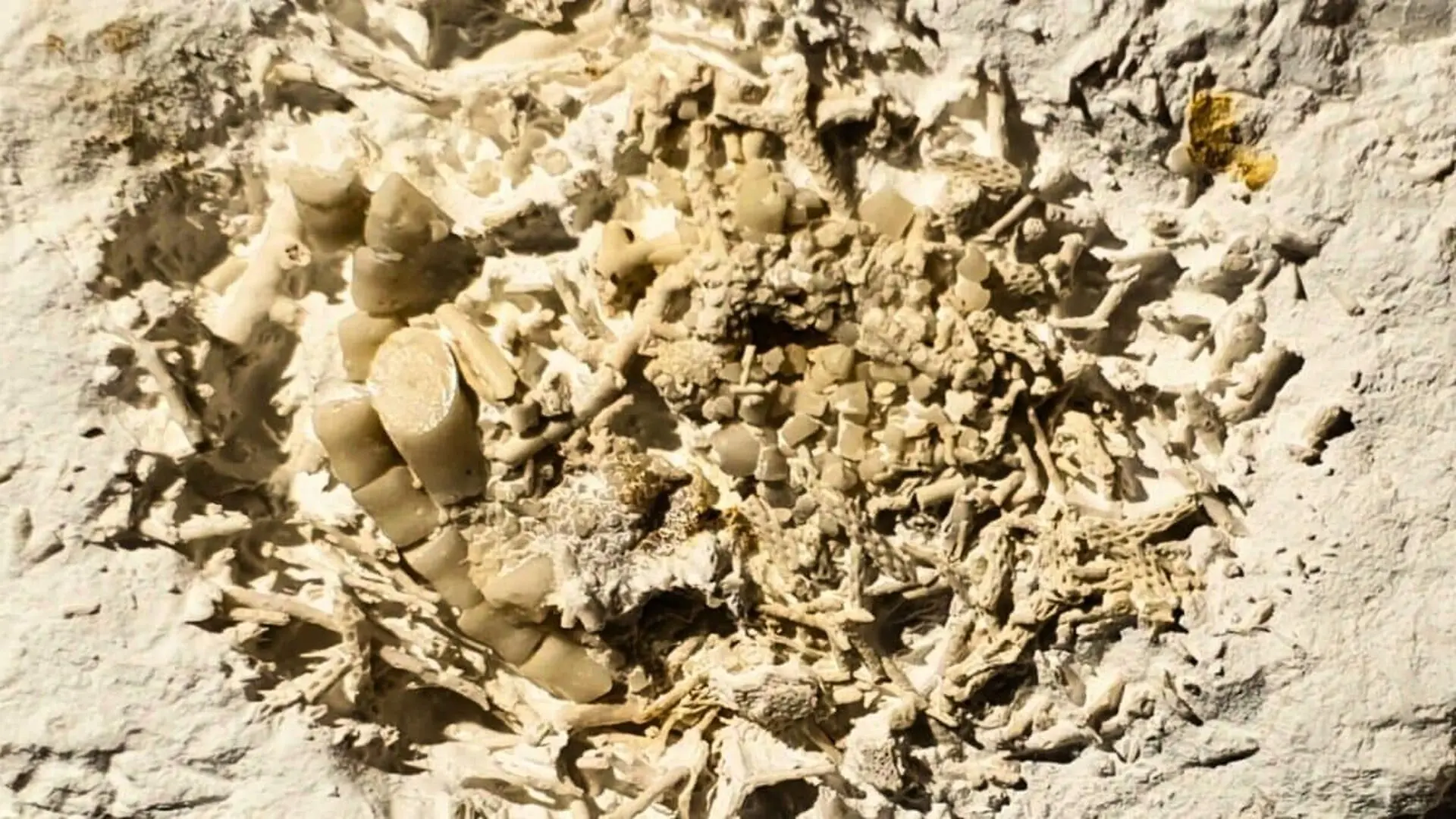
A remarkable discovery along the chalky cliffs of Stevns Klint in Denmark has offered paleontologists a rare glimpse into a predatory encounter from 66 million years ago. Geologist Peter Bennicke unearthed a peculiar specimen embedded within the rock, which subsequent analysis at Geomuseum Faxe revealed to be a mass of sea lily fragments. This find, now officially classified as a regurgitalite, represents the indigestible remains of a prehistoric meal, expelled by a predator near the end of the Cretaceous Period.
Experts, including sea lily specialist John Jagt, identified at least two distinct species of crinoids—the biological group that includes sea lilies—within the fossilized mass. The Museums of East Zealand suggests that because these animals were largely composed of calcareous plates rather than nutrient-rich soft tissue, they were likely an accidental or opportunistic snack rather than a preferred primary food source.
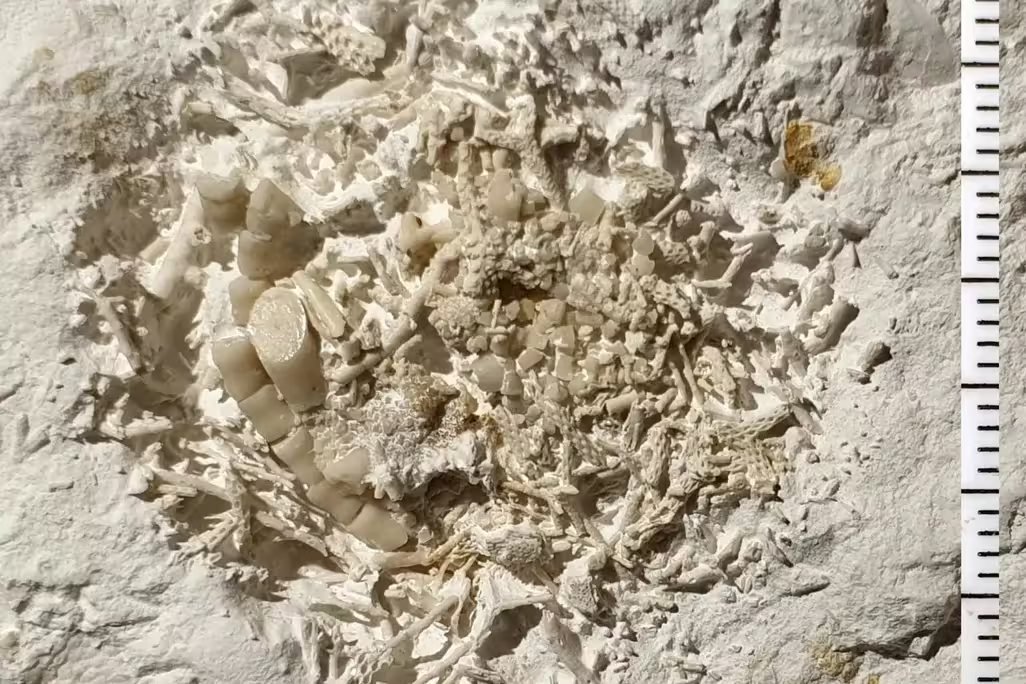
Jesper Milàn, a curator at Geomuseum Faxe and a member of the Danekræ Committee, described the find as an exceptionally rare window into ancient ecosystems. While typical fossils like bones and shells show us what creatures lived in the Cretaceous seas, this regurgitalite provides direct, tangible evidence of a specific feeding event. Identifying the culprit behind the meal remains a challenge, though researchers suspect it was likely a fish or perhaps a bottom-dwelling shark with specialized teeth capable of crushing hard biological structures, as reported by the Smithsonian.
The nature of the fossil has sparked nuanced debate among experts regarding the mechanics of the event. Paleontologist Paul Olsen of Columbia University noted that the sea lily fragments remain remarkably intact, with sharp, well-defined edges, suggesting they were not subjected to the long-term effects of stomach acid. Speaking to NPR, Olsen categorized the find as a gastric ejection rather than traditional vomiting, as the material was likely expelled shortly after ingestion.
Although this is not the first regurgitalite ever found—a similar specimen dating back 160 million years was discovered in England in 2002—it remains a scientifically significant addition to the geological record. Due to its importance, the specimen has been granted Danekræ status under the Danish Natural History Act, requiring it to be preserved in a national museum rather than a private collection.
For researchers, the value lies in the details of the diet. By analyzing the remains, scientists can better understand the predator-prey dynamics that governed the ancient oceans before the mass extinction event that marked the end of the Cretaceous. As Milàn noted in coverage by The Guardian, these rare glimpses are essential for reconstructing the complex behaviors of creatures that disappeared millions of years ago.
The broader marine environment of the time was populated by a wide range of echinoderms, and while sea lilies are often associated with the seafloor, their presence in this fossil confirms they were part of the wider food web, potentially vulnerable to the predators patrolling the ancient coastal waters.
This article has been fact checked for accuracy, with information verified against reputable sources. Learn more about us and our editorial process.
Last reviewed on .
Article history
- Latest version
Reference(s)
- <https://www.oesm.dk/en/usaedvanligt-fund-af-danekrae-paa-stevns-klint/>.
- Bassi, Margherita. “Fossil Hunter Discovers 66-Million-Year-Old Vomit in Denmark, Offering a Clue to the Cretaceous Food Chain.”, January 30, 2025 Smithsonian Magazine <https://www.smithsonianmag.com/smart-news/fossil-hunter-discovers-66-million-year-old-vomit-in-denmark-offering-a-clue-to-the-cretaceous-food-chain-180985931/>.
- “NPR - Breaking News, Analysis, Music, Arts & Podcasts.” NPR <https://www.npr.org/>.
- reporter, Guardian. “‘An unusual find’: 66m-year-old animal vomit discovered in Denmark.”, January 28, 2025 The Guardian <https://www.theguardian.com/science/2025/jan/28/an-unusual-find-66m-year-old-animal-vomit-discovered-in-denmark>.
Cite this page:
- Posted by Hassan Raza