Rediscovered Antarctic Fossil Turns Out to Be First Dinosaur Ever Found on the Continent
Scientists uncover the earliest Antarctic dinosaur fossil—a tiny tailbone hidden for 40 years in a Cambridge collection.
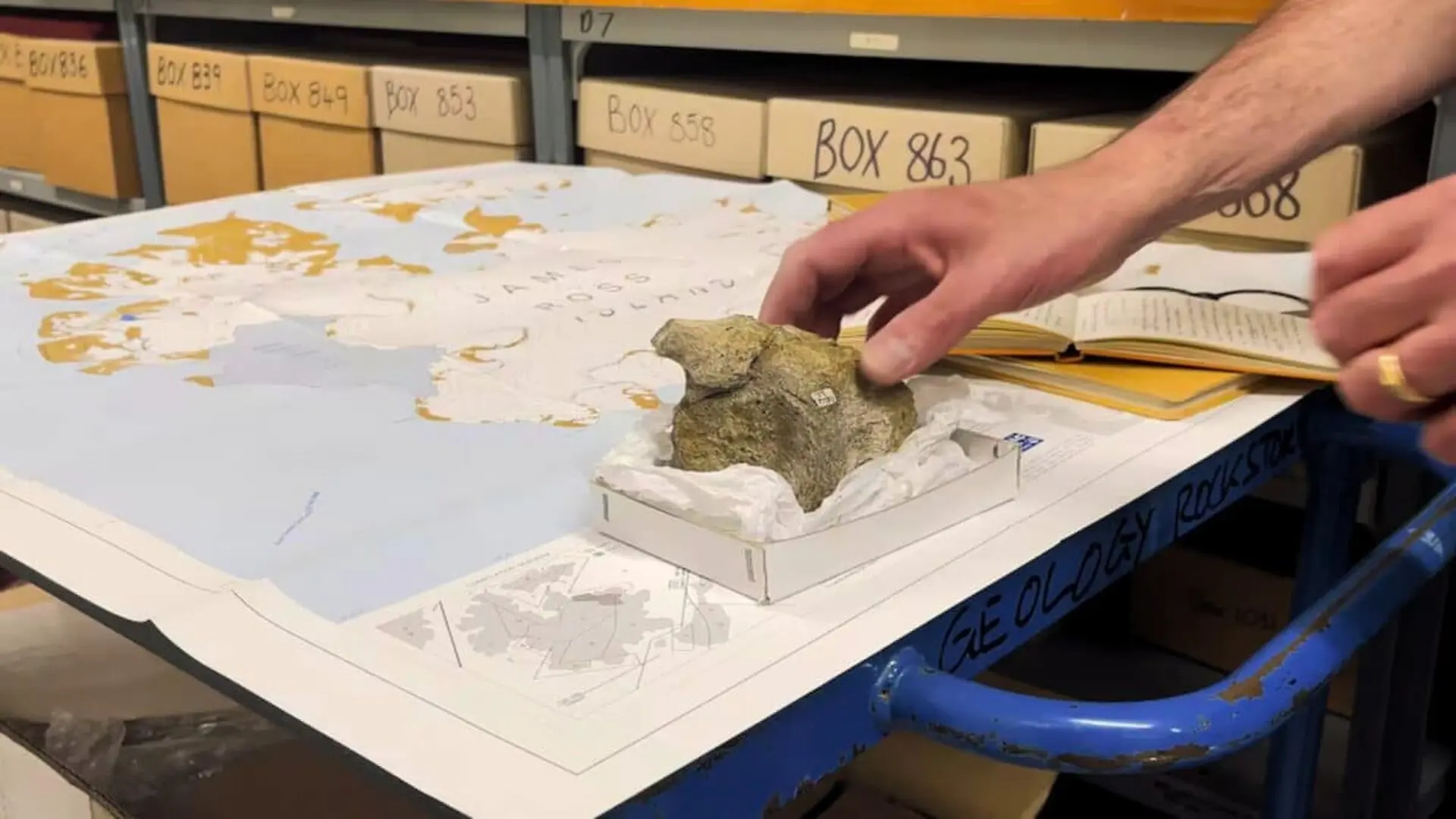
During a 1985 British Antarctic Survey mission on James Ross Island, a fossil was collected but never received a definitive taxonomic assignment. The specimen was subsequently stored among thousands of rocks and bones in the BAS geological collections in Cambridge, where it lay largely unnoticed for decades.
A recent re‑examination has elevated the once‑overlooked bone to a landmark status in Antarctic paleontology, as scientists now recognise it as the earliest dinosaur remain recorded from the continent, based on the date of its acquisition, even though later dinosaur finds have been reported.
Four Decades Later a Hidden Treasure Comes to Light
“It’s only when you start asking, ‘What’s in this drawer?’ that you sometimes find something and think, ‘That looks interesting,’” Evans said.
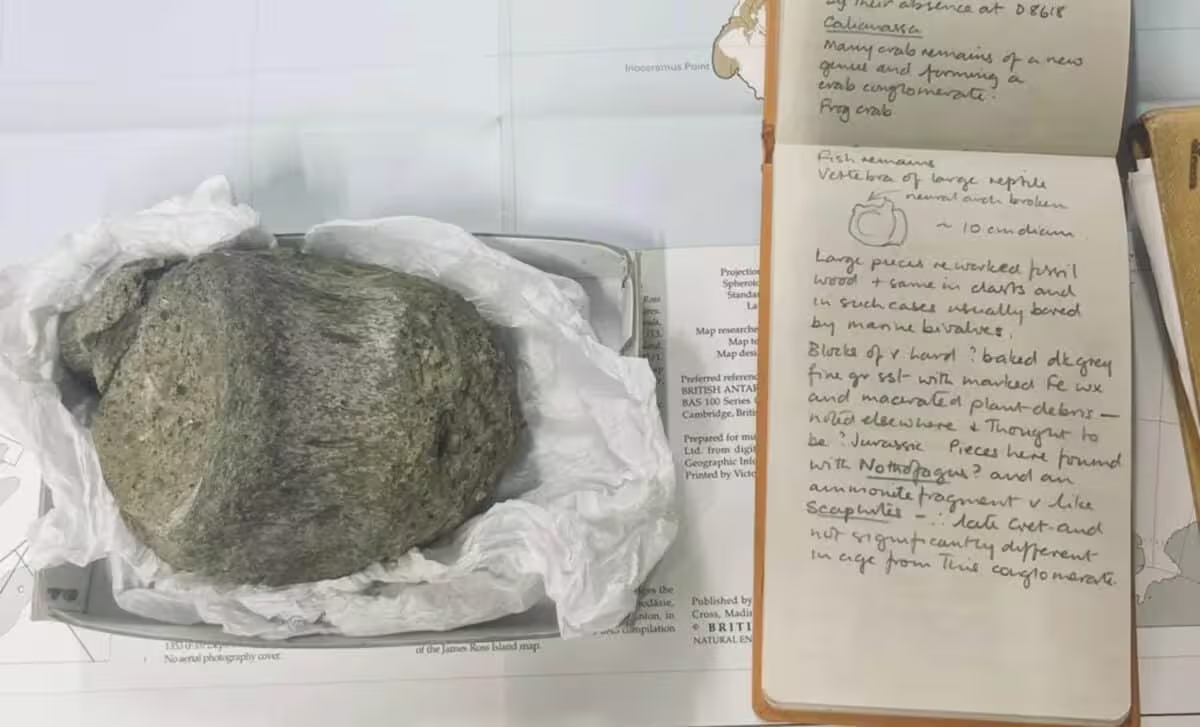
The original field notes, penned by geologist Mike Thomson, record the find on James Ross Island. A sketch dated 9 December 1985 labels the piece as a “vertebra of a large reptile” roughly 10 cm across.
According to BBC News, the 1985 team likely interpreted the bone as belonging to a marine reptile. Evans, however, spotted anatomical traits reminiscent of a dinosaur vertebra and realised that, given its collection date, it could represent the first dinosaur fossil ever documented in Antarctica.
Titanosaur Affinity Confirmed by Specialists
To test the identification, Evans consulted Professor Paul Barrett of the Natural History Museum.
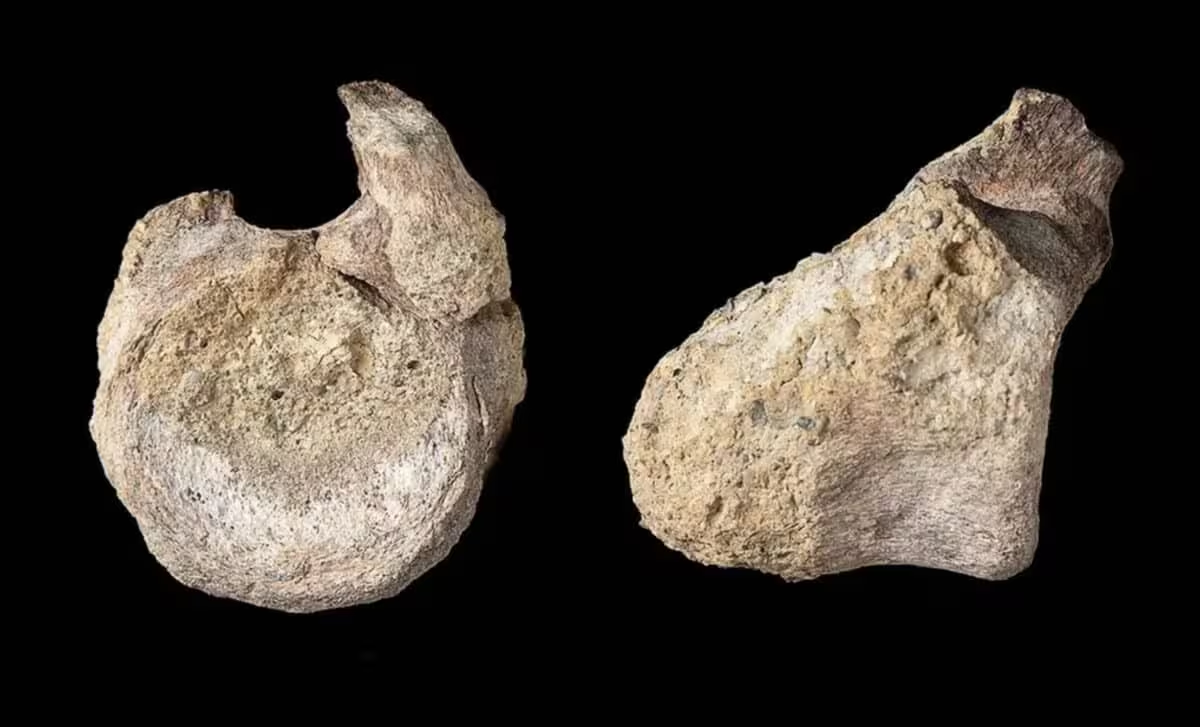
Barrett noted that while the fragment appears modest, its morphology is highly diagnostic. He highlighted a socket at one extremity and a rounded protrusion at the opposite end, forming the characteristic ball‑and‑socket articulation of sauropod vertebrae.
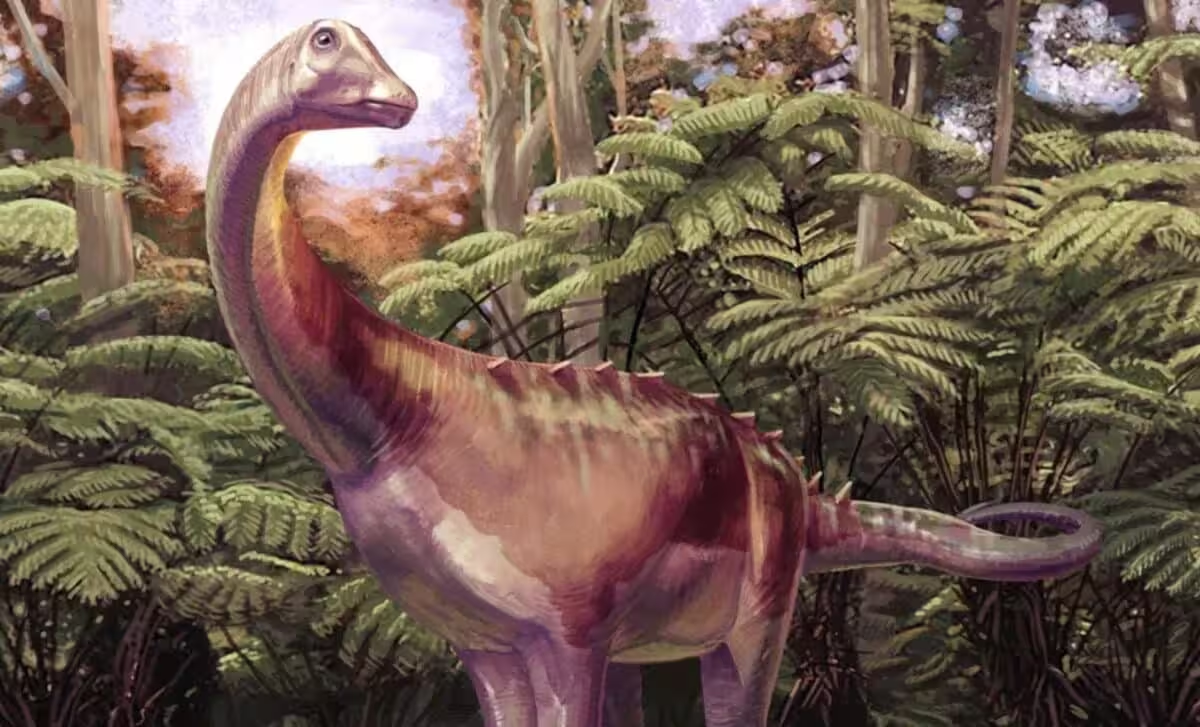
Titanosaurs now number over a hundred species worldwide. These quadrupedal herbivores possessed elongated necks for high browsing and massive tails that served as counterweights. The largest members stretched beyond 35 m and tipped the scales at roughly 60 t.
Measurements of the Antarctic vertebra suggest a body length of about 7 m. Barrett proposes that the individual may have been a subadult or a comparatively small adult relative to its giant relatives.
Insights into a Lost Antarctic Landscape
The bone dates to roughly 82 million years ago, placing it in the Late Cretaceous when Antarctica was draped in temperate forests that could sustain large herbivores.
Although additional dinosaur remains have surfaced in Antarctica since the 1980s, the continent’s extreme conditions and thick ice sheets keep its fossil record exceptionally sparse, making each discovery particularly valuable.
“This shows that a region we think of today as being really uninhabitable was actually once very habitable and supported a huge diversity of species,” Barrett said. He noted that the find helps scientists piece together how such megafauna fit into the southernmost ecosystems of the Late Cretaceous.
This article has been fact checked for accuracy, with information verified against reputable sources. Learn more about us and our editorial process.
Last reviewed on .
Article history
- Latest version
Reference(s)
- Morelle, Rebecca. “Le premier os de dinosaure de l'Antarctique a été découvert dans un tiroir.”, July 2, 2026 BBC News Afrique <https://www.bbc.com/afrique/articles/cy73mvlmj8mo>.
Cite this page:
- Posted by Hassan Raza