Deep Inside China’s Giant Sinkhole, Scientists Find a Hidden Forest Brimming With Rare Species
Explore the 128,000‑year‑old Xiaozhai Tiankeng, a hidden sanctuary where rare wildlife and unique plants thrive in isolation.
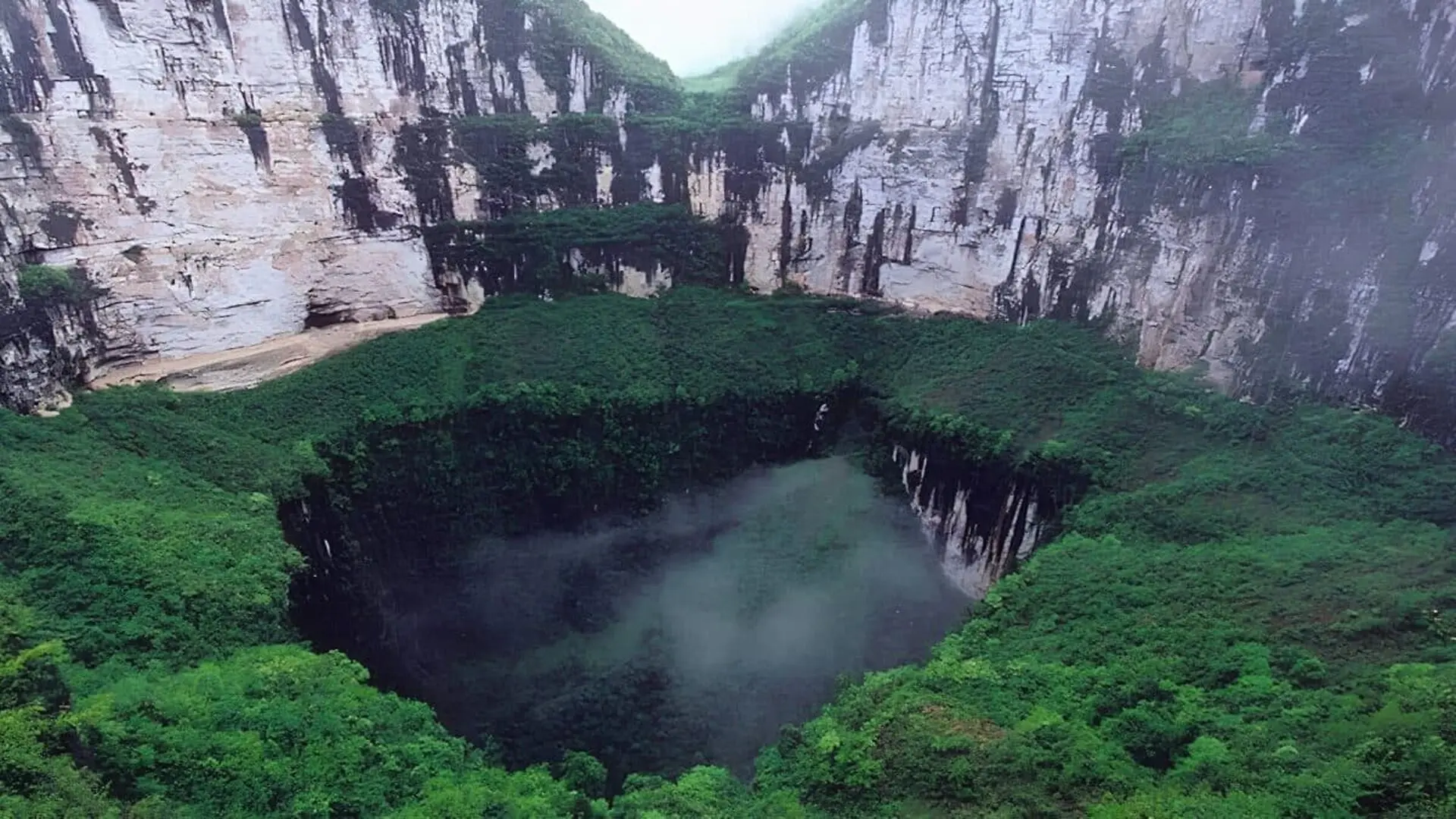
Deep in Chongqing’s jurisdiction, the Xiaozhai Tiankeng ranks among the planet’s most colossal sinkholes. Its vertical span reaches 626 m and its mouth stretches 527 m, sheltering a subterranean world that attracts both geoscientists and ecologists for its rare geological record and vibrant life forms.
While generations of nearby residents have been aware of the pit, precise measurements were only confirmed by Chinese researchers in 1994. “Xiaozhai” references a long‑abandoned village, and “Tiankeng” translates to “heavenly pit” in the regional karst lexicon, underscoring the site’s dramatic scale relative to other known depressions.
Immense Scale: A Void That Could Hold Tens of Thousands of Olympic Pools
Situated in Fengjie County, roughly 250 km northeast of Chongqing, the cavity’s estimated volume approaches 120 million m³—equivalent to about 40 000 Olympic‑size swimming pools. Its breadth could accommodate two Eiffel Towers stacked vertically, and the entrance is wide enough for one and a half London O₂ Arenas.
Millennial Collapse That Shaped a Giant Karst Feature
According to Science et Vie, the pit began forming around 128 000 years ago. Rainwater enriched with atmospheric CO₂ progressively dissolved the limestone, widening fissures while an 8.5‑km underground river carved the Difeng Cave system, descending 364 m. When the rock roof could no longer bear the load, it gave way, exposing the massive void.
The structure displays a two‑level configuration: a broad upper crater bordered by sheer cliffs narrows into a smaller lower chamber, producing an hourglass silhouette. Researchers interpret this as evidence of two distinct collapse episodes separated by several millennia, although exact timings remain uncertain.
A Secluded Forest Harboring Ancient and Endemic Flora
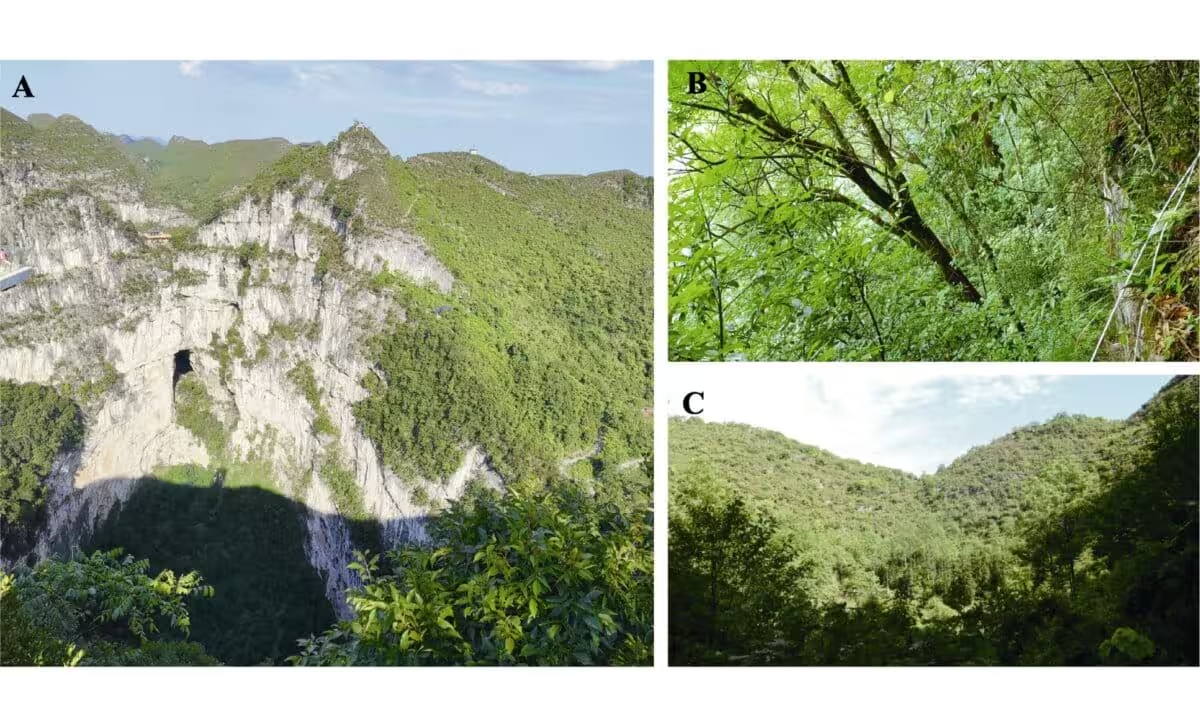
The pit’s floor sustains a cool, moist microclimate that nurtures a mature subtropical forest despite the scant sunlight that reaches it. Naturalists have catalogued more than 1 200 plant species within the enclosure, including ginkgo trees—living fossils from the Mesozoic era—as well as distinctive ferns and mosses found nowhere else.
The area also supports a clouded leopard, an arboreal predator capable of opening its jaw to a 100‑degree angle. Its presence suggests a functional ecological corridor linking the sinkhole’s interior to surrounding woodlands.
Chemical Tweaks Reveal How Plants Thrive in Darkness
A recent investigation published in the Chinese Journal of Plant Ecology compared foliage from the subterranean forest with that of surface‑growing counterparts. The study reported that leaves from the sinkhole’s interior contain elevated levels of nitrogen, phosphorus and calcium, while showing reduced carbon concentrations.
These elemental shifts reflect adaptation to a dim environment rich in humus, supplied by runoff and falling organic debris, rather than reliance on photosynthetic efficiency.
Provincial authorities now allow limited tourism at Xiaozhai Tiankeng, but biologists warn that growing visitor numbers could jeopardize species that remain undescribed and fragile.
This article has been fact checked for accuracy, with information verified against reputable sources. Learn more about us and our editorial process.
Last reviewed on .
Article history
- Latest version
Reference(s)
- Polge, Auriane. “Une forêt souterraine a été découverte à 626 mètres de profondeur dans le puits céleste chinois Xiaozhai Tiankeng et elle regorge d'espèces rares.”, July 3, 2026 Science et vie <https://www.science-et-vie.com/nature-et-environnement/une-foret-souterraine-a-ete-decouverte-a-626-metres-de-profondeur-dans-le-puits-celeste-chinois-xiaozhai-tiankeng-et-elle-serait-vieille-de-128-000-ans-238536.html>.
- Li-Li, ZHENG., et al. “Nutrient characteristics and adaptability of plant leaves in Tiankeng Complex of Dashiwei, Guangxi, China.” Chinese Journal of Plant Ecology, vol. 48, no. 7, January 1, 2024, pp. 872-887. Chinese Journal of Plant Ecology, doi: 10.17521/cjpe.2023.0217. <https://www.plant-ecology.com/EN/10.17521/cjpe.2023.0217>.
Cite this page:
- Posted by Hassan Raza