AI Moon Crater Maps Flawed: Study Shows Major Accuracy Gaps and Calls for New Standards
AI-made lunar crater catalogs require stricter validation to reliably aid planetary science research.
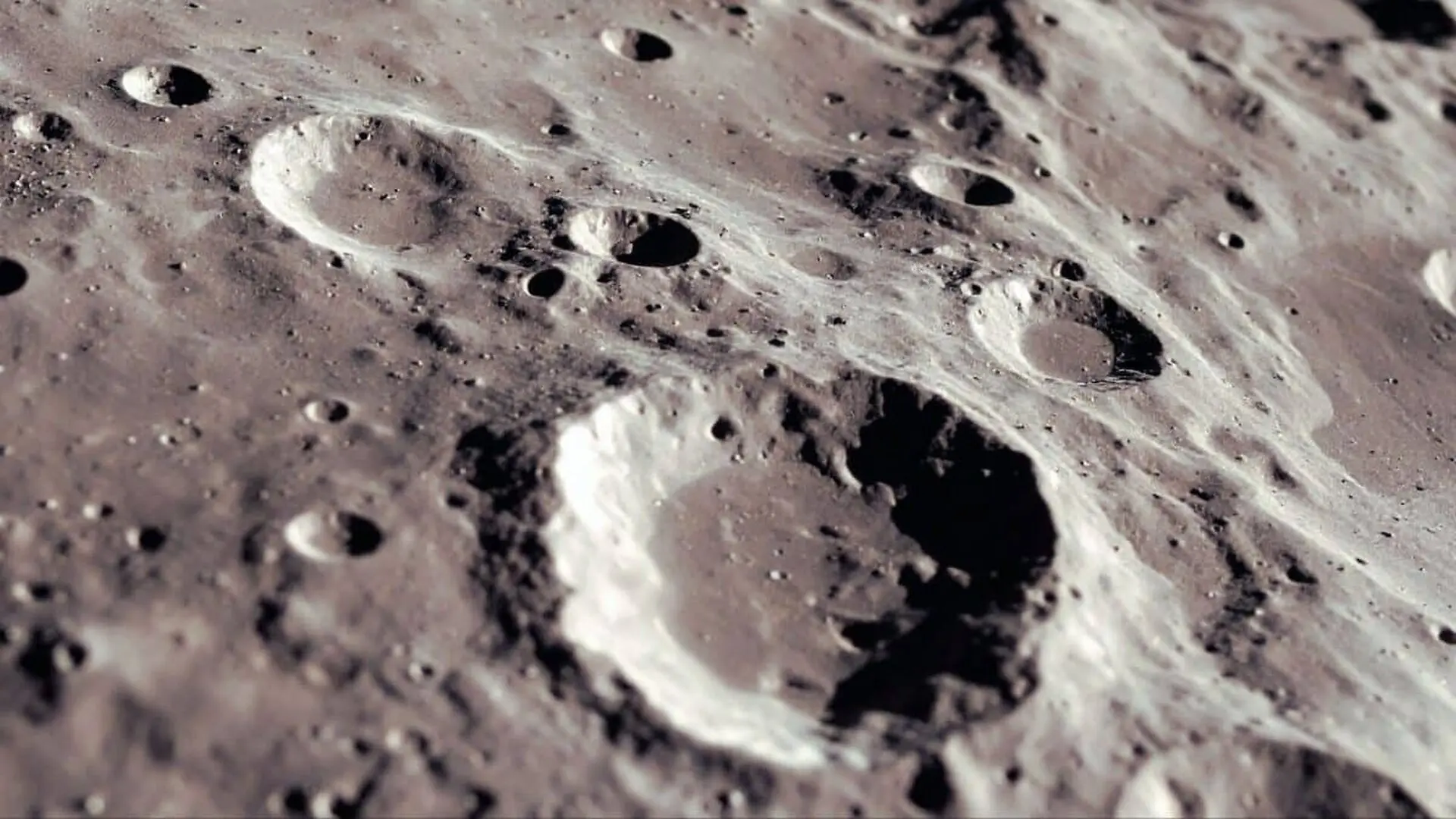
A recent paper in The Planetary Science Journal demonstrates that several AI‑produced lunar crater inventories fall short of the accuracy levels claimed by their developers, prompting a reassessment of how machine‑learning outputs are integrated into planetary research.
Assessing Machine‑Learning Crater Maps
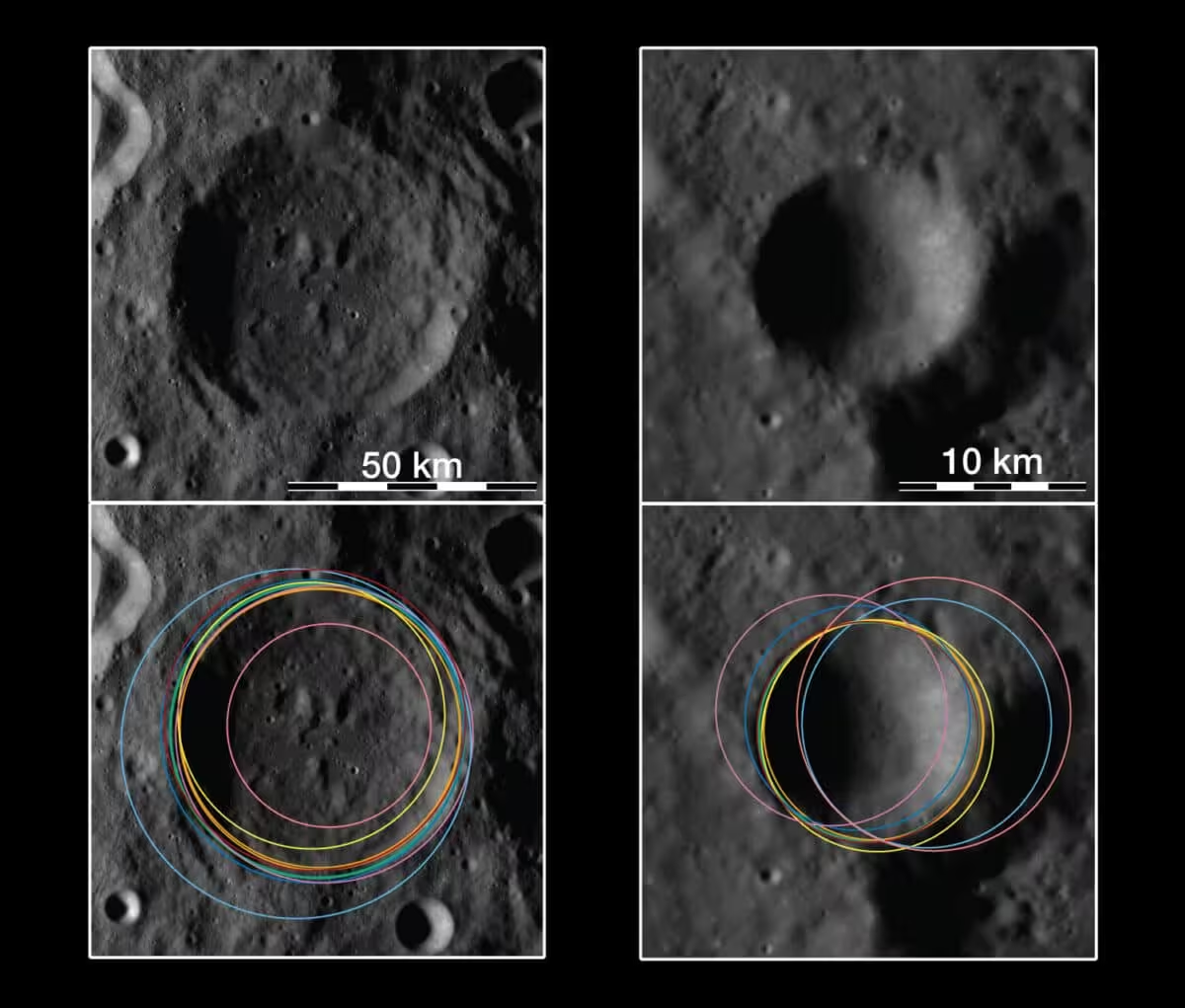
Scientists from the Southwest Research Institute put eight large‑scale AI‑derived lunar crater datasets side by side with a painstakingly assembled manual catalog that reflects years of expert analysis. Their objective was to test whether automated pipelines could reliably reproduce the measurements that underpin age dating and geological interpretation of the Moon’s surface.
Lunar craters serve as chronometers, allowing scientists to infer the relative age of terrain by counting and sizing impact structures. Because impact rates are relatively stable over geological timescales, regions with higher crater densities are interpreted as older. These datasets therefore feed directly into models that reconstruct lunar and planetary evolution.
The appeal of AI in this field stems from the sheer volume of craters that need to be cataloged—manual identification is labor‑intensive and time‑consuming. Automated detection promises to scale analyses to the massive image archives generated by current and upcoming lunar missions.
When the researchers applied the same validation criteria used for human‑compiled inventories, many AI catalogs showed pronounced drops in fidelity, revealing that published performance scores can mask underlying deficiencies.
“AI has enormous potential to help with repetitive, time‑consuming scientific tasks, especially gathering some of our data,” said Dr. Stuart J. Robbins of SwRI’s Solar System Science and Exploration Division in Boulder, Colorado, and lead author of the study. “But our analysis shows that researchers should not assume an AI‑generated crater catalog is ready for scientific use solely based on its published metrics.”
Uniform Benchmarks Expose Hidden Flaws
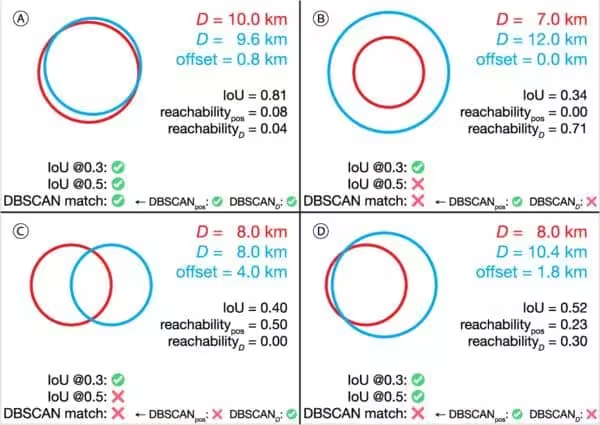
The investigation, titled “A Comparison of Lunar AI‑Based Crater Databases Using Uniform Criteria,” evaluated eight globally scoped AI crater catalogs. By imposing identical matching rules on the AI outputs and the reference manual set, the team quantified how closely the automated results aligned with established scientific standards.
The analysis highlighted that the definition of a “successful” match—whether it concerns position, diameter, or overall geometry—drastically influences reported accuracy. Some computer‑vision models correctly identified crater‑like shapes but failed to capture the precise metrics required for downstream scientific calculations.
Robbins emphasized that “a crater catalog is not just a random list of circles.” Misplaced, duplicated, or mis‑sized entries can propagate errors into age‑modeling algorithms, potentially skewing surface‑age estimates by large factors.
Broad summary scores often painted an optimistic picture, yet a deeper dive uncovered systematic weaknesses that could compromise specific research applications.
Performance Shifts with Crater Size
A key insight from the study is that AI accuracy is not uniform across all crater diameters. Systems tended to excel at recognizing larger basins while struggling with smaller pits, which are crucial for investigations of recent impact activity and surface modification.
“Diameter dependence matters,” Robbins noted. “A catalog might look acceptable from one overall number, but when you break it down by crater size, it may be useful for one question while unreliable for many others.”
Under stricter repeatability criteria that mirror human identification practices, several AI databases saw their performance metrics drop by more than an order of magnitude.
Toward Transparent AI Validation in Planetary Science
The authors do not dismiss AI’s role in space research; instead, they call for clearer reporting on match‑determination methods, error quantification, and independent benchmarking. Such transparency would enable scientists to assess the suitability of each dataset before employing it in analytical pipelines.
As lunar and planetary missions generate ever‑larger volumes of high‑resolution imagery, robust automated tools will become indispensable. When properly vetted, AI could accelerate surface analyses and uncover patterns that would otherwise require years of manual effort.
Robbins concluded, “AI may eventually transform crater cataloging and revolutionize how we gather our science data—potentially saving years of time. For now, researchers need to not chase it as the solution to everything. We need to understand how these tools work, where they fall short and whether their performance is good enough to support the science being done.”
This article has been fact checked for accuracy, with information verified against reputable sources. Learn more about us and our editorial process.
Last reviewed on .
Article history
- Latest version
Reference(s)
- Robbins, Stuart J.., et al. “A Comparison of Lunar AI-based Crater Databases Using Uniform Criteria.” The Planetary Science Journal, vol. 7, no. 7, July 6, 2026, pp. 164 American Astronomical Society, doi: 10.3847/PSJ/ae6b82. <https://iopscience.iop.org/article/10.3847/PSJ/ae6b82>.
Cite this page:
- Posted by Karan Das