New Scientific Roadmap Aims to Test Mars Warming With Tiny Aerosol Experiment
Scientists examine a suite of targeted technologies that could slowly terraform Mars, making it more habitable for future generations.
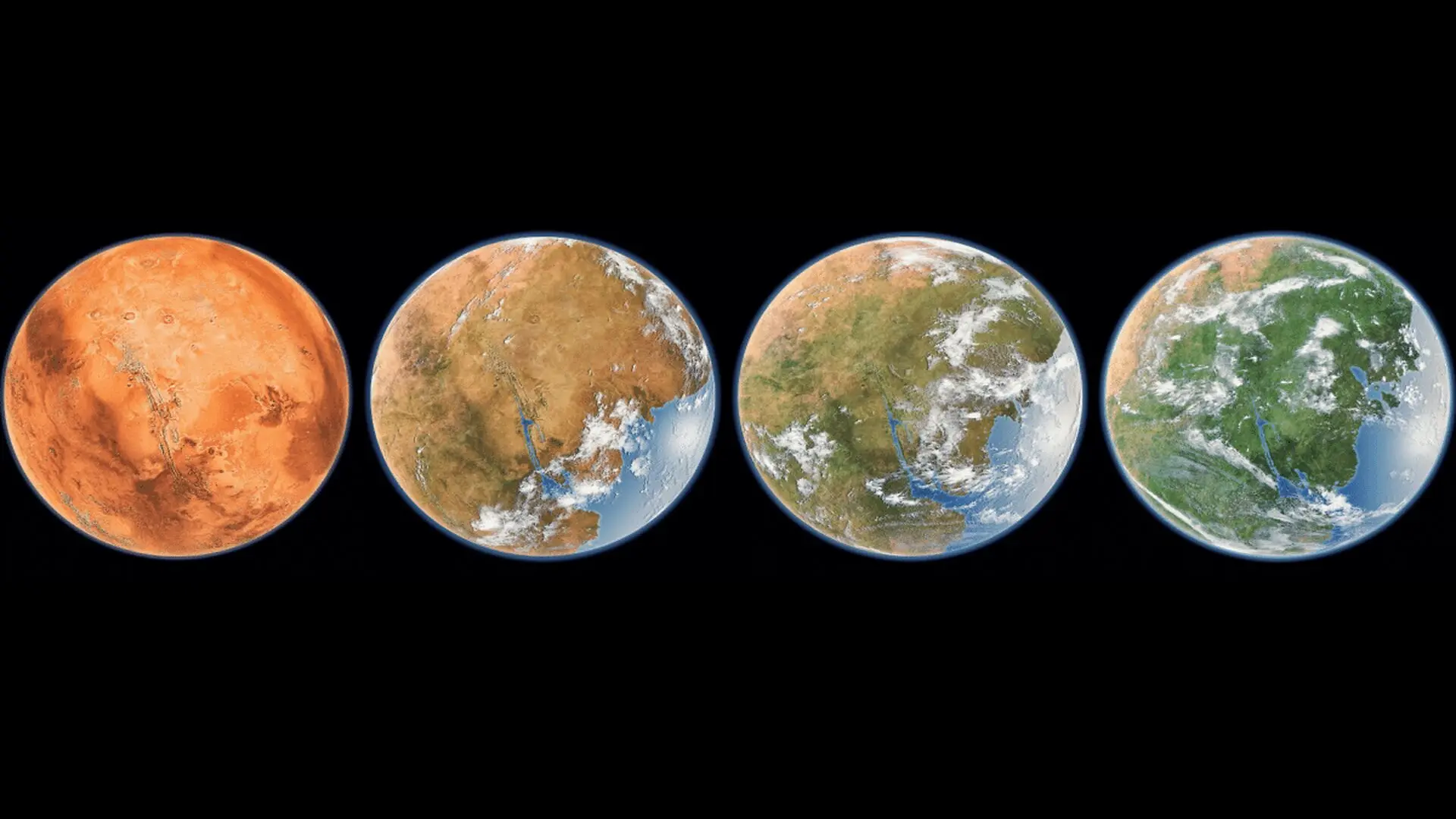
A growing cohort of scientists is turning a long‑standing sci‑fi dream into a research agenda: reshaping Mars so that it could sustain life on a planetary scale. New studies are moving the conversation from speculation toward concrete experiments that could reveal how the Red Planet might be warmed in the future.
A Stepwise Plan to Test Mars‑Warming Strategies
Geophysicist Edwin Kite of the University of Chicago has outlined a detailed roadmap for assessing the practicality of raising Mars’ temperature. Rather than assuming terraforming is inevitable, his team is cataloguing the scientific hurdles, required technologies, cost estimates and potential hazards. Central to the proposal is the intentional release of engineered aerosol particles into the thin Martian atmosphere to amplify greenhouse warming. The effort also helps define a nascent discipline called applied astrobiology, which examines how self‑sustaining habitats and ecosystems might be built beyond Earth.
“Creating sustainable habitats and biospheres beyond Earth is an enormous scientific and technical challenge, but it’s one we’ll have to surmount if we’re going to extend life beyond Earth,” Kite told Space.com.
“We do not yet know enough to create a biosphere from scratch,” he added. “Applied astrobiology, like planetary science, requires contributions from many disciplines.”
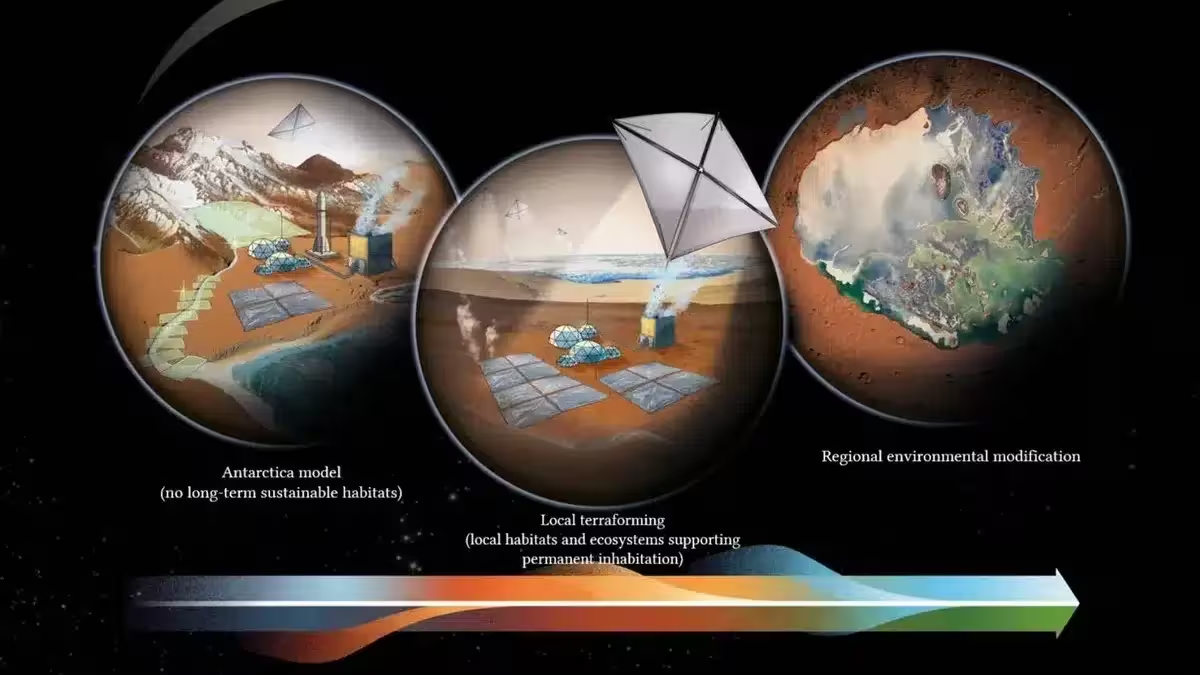
From Local Greenhouses to Planet‑Scale Climate Engineering
The plan proposes a gradual escalation of technologies. Initial efforts would concentrate on warming the immediate vicinity of human outposts using solid‑state greenhouse membranes that melt subsurface ice into liquid water, thereby supporting food production and life‑support systems. Subsequent concepts include orbital mirrors that could redirect additional sunlight onto targeted regions of the Martian surface. In later stages, engineered aerosols might be deployed to strengthen Mars’ weak greenhouse effect and raise temperatures over broader areas.
Researchers stress that each phase would need extensive validation before any hardware is sent to the planet. Even if warming mechanisms succeed, it remains uncertain whether Mars could eventually host a self‑sustaining biosphere. Such an ecosystem would have to operate over centuries, maintaining its own atmospheric contributions and biological activity.
Mini‑Mission to Test Aerosol Dispersion on Mars
A standout element of the roadmap is a proposed technology‑demonstration mission. The concept envisions an autonomous payload releasing under one kilogram of microscopic artificial particles into the Martian atmosphere. Ground‑based lasers would then monitor how the particles spread and ascend, providing direct data on the feasibility of aerosol‑driven warming under real Martian conditions.
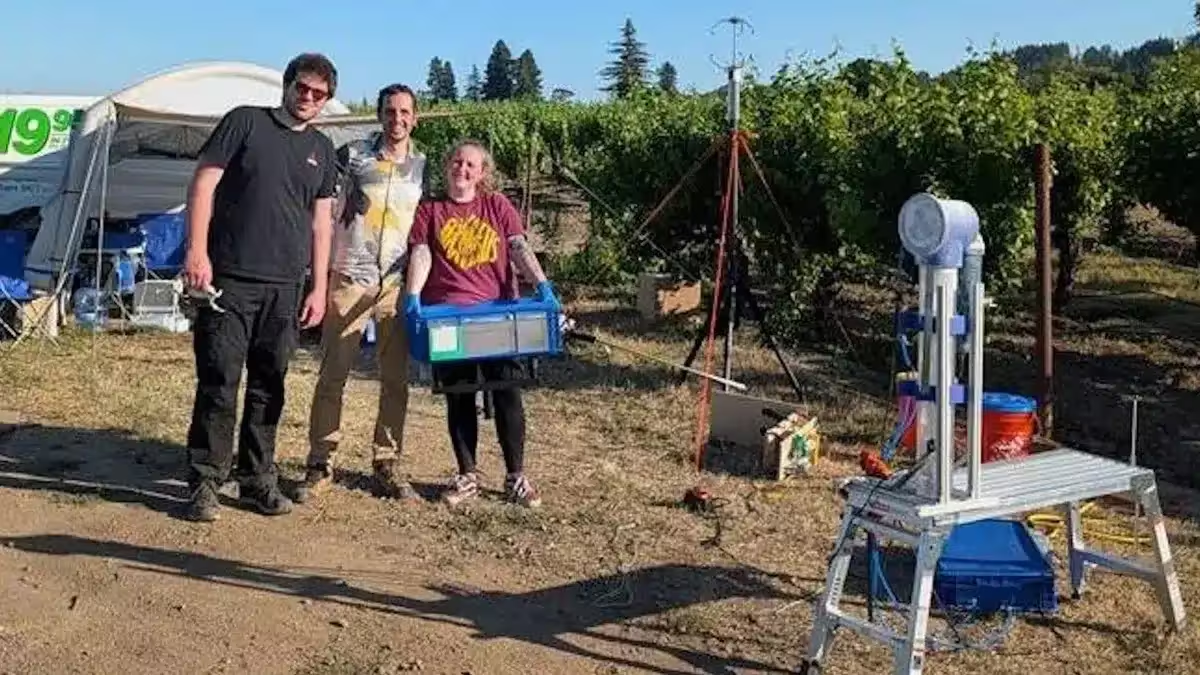
Engineering this system is challenging; the dispenser must operate reliably in Mars’ extreme environment. Early testing will occur at NASA’s Planetary Aeolian Laboratory in California, a facility that can simulate atmospheric conditions on Earth, Mars and even Saturn’s moon Titan. Results from these experiments would offer insights that computer models alone cannot deliver.
Knowledge Gaps and International Collaboration
Key uncertainties remain, notably the distribution of subsurface ice, long‑term climate patterns and the composition of Martian rocks. Improved mapping of underground water reservoirs is deemed essential for any future habitation strategy.
“Mars sample return will be done by China’s space agency. The original plan for their Tianwen‑3 mission was to grab some rocks from wherever and then head back to Earth,” Kite said. “The new plan is to go around with a helicopter and collect rocks from a wide area. I’m hopeful that they share their Martian samples, allowing all the world’s labs to have a crack at them.”
Kite also pointed to the previously studied International Mars Ice Mapper, a joint mission concept that, while not currently active, still offers valuable objectives for locating deep aquifers via electromagnetic sounding.
“It’s a good idea and could always come back,” said Kite. “We should search for deep aquifers using electromagnetic soundings — that’s the best strategy. We don’t know whether there’s still liquid water deep underground. There are big gaps in our knowledge about Mars.”
Also ReadMars, Saturn And A Thin Crescent Moon Will Create A Stunning Dawn Alignment: Here’s When to Watch
Decades‑Long Horizon for Any Significant Change
Scientists caution that even optimistic scenarios place kilometer‑scale warming at least a decade away, with broader environmental modification requiring sustained investment over many subsequent decades. The roadmap emphasizes that any tangible impact would unfold across generations, not within a single mission timeline.
“Even under optimistic assumptions, warming at kilometer scale is at least a decade away, and wider environmental modification would require sustained investment over many decades beyond that,” states the recent research paper, which Kite led.
The authors argue that modest research funding now could keep the option of extending life beyond Earth open as Mars exploration continues. While the planet remains a cold, arid world visited by robotic explorers, the new roadmap provides a systematic scientific pathway to answer one of space exploration’s biggest questions: can an entire planet ever be made more hospitable to life?
This article has been fact checked for accuracy, with information verified against reputable sources. Learn more about us and our editorial process.
Last reviewed on .
Article history
- Latest version
Reference(s)
- David, Leonard. “Could we actually terraform Mars? Scientists are trying to find out.”, June 22, 2026 Space <https://www.space.com/astronomy/mars/could-we-actually-terraform-mars-scientists-are-trying-to-find-out>.
Cite this page:
- Posted by Aisha Ahmed